Source: Climate Council
Of all the things being destroyed as a result of the United States and Israel’s war on Iran, long-term demand for liquefied natural gas (LNG) is not the first to spring to mind.
But when high fuel price projections cause Vietnam’s biggest company to dump its plans to build the country’s largest LNG-fuelled power plant and instead focus on renewables, you can be sure this demand destruction is happening.
LNG demand is also taking a battering elsewhere in Asia. Pakistan has already banked billions in avoided oil and gas imports thanks to its impressive pivot from LNG to solar after the last gas price spike in 2022. With another US$6 billion in similar savings projected for Pakistan by the end of the year, the LNG industry’s much vaunted hopes of emerging Asian economies delivering demand growth are becoming shakier by the day.
Now, more than ever, investors need gas companies to be completely upfront about the fundamentals of projects they want to bring into this rapidly shifting and increasingly risky global gas market.
Market Forces is deeply concerned that Australia’s largest gas pipeline company, APA Group, may have let investors down in this respect.
APA’s proposed North to East Pipeline project would be Australia’s largest gas pipeline. It would essentially enable widespread fracking of the Beetaloo gas basin in the Northern Territory, providing a link from the massive planned gas fields to LNG export terminals in Queensland.
Earlier this week, Market Forces lodged a complaint requesting Australia’s corporate regulator, the Australian Securities and Investments Commission (ASIC), investigate concerns that APA bolstered the case for development of the Beetaloo Basin by misrepresenting that it is cheaper and of a larger scale than other Australian gas production projects.
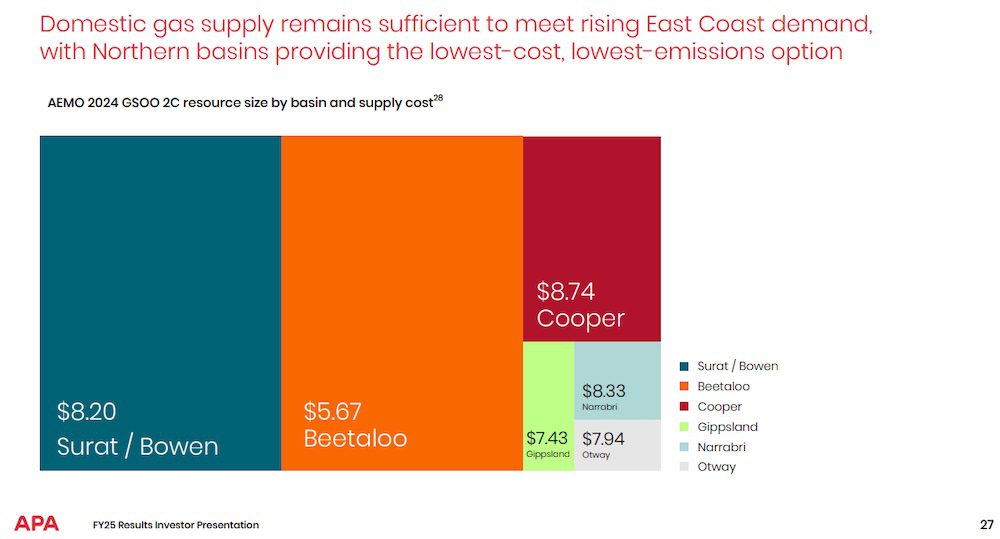
Firstly, APA’s Financial Year 2025 Results Presentation presents estimated production costs of the Beetaloo Basin and other domestic projects in a way that appears the cost estimates are comparable, when in reality they are apples and oranges.
The apples are “developed” production costs, which exclude drilling and gas processing costs and assume reductions in well costs. “Undeveloped” production costs – the oranges – are typically significantly higher.
Surprise, surprise, the difference in underlying assumptions means APA’s presentation portrays Beetaloo as 24% cheaper than Surat/Bowen. However, when you actually compare like-for-like, Beetaloo is a staggering 53% more expensive. And these are just production costs. When adding the extra tariffs APA will need to charge customers to cover the costs of connecting the remote field to the East Coast via its monster pipeline, Beetaloo gas will be even less competitive.
It appears that APA is going to great lengths to obfuscate the simple fact that Beetaloo gas would be extremely expensive. Independent energy research provider Rystad Energy estimates that by the time Beetaloo gas reaches Sydney, it would cost $14 to $18 a gigajoule (GJ). Current Sydney prices of around $10/GJ are already driving household bills through the roof, and industrial gas users to the brink.
Then there’s the size of the resource – how much gas is actually sitting in the basin. This is a major consideration for investors in a company whose biggest growth prospect – with a price tag potentially as high as $7 billion – hinges on tolling the volume of gas that flows from Beetaloo to the east coast.
In its FY25 Results Presentation, APA presents resource size estimates for the Beetaloo Basin from AEMO’s 2024 Gas Statement of Opportunities (GSOO). Another surprise: this outdated and less specific estimate is more than four times larger than the 2025 GSOO’s figure, which was publicly available at the time of APA’s results presentation.
If you think this is starting to look a bit dodgy, you’re not alone. APA felt the need to significantly alter its presentation of both the resource size and production cost estimates for the Beetaloo in a half-year results presentation in February.
Slide from 2025 Full Year Results Presentation, 20 August 2025
Slide from 2026 Half-Year Results Presentation, 19 February 2026
This updated graphic dramatically reduces the relative resource size of the Beetaloo Basin and no longer presents it as the lowest cost option.
The new disclosure came after Market Forces wrote to APA twice, outlining our concerns and calling on the company to issue a correction. However, the updated graphic did not come with an explicit correction to the significantly different representations made just six months earlier.
As stated in our ASIC complaint: “It is not enough for APA to quietly update later representations while the earlier misleading representations remain uncorrected and available for viewing on the ASX and APA websites.”
It’s worth noting that there still seems to be some comparing of apples and oranges, even in APA’s updated disclosures, the company uses its own $7 per gigajoule figure for Beetaloo production costs, whereas all others are taken from GSOO 2025.
The AEMO publication puts Beetaloo’s costs at $9.33, and APA provides only a vague footnote several pages later to suggest the Beetaloo figure is not from the same source and instead includes APA’s own assumptions.
APA Group’s decision to publish arguably misleading representations about the Beetaloo Basin’s economics while seeking support for its multi-billion dollar pipeline project raises serious questions about the rigour and transparency of its investor communications.
While the quiet update suggests an acknowledgment of its flaws, APA’s failure to issue an explicit correction means the potential for investor misinformation persists.
In a market where long-term gas demand is collapsing due to global instability and the rapid rise of cheaper, less volatile renewables, investors need absolute confidence that the information guiding their decisions is accurate and comparable.
Market Forces believes APA has fallen short of this essential standard, and is calling on ASIC to step in and ensure the market is protected from misleading disclosures by fossil fuel proponents.
Will van de Pol is chief executive of Market Forces
Sydney-based "distributed" renewables outfit inks deal to buy portfolio of 27 small solar and battery…
The demand for batteries - for EVs and grid - has surged in the last…
A massive hybrid renewables and battery project has joined the queue for federal environmental assessment,…
Updated: Snowy Hydro lands $1.9 billion deal to supply 100 pct renewable power for state's…
BMI's Iola Hughes discusses the extraordinary growth of battery storage, for EVs and the grid,…
State says energy regulator and network companies must guarantee ready access to smarter and cheaper…