What if jet fuel could be grown sustainably? Fe Ilya/Flickr, CC BY-SA
Private jet travel offers flexibility and convenience, but at a steep cost to the environment.
In a recent study, we found that private jet activity generated 19.5 million tonnes of carbon dioxide-equivalent (CO2e) emissions globally in 2023; on average, over the course of a year, private jets produce the same amount of emissions generated by 177 passenger cars.
Global sporting events – such as the World Cup – are a well-known driver of private jet activity, as VIPs fly in from around the world to sit courtside, ringside, or trackside at the year’s highest-profile competitions.
But just how much do these events contribute to private jet emissions, and are there suitable commercial flights eventgoers could have taken instead?
To find out, I looked at three major sporting events in 2023: Super Bowl LVII in Glendale, Arizona; the Masters Tournament in Augusta, Georgia; and the Monaco Grand Prix in the French Riviera.
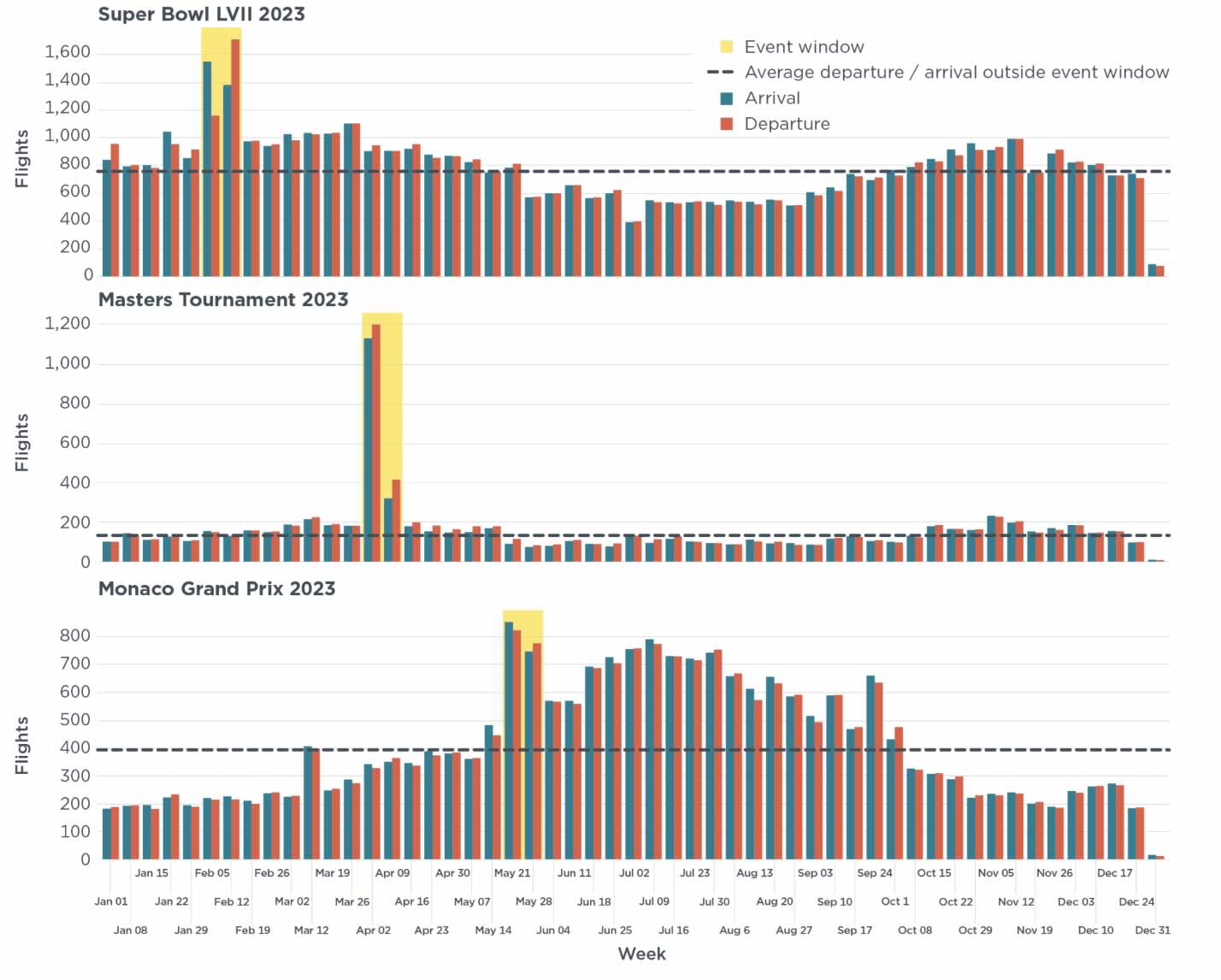
For each event, I tracked private jet activity at airports located within a 100 km radius, comparing it with typical activity at those airports throughout the rest of the year (Figure 1).
Figure 1. Spikes in weekly private jet activity around major sporting events, 2023
The results were striking. Private jet activity more than doubled around the Super Bowl, increasing from 110 to 247 average daily flights.
The Masters saw the most dramatic surge, with daily operations rising more than eightfold from 19 to 139 average daily flights, likely because Augusta is a relatively minor destination with limited commercial air service.
The Monaco Grand Prix coincided with the Cannes Film Festival, making it harder to discern which private jet activity was associated with which event. However, based on my analysis, the Monaco Grand Prix likely triggered a 60% increase in private jet activity compared with the weekly average for the year.
Across all three events, private jet activity to and from the surrounding airports was at its highest for the entire year—and more than double the airports’ weekly averages in 2023.
As private jet activity surges, so do emissions.
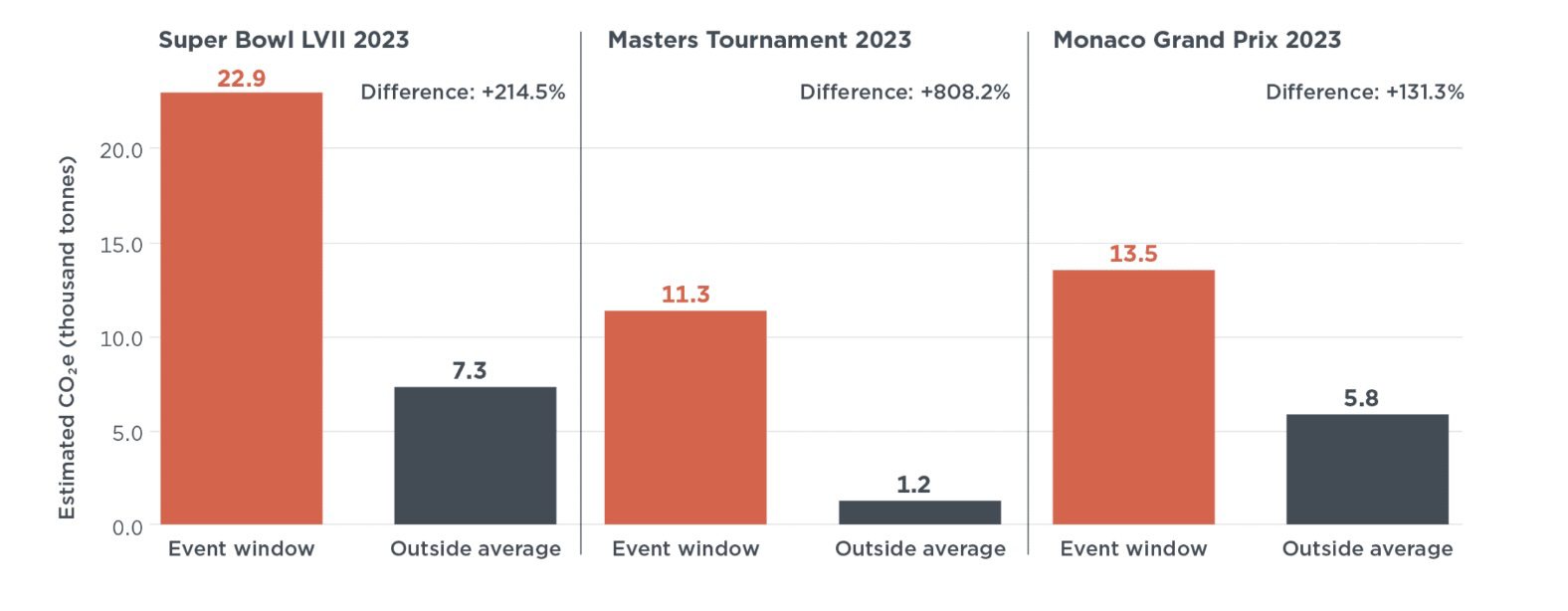
The greenhouse gas emissions from private jet flights to and from these events increased by an estimated 131%–808% at nearby airports, resulting in an additional 33,000 tonnes of CO2e—about the same as putting 7,200 passenger cars on the road for a year (Figure 2).
Private jet traffic associated with the Super Bowl alone created almost 16,000 tonnes of additional CO2e, the highest of the three, likely because attendees were flying longer distances.
Private jet activity surrounding the Masters showed the highest percentage increase, at 9 times the normal rate at nearby airports.
Figure 2. Emissions impacts of major sporting events in 2023
What’s more, most of these flights didn’t need to happen by private jet at all.
Based on our 2023 commercial flights inventory, 90% of private jet flight routes to and from the Monaco Grand Prix were substitutable—in other words, they operated on routes for which a direct commercial flight alternative was available during the event (although we didn’t check for seat availability).
For the Super Bowl and the Masters, the figure was around 81%–82%. These numbers show that the choice to fly privately was driven overwhelmingly by a preference for luxury and flexibility, not necessity.
And if those traveling by private jet had taken commercial flights instead, private jet emissions could have been reduced by up to 70%.
At the final whistle, the result is clear: global sporting events generate outsized private jet emissions, even though alternatives are almost always available.
That makes a strong case for a private jet levy to create a more equitable tax system and fund the aviation-related climate investments needed to accelerate the transition to net-zero aviation—a win-win, regardless of what happens on the field.
Daniel Sitompul is an Associate Researcher at the International Council on Clean Transportation. Reproduced with permission.
Huge wind project with one of the country's biggest batteries to become the first to…
Footy for Climate, founded by two ex AFL stars, aims to install solar and battery…
Uncertainty around the timeline for closure of Australia's remaining coal generators are having a material…
Small Australian manufacturers urged to cut fossil fuels from their production lines with help of…
The black box of a federal consumer renewable energy scheme raises questions over whether it's…
More households are looking to install solar, or increase the size of their existing systems,…