(AAP Image/Supplied by Queensland Fire and Emergency Services)
Political bipartisanship across successive Australian governments has overseen a massive expansion of oil, gas and coal production despite promises to act on climate change over the last three decades, a new report suggests.
The report, Exporting Harm: The Climate Toll of Australia’s Fossil fuel Expansion, by the Fossil Fuel Non-Proliferation Treaty Initiative, a diplomatic and civil society campaign to create a treaty to stop fossil fuel exploration, expansion and set up a managed phase-out of oil, gas and coal use, to examine Australia’s track record on climate change.
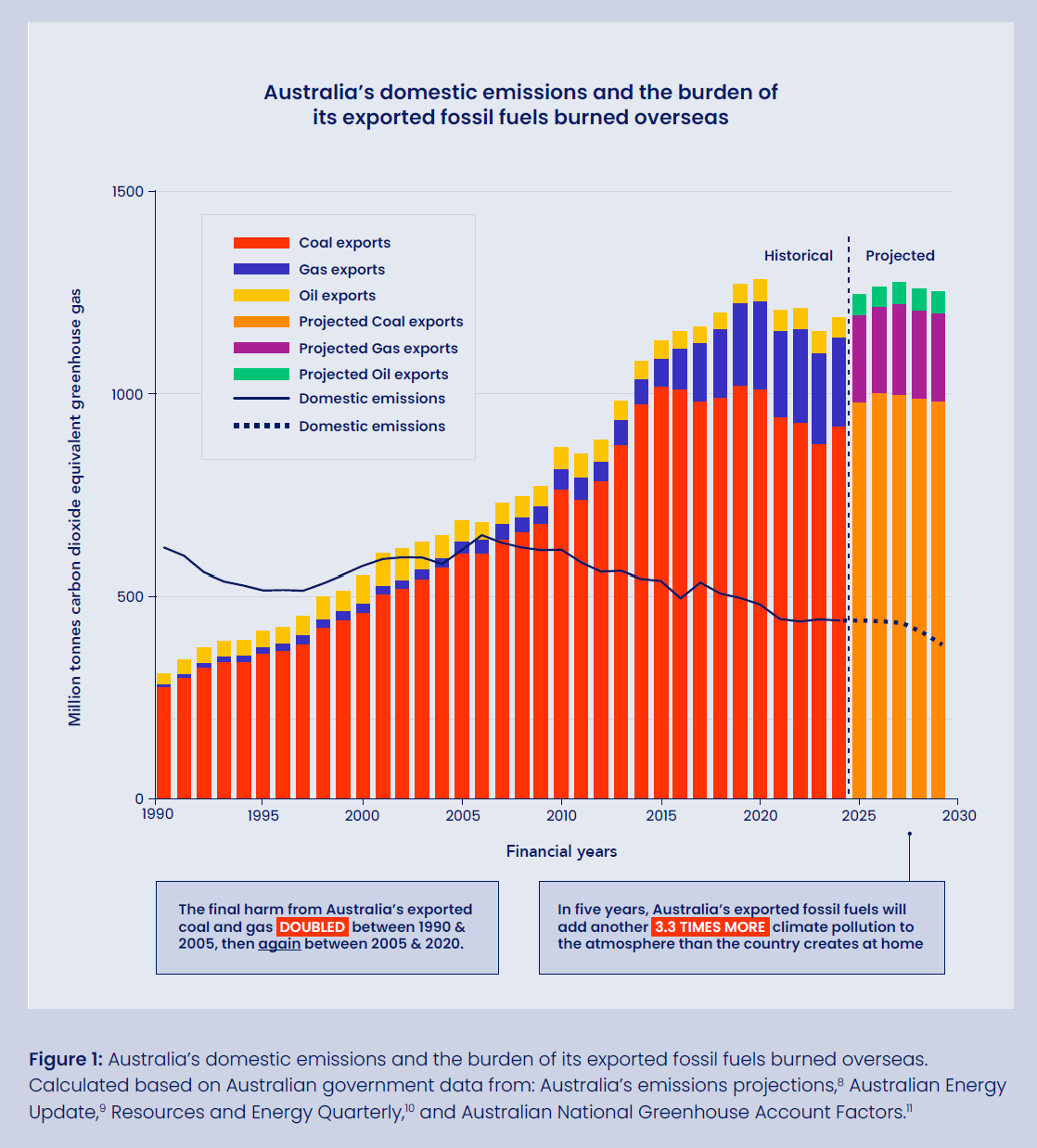
It found that despite its rhetoric, Australia has worked to establish itself as “a fossil fuel behemoth” over the past three decades since the International Panel on Climate Change released its First Assessment report in 1990, with the country exporting increasing amounts of fossil fuels even as its domestic emissions have fallen.
In the fifteen years after the release of the First Assessment Report, the burden of Australia’s fossil fuel exports doubled. It doubled again between 2005 and 2020, driven by a massive increase in coal and gas exports.
During this time the Australian government was variously led by both Labor and the Coalition, in what Michael Poland, campaign manager for the Fossil Fuel Treaty Initiative in Northern New South Wales said was “a bipartisan consensus on expanding coal and gas.”
“At least Russia is somewhat honest about being a major fossil fuel producer,” Poland said. “I think for me that fossil fuel exports have doubled twice in the past three decades really just shows how deeply ingrained bipartisan support for the fossil fuel industry is.
“Both major parties have had a bipartisan position on expanding oil and gas. In the wake of years of cyclones and floods and heatwaves, it’s really time to break that repetitive cycle.”
With the focus of international agreements like the Paris Climate Agreement focussed on the domestic use of oil, gas and coal, Poland said the US, Canada and Australia have been able to rely on the “drug dealers defence” – idea that exporters are just filling a demand and that if they don’t sell a particular fossil fuel, someone else will – to justify continuing fossil fuel expansion.
Poland, whose family live in northern New South Wales and who have been without power since Thursday just before Tropical Cyclone Alfred made landfall, said the findings were particularly “surreal given the circumstances.”
“The thing I’ve been thinking about at night while I’ve had no power is that the Albanese government has approved 19 fossil fuel projects since the 2022 Lismore floods and that the PM this week could come back to Lismore and not take responsibility for the impact those decisions are having on events like this and communities like ours,” he said.
The report found 48% of the world’s internationally-traded metallurgical coal and 19% of thermal coal originated in Australia, making the country the second-largest exporter of each, respectively.
Australia’s LNG exports have increased seven-fold since 2005, with the country now producing 20% of all internationally-traded LNG.
Meanwhile the country currently has 30 new coal and gas projects at various levels of development, with a conservative estimate suggesting this could add 18.6bn tonnes of greenhouse gases to the atmosphere.
The possibility that a cyclone such as Tropical Cyclone Alfred might make landfall in South East Queensland was previously described in 2021 as a “nightmare scenario” by the Australian insurance industry owing to high population density in the region.
Australia has been increasingly rocked by large natural disasters likely to have been made worse by climate change in recent months and years, including bushfires outside Perth and in regional Victoria, a developing drought in South Australia, widespread flooding across New South Wales in 2022 and the Black Summer Bushfires.
As of 2021, climate change was costing the country $39bn a year, with this figure expected to rise to $73bn by 2060.
Currently 16 governments have endorsed a Fossil Fuel Non-Proliferation Treaty including the governments of Colombia and Pakistan, and Pacific countries such as Fiji, Nauru, Samoa, the Solomon Islands, Timor-Leste, Tuvalu, Vanuatu and Tonga.
Australia's first commercially operated solar thermal power station and one of the first of its…
Andrew Forrest’s 2 gigawatt wind plans to help decarbonise his Pilbara iron ore operations have…
New data shows new global wind capacity hit a third-straight record year in 2025, led…
Renewables retailer seals "foundational" offtake deal with a project that is helping to lay the…
Judge accuses regional council of having a "bee in their bonnet" and of losing perspective…
Massive, multi-gigawatt solar and battery project has started on the environmental journey, after a short…