Image: PilbaraRailways.com.au
Iron ore billionaire and green energy investor Andrew Forrest says he expects his Fortescue Metals Group to seal five big green energy deals in 2023, and expects its newly acquired battery technology business to turn into a multi billion dollar prospect, with manufacturing to start in a few months.
Forrest made the predictions at the company’s quarterly production report, and despite confirmation of news – first flagged by RenewEconomy in November – that the company had lost its planned technology partner for the much hyped electrolyser manufacturing facility in Gladstone.
The US-based Plug Power said it had withdrawn because the project no longer made economic sense. Forrest insisted on Friday that the project will open this year with FFI’s “own world leading technology” and at the scale predicted. See: “We could do better:” Forrest to use own tech after US partner pulls Plug on electrolyser factory
Forrest says the company expects to reach a final investment decision this year on five green energy projects under the auspices of Fortescue Future Industries, with first production due in 2024. These include the Gibson Island green hydrogen project in Queensland, but the others are likely to be located in the US, or Europe.
Forrest says his recent visit to Davos confirmed there is enormous demand for green energy and green hydrogen.
“The demand for green energy is immense,” he said. “This gives us confidence that global capital markets will be aligned to progress five FFI green energy projects to Final Investment Decision in calendar 2023 allowing first production in 2024.”
The newest element of Forrest’s comments, however, was the big focus on battery storage, and the technologies being developed by WAE – formerly Williams Advanced Engineering – that Fortescue bought in 2021 and is now chaired by FFI chief executive Mark Hutchinson.
WAE will begin battery manufacturing at its first facility at Kidlington in the UK in April, and Forrest expects this to become a multi-billion dollar green technology, battery and vehicle control systems company, specialising in batteries for trucks, trains, and stationary energy.
WAE has already delivered the first 15 tonne battery that will be used in the massive 240 tonne haul trucks that operate in Fortescue’s iron ore mines, and is also developing the battery technology for the so-called “infinity trains”.
These trains will use battery technologies and gravity to power them. They will charge the batteries as they run fully laden with iron ore down hill from the mines to the ports on the coast, and will use the charge to return – empty – back up the hill to the mine sites.
“So the cells that make up the battery are chemically quite strong. Secondly, Williams is the world’s best in making the best use of those cells through very sophisticated battery management software. So we squeeze more out of those cells.
“The final thing I would say is that the optimal size and therefore the weight of the battery is still under, I would say finalization, and we’ll get our first truck up and running this year with the current battery.
“And depending on the test results, we might scale up or down a little bit further, so don’t be surprised if the batteries a year from now are different.”
Forrest said record shipments for Fortescue meant that it could fund its green energy expansion opportunities through its own cash flows.
““Green hydrogen gives the world energy storage potential of the massive scale of oil, gas and coal. Green electrons are already the world’s lowest cost energy and rely on batteries for firming capacity and energy mobility,” he said in his introduction.
“Batteries are also fundamental to the rapidly growing global hydrogen fuel cell industry and are therefore one of Fortescue’s preeminent focuses.”
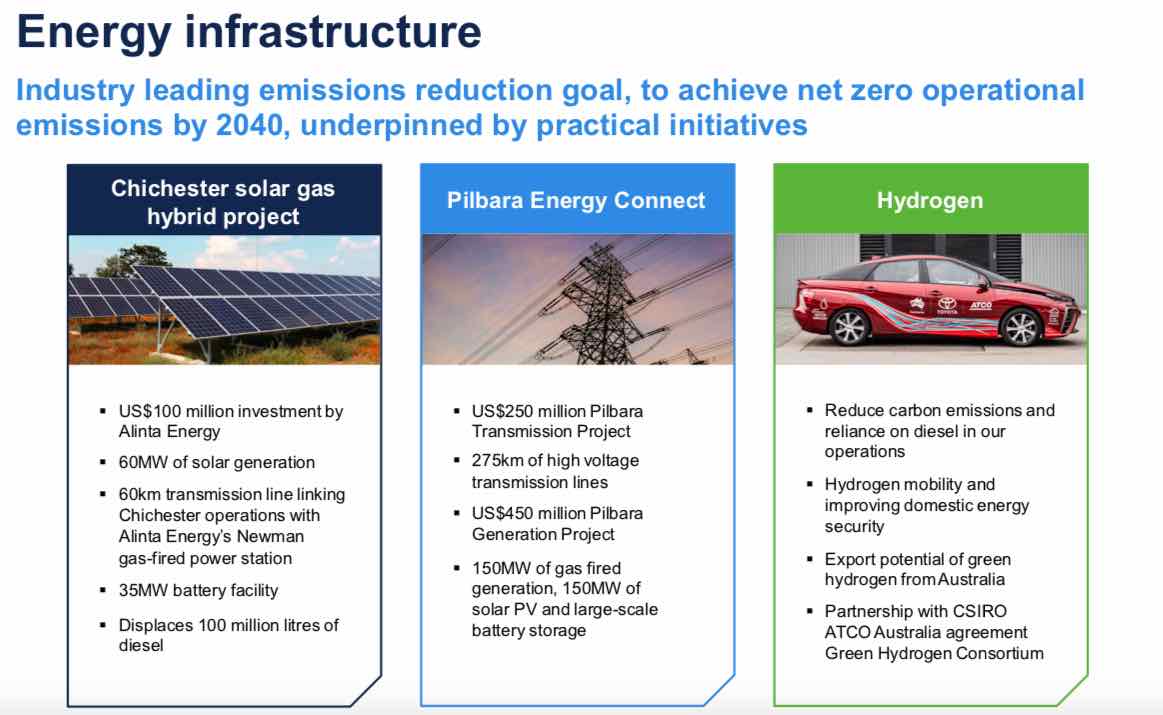
The company also noted that civil works had begun on a new solar farm to be connected to its Pilbara mining network, which will also include battery storage.
Australian businesses looking to ditch gas and diesel can do the sums, find electrification will…
An abundance of rooftop solar generation has helped set a new record high for the…
Windlab's John Martin on the project that broke the investment drought for big wind, and…
Federal Labor's determination to power new data centres with renewables, and to minimise emissions and…
The huge, two-hour battery built at the site of a partly demolished coal plant reaches…
An Australian startup aiming to make green hydrogen work for heavy industry has launched an…