Image: EnergyCo
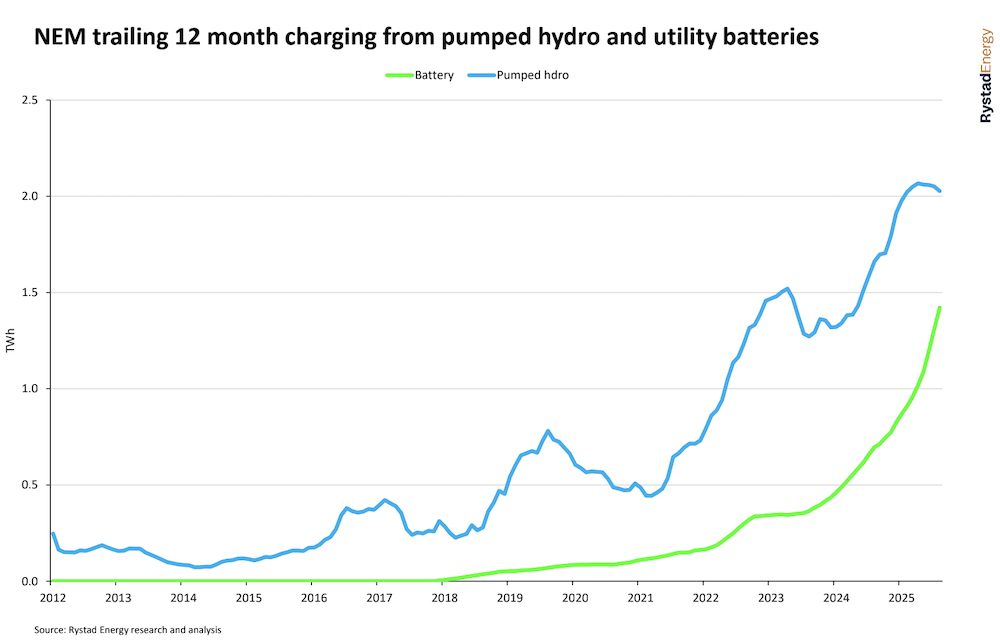
“Exponential growth” in customer load from more and more big batteries have helped soak up excess wind and solar and trim the number of hours of wholesale prices spent below zero in the last month, new data has revealed.
The latest monthly update from Rystad Energy shows that large-scale solar and wind generated a combined total of 4,863 gigawatt-hours (GWh) of electricity over the course of August, up 12 per cent from the same time last year.
Despite this increase in generation, there were 554 hours of negative prices across the main grid, the National Electricity Market (NEM) and the Western Australia WEM in August, lower than both August 2024 and August 2023.
Rystad’s David Dixon says this is partly due to higher underlying demand – with increasing electrification and a cold winter – but it’s also due to more charging from more utility-scale batteries, as well as from pumped hydro.
“On the charging side, there’s been exponential growth in load from utility batteries (1.4 TWh – Trailing 12 months), which are expected to overtake pumped hydro (2.0 TWh – Trailing 12 months) over the next 6-12 months as utility batteries continue to commission,” Dixon says on LinkedIn.
On the generation side, a windy month put Victoria in top, Dixon says, generating a total of 1,363 GWh in August with 1,188 GWh from wind and 175 GWh from utility-scale solar.
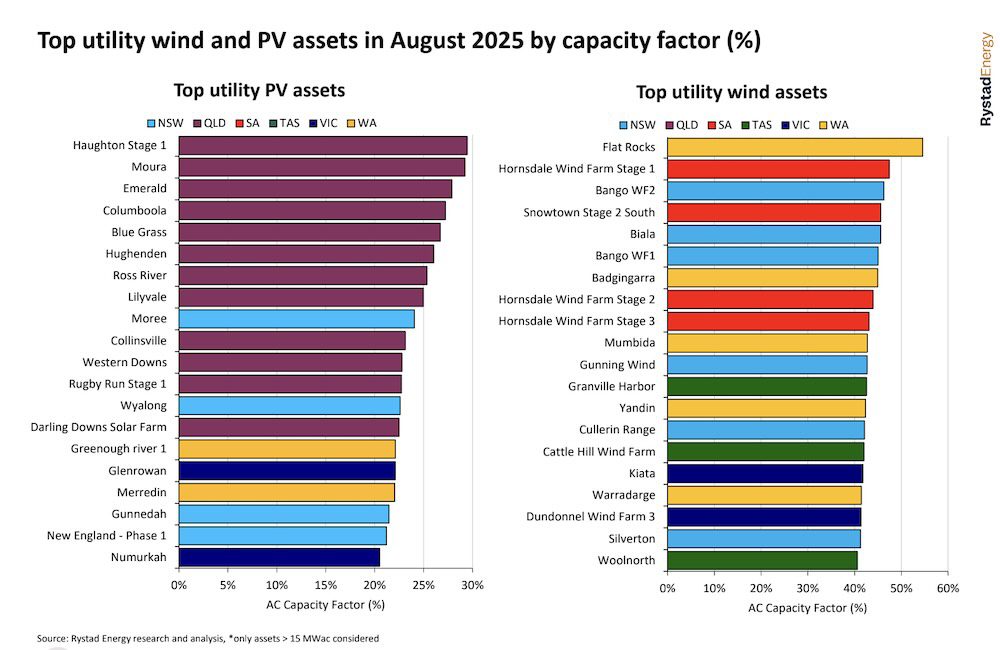
That said, the nation’s top performing wind assets for the month were mostly located in Western Australia, South Australia and New South Wales, led by Potentia Energy’s Flat Rocks wind farm in WA, with a capacity factor (CF) of 54.6%.
In SA, the Atmos Renewables Renewables and Neoen-owned Hornsdale stage 1 wind farm placed second on the charts (47.4% CF) and Squadron Energy’s Bango stage 2 wind farm in NSW had a capacity factor of 46.3%.
For solar, the best performing assets were mostly in Queensland, including Pacific Blue Australia’s Haughton stage 1 solar farm, which had a capacity factor (CF) of 29.5% AC for the month; Metka’s Moura solar farm (29.2% AC CF) and Lighthouse Infrastructure’s Emerald solar farm (27.9% AC CF).
All up, electricity generation from renewables energy resources (solar PV, wind, hydro & biomass) reached 40 per cent in the NEM in August, Dixon says, and 36% in the WEM.
See also: Wind and solar up, coal down, and some notable battery records in August
When conflicts affect global oil and gas routes, Australians feel it. But Australia has all the…
Community focused retailer launches first of seven batteries to be deployed across regional Victoria and…
The Australian trucking industry is about to experience an electric revolution, with plunging battery prices…
Latest grid ratings include bad news for solar farms in some areas, but a boost…
Final panel installed at Australia's first large scale solar-battery hybrid facility to connect to the…
Plans to develop a 1GW wind farm in waters off the coast of Gippsland have…