Electrified homes and vehicles could help transform Australian cities into “giant batteries,” a new study has found, where each resident is effectively equipped with around three Tesla Powerwalls-worth of flexible energy storage capacity.
The Australian National University study, published in Renewable Energy, uses travel data, electricity demand profiles and geospatial mapping to evaluate how electric vehicles (EVs) and hot water systems can shift energy use to reduce strain on the grid at times of peak demand.
The modelling uses the Australian Capital Territory (ACT) as a case study and – in collaboration with Evoenergy – high-resolution data to map flexible capacity across urban neighbourhoods.
The results show that EV batteries and electric hot water systems can provide storage capacities of 43 kWh and 2.6 kWh per capita, respectively – a total of nearly 46 kWh, or the equivalent to two-to-three average-sized home battery systems
The ANU study finds that by adjusting the timing of car charging and water heating, each person could shift around 5 kWh of electricity per day to off-peak hours.
Fig. 4. Different charging/heating strategies: Baseline, Daytime, Overnight and Flat. Horizontal axis: hour of day; vertical axis: % of daily charging/heating load. Source: ANU
This flexible energy represents about one-third of the average daily per capita electricity use, the researchers say, and can be timed to support the grid, rather than strain it.
“Cities are often seen as energy-hungry giants,” says Bin Lu, a senior research fellow at the ANU College of Systems and Society, and lead author of the study.
“But with widespread electrification, they could also become giant batteries – managing energy, not just consuming it.”
The flip-side of the widespread electrification of homes and transport is that, without management, it could send demand soaring by more than 30 per cent and put fresh strain on rapidly changing grids.
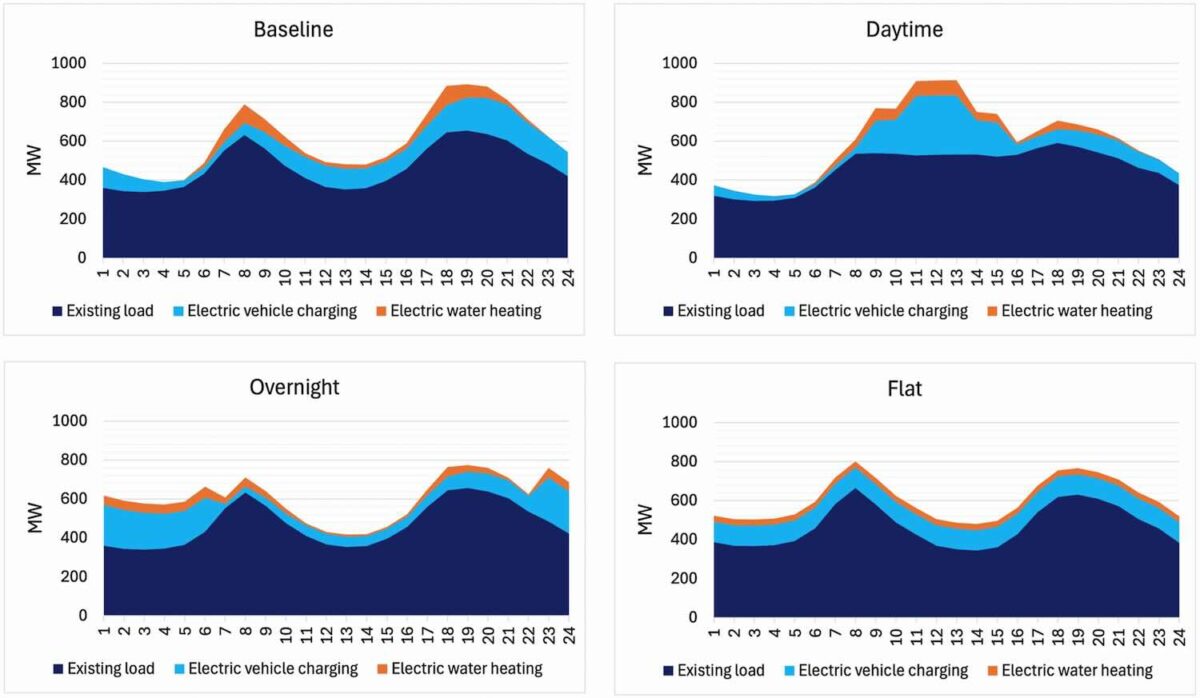
But Lu says that by shifting just half of the flexible load identified in the study to off-peak hours, projected increases to peak demand could be halved, removing the need for costly grid upgrades and making better use of abundant rooftop solar resources.
Fig. 5. New peak loads under four charging/heating strategies. The resulting peak loads are 893 MW occurring at 7 p.m. on 20 June 2023 (Baseline); 915 MW at 1 p.m. on 1 July 2022 (Daytime); 774 MW at 7 p.m. on 20 June 2023 (Overnight); 802 MW at 8 a.m. on 21 June 2023 (Flat). Source: ANU
The research also finds that the distribution of distributed energy storage (DES) resources is highly dependent on population density and urban growth, as well as daily travel patterns.
This can result in “storage hotspots,” or high-density employment areas where flexible demand is both high and valuable, and which present strong opportunities for smart workplace charging, dynamic pricing incentives, and innovative smart energy management platforms.
“The energy transition is complex with many moving parts,” says Sam Sachse, acting general manager of Evoenergy.
“Understanding how these new electric loads behave and how we can manage them is crucial to building a smarter and more reliable electricity network.
“As countries seek to meet climate targets and accelerate the clean energy transition, this research points to a new path: enabling homes, cars and hot water systems to plug in, heat up, and help power the grid.”
Legal bid to overturn state approval of a NSW wind project ends with a whimper,…
Safety has become one of the most defining priorities for solar and energy storage developers.…
The latest gas market outlook is less of a temporary supply-gap reprieve and more the…
Andrew Forrest says fossil fuels carry volatility, political cost and risks for mums and dads…
Tony Abbott's climate attacks inspired a local community to build a first of its kind…
A solar farm inspired by Tony Abbott's climate attacks has finally been opened. Mhairi Fraser…