In a major update to Australia’s electricity planning frameworks, the Energy Security Board (ESB) has released its Post-2025 Directions paper, designed to pre-empt the impending closure of sixteen gigawatts of thermal power stations in Australia’s National Electricity Market (NEM).
Stakeholders in the ESB’s lengthy consultation processes were mixed in what is required to ensure new wind and solar projects can replace the closure of thermal power stations, but formed a consensus that federal and state energy policies ought to be aligned with NEM requirements.
As discussed in this piece by ITK Principal and RenewEconomy contributor David Leitch, the paper has five areas of focus:
1. Manage exit of coal stations while providing reliability
2. Work out how to provide system services when everything is done by power electronics
3. Work out how to redesign the system so that distributors, communities and household seamlessly integrate with industrial size generators and consumers.
4. Coordinate REZ introduction process and associated transmission
5. Try and herd the States back into the NEM framework
The head of the ESB, Kerry Schott, has previously highlighted the uniquely fast pace of renewable energy development in Australia, and how that can be managed and enabled into this coming decade, suggesting the default pathway is one in which Australia hits a 94% renewables share by 2040.
The recent Directions paper includes more specific suggestions on how to address the looming actions that must be taken to enable this situation, such as working to enhance and realise several new “renewable energy zones”, reducing barriers to grid access, and enabling greater involvement of household consumers in electricity generation and consumption.
The paper was released alongside an updated “Health of the NEM’ report for the year 2020. In a media release, the Australian Energy Markets Commission (AEMC), said the report “finds that emissions across the NEM at present are approximately 25 per cent lower than in 2005. By 2030, those emissions will be between 40 and 60 per cent lower than 2005. And between 70 and 95 per cent lower by 2042”.
The dual challenges of upgrading grid networks to accommodate zero emissions technologies and dealing with increasing rates of failure in old fossil fuel power stations are key focus areas for Australia’s regulatory and planning bodies.
A release from the COAG Energy Council says that the 2020 Health of the NEM report finds that “real progress has been made with improved generation capacity (reliability), emission reduction, competition and network investment. But system stability (security) and investor confidence remain critical”.
“We are concerned about security constraints in some parts of the NEM and the increasing pressure on distribution networks from growing rooftop solar penetration,” said Dr Schott. “This, combined with growing large scale renewable generation and low wholesale prices, means it is vital that post 2025 reforms are put in place that can work alongside government policy schemes”.
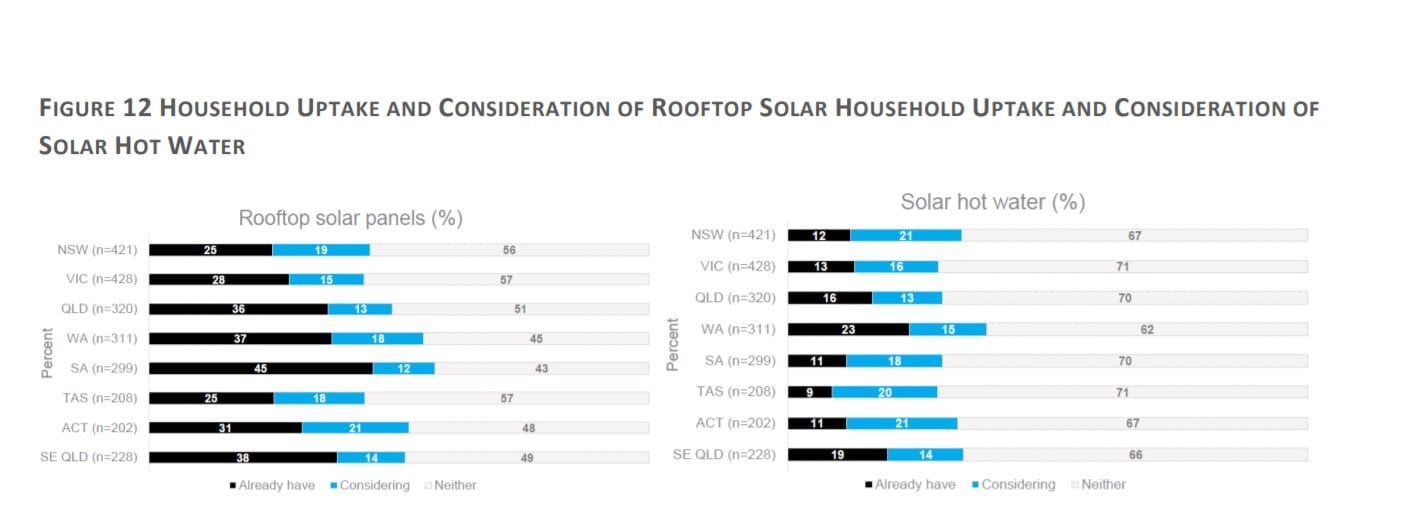
The Health of the NEM report also identifies a high level of consumer interest in increased participation in electricity markets, with 12 to 21 per cent of respondents to the group’s ‘Energy Consumer Sentiment Survey’ considering adopting rooftop solar, 20 to 30 per cent considering battery storage and 15 to 25 per cent considering an electric vehicle.
Rooftop solar uptake has ridden the wave of Cheaper Home Batteries, but new data shows…
A Taiwanese offshore wind farm has experienced its second turbine blade failure in two months.
Australia's first offshore wind auction will adopt features of the UK's successful program, including longer…
Federal energy minister concedes controversy over Marinus Link project at a ceremonial sod-turning ceremony that…
First Nations group behind several giga-scale renewables projects launches DA for its latest huge wind…
Leaders and delegates meeting in Fiji and Tuvalu this week for climate negotiations are doing…