Government and corporate fleets do not have to spend extra money by switching to electric vehicles, according to new research from ClimateWorks. They already pay for themselves – if viewed on the total cost of ownership, rather than the upfront ticket price.
The research – from the Melbourne-based research house ClimateWorks – shows that although there is only limited choice of EVs currently in Australia, this does not mean there is a need for councils and organisations to wait for more electric vehicle choice.
CEO Anna Skarbek told the Electric Vehicle Transition conference – hosted by The Driven and RenewEconomy in Sydney on Monday – that savings from lower fuel (or rather, energy) and maintenance costs means councils and organisations can benefit when choosing to “go electric”.
The data, put together in collaboration with the Electric Vehicle Council and the Municipal Association of Victoria (MAV), shows that across the majority of segments of vehicles used by Victorian councils, there are already models that fit within council operating parameters.
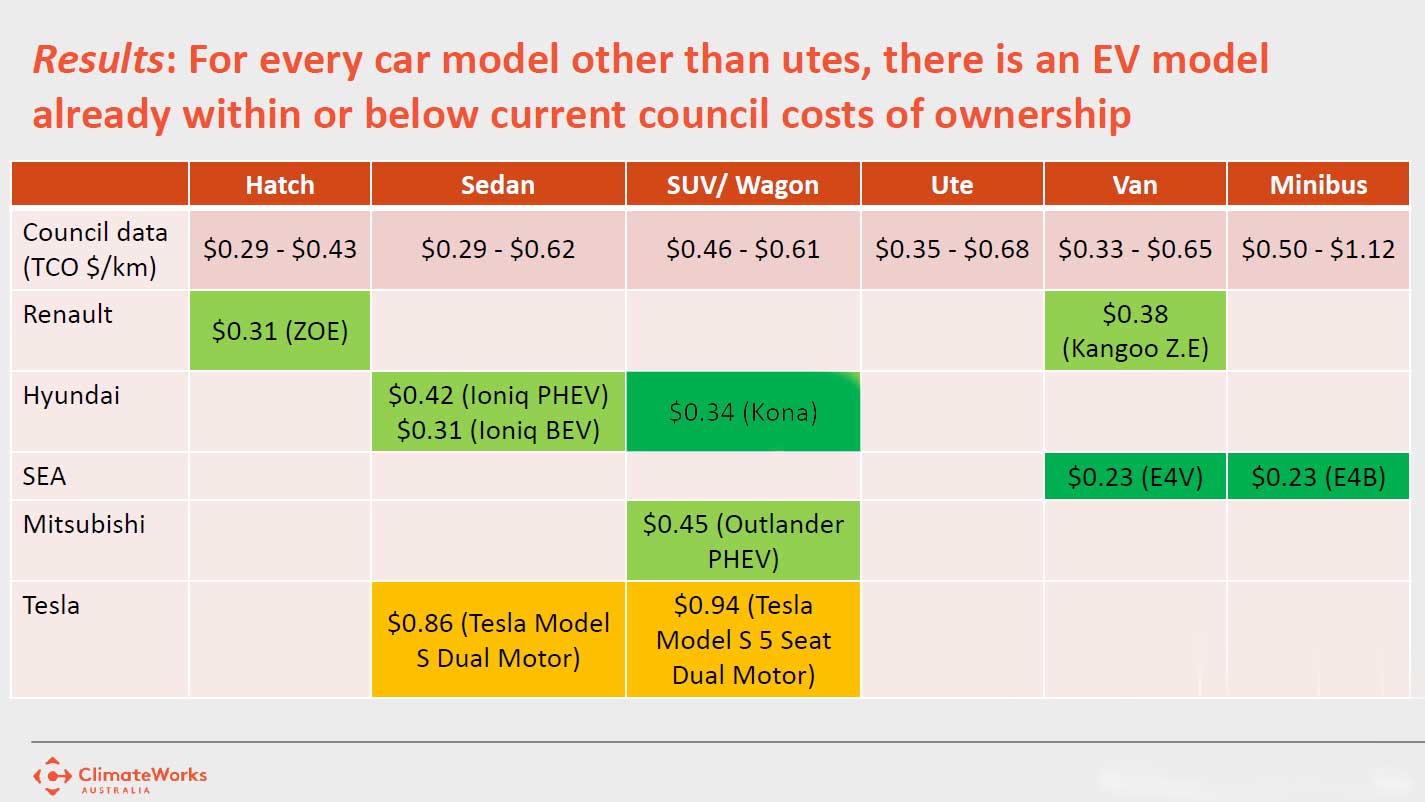
The Renault Zoe, Kangoo Z.E, as well as Hyundai’s Ioniq battery electric and plug-in hybrid electric (PHEV) and the Mitsubishi Outlander PHEV all represent zero emissions vehicles that can help councils and organisations work towards net zero emissions goals without compromising on cost.
In the case of the Hyundai Kona Electric and SEA-Electric E4V and E4B, there can also be significant savings, as well as reduction of carbon emissions.
In this graph below, the light green shows EV models that compete with current fossil fuel cars in terms of total ownership cost. The dark green shows EVs that show clear savings.
The data is based on 6 years ownership, using purchase price minus resale value, plus fuel, maintenance, insurance, tyres, divided by number of kilometres from data compiled from 79 local Victorian councils.
According to Skarbek, the opportunity for fleets to accelerate the transition to electric vehicles – which is sorely needed if other Australian sectors are not left to do the heavy lifting of reaching Paris targets – is huge.
Local goverments buy 9,000 cars a year for their fleets, and all governments buy 38,000 a year. Shifting fleets to electric vehicles can not only assist in reducing carbon emissions at an organisational level, it can also feed the growing interest in secondhand electric vehicles in Australia.
This is equally significant for the transition to EVs in Australia, as Roy Morgan data released in August showed consumer intention to buy a secondhand electric vehicle in Australia is rapidly on the increase.
“Fleet owners want to shift, but they do need help,” Skarbek said, pointing to the fact that often decision makers for fleet purchasing are multitasking and providing data such as the above can assist in making informed decisions.
Not only can shifting to EVs help with achieving targets (most Australian mayors have signed an MOU to reach Paris equivalent targets despite inaction at a federal level), they are also a very visible demonstration to consumer markets about the benfits of EVs.
According to the ClimateWorks project conducted with the EVC and MAV, there are three program required to assist councils and organisations move forward:
The ability to connect buyers with automakers and leverage bulk buying opportunities is also valuable, says Skarbek.
To read the original version of this story on RenewEconomy’s electric vehicle dedicated site, The Driven, click here…
The lengthy delays at what would have been the country's biggest wind farm have forced…
The public remains largely in the dark about the full cost of the giant Snowy…
Amandine Denis-Ryan from IEEFA on what can be done about Australia's unique and unhealthy dependence…
For maximum readings, September came in as Australia's third warmest. For minimums, last month narrowly…
Diesel fuel tax credits earned over 10 years nearly equate the price of a huge…
Updated: The biggest wind farm to reach financial close in Australia in the last two…