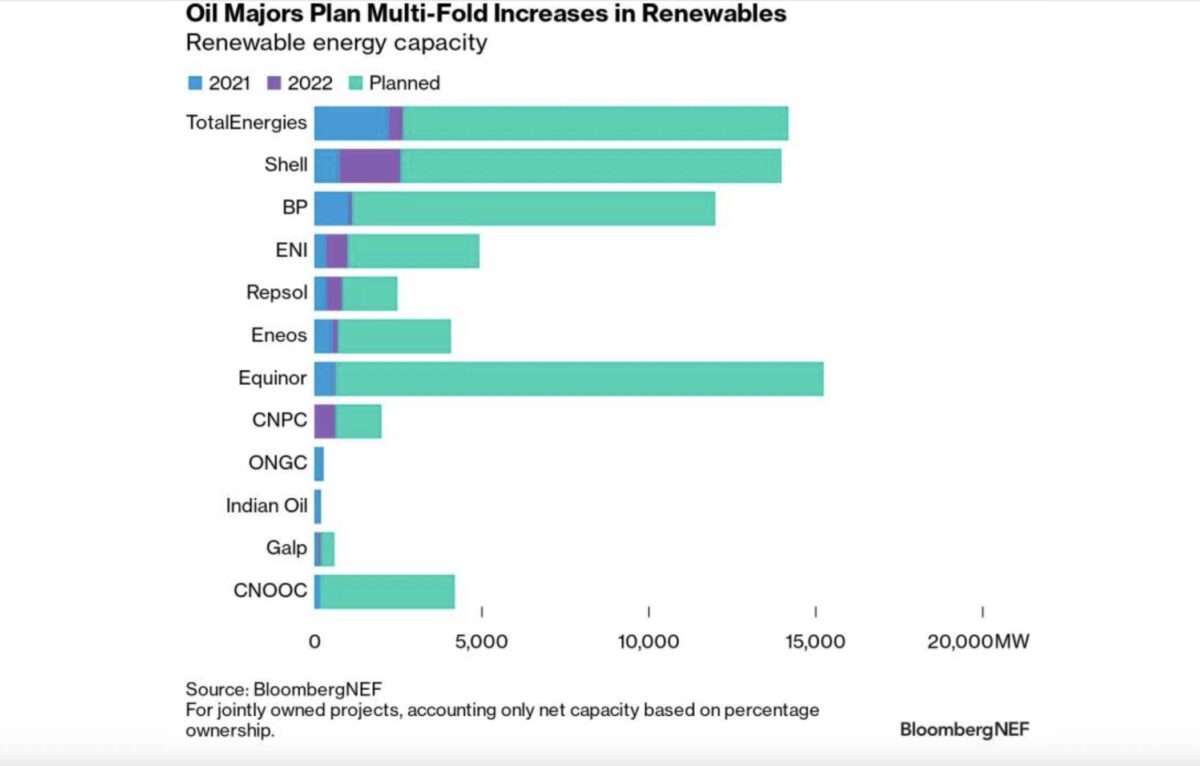
Despite more than doubling profits in 2022 and regularly claiming their enthusiasm for a renewable energy future, oil majors added only 1% of the world’s renewables in 2022.
According to a new analysis from Danya Liu, a climate risk senior associate at BloombergNEF, the biggest 41 oil majors installed just 4.5GW of renewables in 2022.
The analysis rests behind BloombergNEF’s paywall, but the headline figures was highlighted on LinkedIn by BNEF’s Kobad Bhavnagri, an energy transition expert and global head of strategy at BNEF.
Bhavnagri says there was 378GW of new renewable energy capacity installed around the world in 2022, of which just 4.5GW – or 1.2 per cent – came from the oil majors.
Different figures were published by the International Renewable Energy Agency (IRENA) in March and concluded that new renewable energy capacity added in 2022 amounted to 295GW.
Even so, this would still only put Big Oil’s contribution to new renewable energy capacity to 1.5%. And while the two years highlighted in the graph above are immediately post-COVID, both years saw record renewable growth.
The figures stand in sharp contrast to the publicly advertised enthusiasm from Big Oil for renewable energy, not to mention the sharp contrast with the more than doubling of profits in 2022, which increased to $US219 billion.
In February, Reuters noted that the “combined $219 billion in profits allowed BP, Chevron, Equinor, Exxon Mobil, Shell, and TotalEnergies to shower shareholders with cash” – money which, in an ideal world that took climate science seriously, could have been thrown instead at fulfilling Big Oil’s renewable energy promises.
As Bhavnagri notes, oil majors have a lot of renewable energy capacity in the “pipeline” – as can be seen in the graph above – “but the data shows today, they talk much more than they act.”
Amandine Denis-Ryan from IEEFA on what can be done about Australia's unique and unhealthy dependence…
For maximum readings, September came in as Australia's third warmest. For minimums, last month narrowly…
Diesel fuel tax credits earned over 10 years nearly equate the price of a huge…
Updated: The biggest wind farm to reach financial close in Australia in the last two…
Australian battery maker whose customers include the federal energy minister has gone into voluntary administration,…
A major new transmission line that the state opposition has vowed to scrap is seeking…