Coal miner in the now-closed Kellingley Colliery at Knottingley, West Yorkshire, June 2012. Credit: Image Source / Alamy Stock Photo
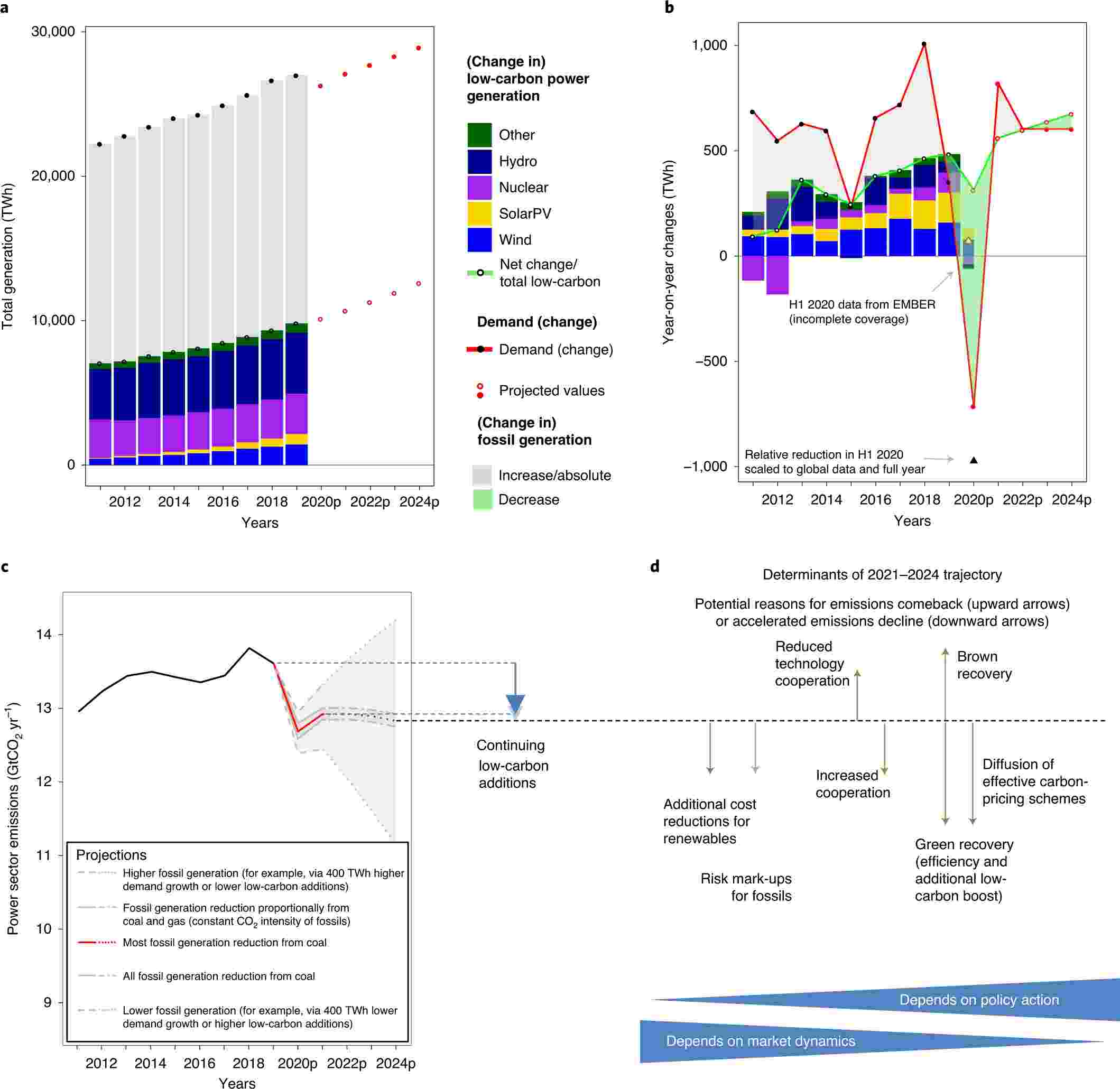
A new study released by a team of economists in Germany has investigated the impact of COVID-19 on the world’s energy systems, and found that the kick to coal power delivered by the impacts of the pandemic could be made into a permanent structural decline in coming decades.
“Coal has been hit harder by the Corona crisis than other power sources – and the reason is simple,” said lead author Christoph Bertram from the Potsdam Institute for Climate Impact Research (PIK).
“If demand for electricity drops, coal plants are usually switched off first. This is because the process of burning fuels constantly runs up costs. The plant operators have to pay for each single ton of coal. In contrast, renewable power sources such as wind and solar plants, once built, have significantly lower running costs – and keep on operating even if the demand is reduced.”
The researchers found that the merit order effect played a key role in pressuring coal specifically, resulting in a dynamic whereby it was the first fuel to be pushed out of the mix as demand fell, in some regions quite significantly. Fossil gas, however, was not quite as affected. Though the fuel is normally somewhat more expensive, the reductions in demand also resulted in a lowered price for fossil gas, making it more competitive.
“Our research shows that investing in fossil-fueled power is not only environmentally irresponsible – it is economically very risky,” says co-author Ottmar Edenhofer, Director of both PIK and the Mercator Research Institute on Global Commons and Climate Change.
“In the end, it will certainly take carbon pricing to cut emissions at the required pace and stabilise our climate. Yet the impacts of the Corona crisis on the power generation sector have put political leaders in a unique position: Along with additional policies such as eliminating subsidies for fossil fuels and increasing investments in wind and solar power, it is now easier than ever before to put an end to high-carbon electricity.”
The impact on the world’s power stations highlights a key moment to seize on the momentum and accelerate the phase-out of coal-fired power; with a particular focus on increasing the rate of change as coal contributes an easy majority of the world’s emissions and most power stations are easily replaced with zero-emissions alternatives. These depend on governments taking swift policy action to seize the moment.
In Australia’s National Electricity Market, 2020 was the lowest generation year for coal on record (since 2006), marking the fifth year in a row that output from the fuel has decreased and the largest drop within that time period. It also marked the lowest gas output year since 2006 and the highest output year for renewables on record. More than $1 billion in value has been wiped off Queensland coal and gas power stations.
It was recently revealed that one of Australia’s largest coal-fired power stations, the Vales Point plant in New South Wales, was told to submit an application for a $8.7m grant prior to approval being announced in the federal budget. Victoria’s coal-fired power stations have come under criticism for air pollution problems and there are a range of detailed plans on offer for a controlled phase-out of Australian coal-fired power.
Renewables met more than 80 per cent of total grid demand for first time on…
A new Consumer Energy Resources Technical Code will define the standards and capabilities required of…
Australian businesses looking to ditch gas and diesel can do the sums, find electrification will…
An abundance of rooftop solar generation has helped set a new record high for the…
Windlab's John Martin on the project that broke the investment drought for big wind, and…
Federal Labor's determination to power new data centres with renewables, and to minimise emissions and…