Image Credit: OX2
CSIRO’s latest annual GenCost report has revealed fresh plunges in big battery costs and a welcome dip in the cost of onshore wind, while also confirming – for the seventh year in a row – that a mix of firmed renewables is the cheapest way forward for Australia’s electricity system.
CSIRO, Australia’s premier science agency, and the Australian Energy Market Operator (AEMO), have collaborated on the annual GenCost report since 2018, when the first report was produced after being commissioned by the then Coalition government.
It was designed as an effort to deliver a “policy-neutral and technology-agnostic assessment” of cost data for new-build generation and storage technologies to underpin electricity system modelling and planning. Its conclusions have been consistent – renewables and storage are the lowest option.
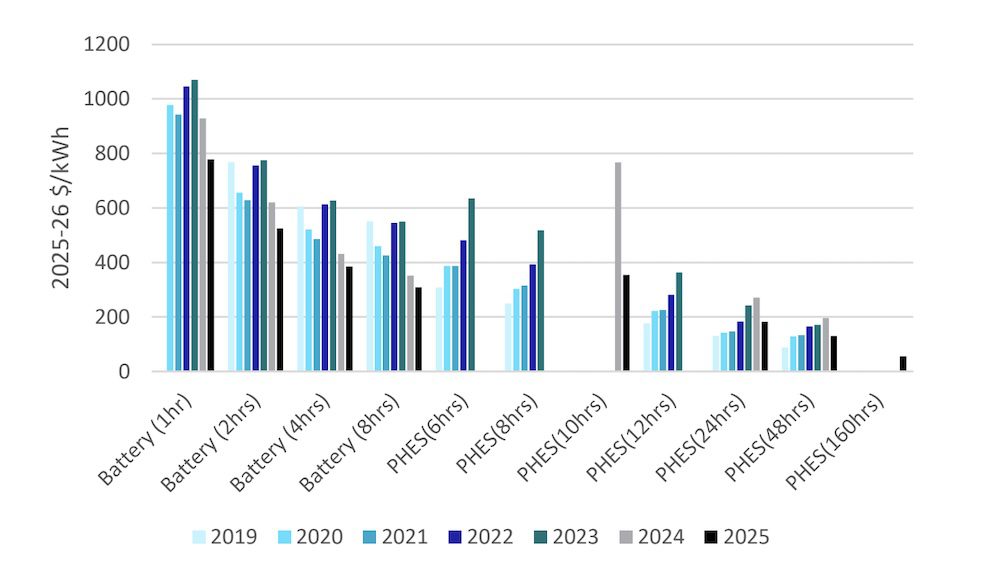
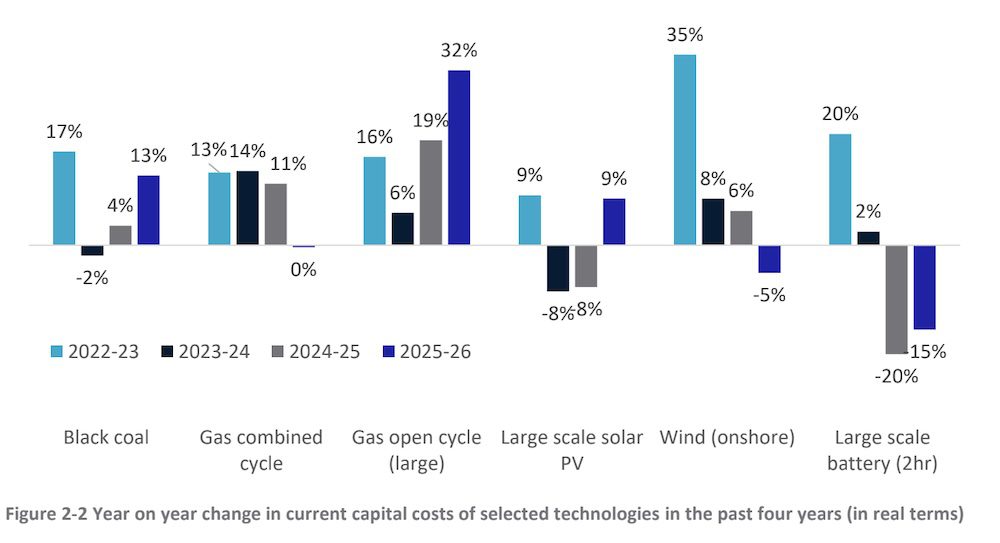
The draft GenCost 2025-26 Report, released for public consultation on Wednesday, finds that big batteries are once again the star performer on capital cost reductions, charting another expected 15 per cent fall, year-on-year, to back up the 20 per cent fall in 2024-25.
In a turn-up for the solar books, large-scale solar PV costs have been revised upwards by 8 per cent for 2025-26, compared to an 8 per cent fall in 2024-25. CSIRO says this represents a reversal of the last two years of gains but likely reflects cost volatility rather than a new trend.
But it is onshore wind that has provided perhaps the biggest about-face, with capital costs charting a 5 per cent drop over the 2025-26 period and showing “tentative signs of stabilising” following the 35 per cent jump in 2022-23.
“As the historical data indicates, onshore wind is one of the technologies which has been most impacted by recent global inflationary pressures,” the report says. “[The] updated data indicates that the costs pressures are stabilising.”
This is a welcome development for the Australian market, where rising costs, planning delays, and a buyers’ strike from major energy retailers have meant no new wind projects reaching final investment decision (FID) in 2025, to date.
This is in stark contrast to a host of standalone battery and solar battery hybrid projects, which have benefited from falling costs and faster development times.
CSIRO says it expects the capital costs of onshore wind to return to their normal cost path by 2035 “in all scenarios,” and then after 2035, to decline by a modest amount. No big plunges in cost, but no further rises, either.
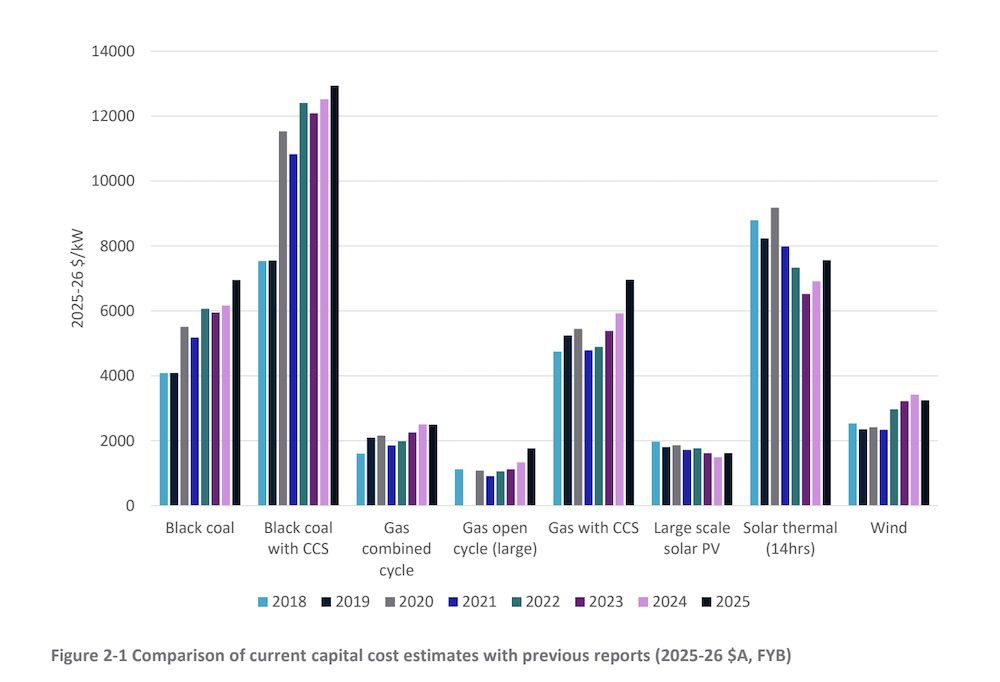
The biggest increases in capital costs, meanwhile, have been in coal and gas open cycle technologies, reflecting general increases in gas turbine and steam turbine costs, the report says.
“The change in current costs over the past four years indicates an easing of inflationary pressures for solar PV, wind and batteries while coal and gas technology costs have recently increased significantly (Figure 2-2).”
Also new this year is a revised methodology for estimating the levelised cost of electricity systems – a change CSIRO says it has made in response to stakeholder feedback.
The changes also address repeated attacks from the Coalition opposition, that have variously accused CSIRO of underestimating renewable firming and transmission needs, cherry-picking data to make renewables seem cheaper and nuclear more expensive, and of lack of transparency in the modelling.
CSIRO says the new system levelised cost of electricity (SLCOE) method estimates a mix of electricity generation sources and their costs, along with a new CSIRO-developed Simple Electricity Model (SEM) to apply it, which is publicly available here: Simple Electricity Model.
Unlike the levelised cost of electricity (LCOE) metric, which compared costs of individual technologies, SLCOE considers the mix of technologies and transmission that deliver the lowest-cost electricity system across varying electricity emission abatement scenarios to 2050.
As CSIRO explains, estimation of the 2030 SLCOE excludes all new technology deployment other than renewables and their supporting technologies.
This is mostly because this approach best aligns with the federal target of 82 per cent renewables by 2030, but it’s also because there is not enough time for any other low emissions technology to contribute to new generation capacity in 2030.
For those who need reminding, high emission technologies are not factored in because they’re “not relevant” to achieving current 2030 policy targets. But the report notes that even if those policies were ignored, mature high emissions technologies would also be constrained by development lead times. And then, of course, the higher costs.
Based on a mix of solar, wind and storage, the new model finds that to meet Australia’s target of 82% renewable energy by 2030, the electricity cost is estimated to be about $91 per megawatt-hour (MWh) when transmission is included, or $81/MWh for generation alone.
The 2050 SLCOE considers either mature firmed renewables only or mature firm renewables plus any of three groups of technologies: floating and fixed offshore wind, coal and gas with carbon capture and storage (CCS) and large-scale and small modular reactor nuclear.
As the charts illustrated, the SLCOE results show that deploying mature technology only (solar PV, wind, gas and storage) is the least cost generation mix in 2050 for all emission intensity levels modelled.
To deliver net zero by 2050, generation costs were projected to be $135–$148/MWh including transmission, or $114-$124/MWh for wholesale generation costs only. This, the report notes, is slightly lower than the National Energy Market (NEM) volume-weighted generation prices of around $129/MWh in 2024-25.
CSIRO says it doesn’t rule out offshore wind, and thinks there’s potential for some projects to be included in the new generation mix between 2030 and 2050 and stay within the forecast cost range.
“Australia is not likely to deploy offshore wind before 2030 and therefore GenCost will continue to be required to rely on global sources of offshore wind cost data until then. A first of a kind premium, in addition to the costs shown, will likely apply when offshore wind is deployed in Australia for the first time,” the report says.
The report also provides an important clarification regarding the relationship between the underlying cost of new build electricity generation and the final retail price paid by customers – important, particularly, for those politicians prone to fixate on the cost of electricity without understanding what drives it.
“Currently, generation accounts for around 33 per cent of retail prices, transmission around 7 per cent and distribution around 35 per cent, with the remainder covering metering, retail services and government programs,” the report says.
“Changes in generation prices are also subject to: Supply-demand imbalance as a result of too much or too little deployment relative to demand growth and retirements; fuel price and weather volatility, [and]; the level of competition amongst suppliers,” it adds.
“These additional drivers of generation price formation can lead to prices significantly lower or higher than the underlying cost of the system and can take many years to correct due to the long lead times for capacity deployment.”
One of the big drivers, recently, has been the price of gas, which sent the electricity price to new heights in 2022 when Russia invaded Ukraine, and has since played a big part in keeping prices at those levels.
“GenCost has evolved from delivering verifiable cost data on individual technologies to now also providing system modelling of the future generation mix and average cost of wholesale electricity,” CSIRO chief energy economist and GenCost lead Paul Graham says.
“Electricity systems will always require a diversity of resources to deliver all their functions and so no single technology will meet all the system’s needs regardless of its relative cost position.”
The draft GenCost 2025-26 Report is open for public consultation here.
ASL outlines plans to structure massive new tenders in ways that supports hybrid projects, with…
Ground-breaking hybrid renewables system installed at an outback opal mining town in South Australia is claiming…
Amid fresh global conflict, the UK government is rolling out new measures to bolster national…
Queensland set two new instantaneous power generation records over the weekend, offering a useful snapshot…
Publicly-owned gentailer completes final concrete turbine foundation at what is the state's first new wind…
The real anathema in the modern Australian economy is not renewable energy, but the idea…