A Queensland wind project has shaved 110 hectares off its footprint and moved some turbine locations as it works its way through the federal environmental assessment process, seeking EPBC approval for construction.
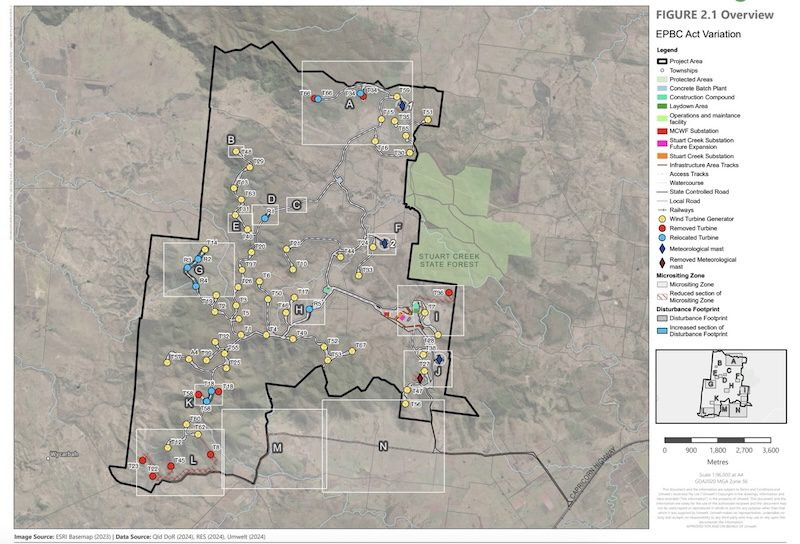
The 360 megawatt (MW) Moah Creek wind project wants to install 60 turbines, but has ditched one of four meteorological masts and shifted four of the turbines in the south west in order to protect more land for greater gliders and a particular variety of cycad.
Central Queensland Power (CQP), a joint venture between Energy Estate and Renewable Energy Systems, is progressing the project after the state-owned utility CleanCo reneged on a deal to buy it in January.
Moah Creek was one of the winners of the fourth federal Capacity Investment Scheme tender, the Commonwealth underwriting scheme for new generation and firming projects.
The project won state approval in August 2023, but the federal environmental assessment is still rolling onwards, after starting almost three years ago.
The latest changes come as part of the environmental planning process, and cut the disturbance footprint from 830 hectares to 720 hectares.
The red dots are turbines that have been moved, the blue are those whose sites have been adjusted slightly, and the yellow remain in place. Image: CQP
New surveys earlier this year found more cycas megacarpas saplings in the area than expected, an endangered cycad whose ancestors were contemporaries of dinosaurs. Shifting the four turbines means CQP cuts 18 hectares of cycad-specific bush out of the work zone.
“It is important to note that whilst there is no overall reduction in impacts to Cycas megacarpa as part of this variation, this is due to an increase in the extent of Cycas megacarpa identified through additional survey findings in 2026.”
The federal Department of Climate Change, Energy, the Environment and Water (DCCEEW) had also consulted on adjustments to CQP’s plan to offset greater glider habitat removal at a farm in the Awoonga Hills, according to an EPBC variation request.
“Given the limitations on the proposed Awoonga Hills property to offset greater glider impacts, a review of the project layout was undertaken with the intention to reduce impacts on the species and allow for alternative offset properties to be utilised,” the request said.
The developer is looking for better offset sites, but has also moved the four turbines to better avoid denning and foraging trees used by Australia’s biggest gliding mammal, as well as narrowing access tracks, reducing construction areas, and making micro-adjustments for other turbines.
The changes also have a positive impact on known habitats for the 13 vulnerable and endangered birds and animals known to be on the site.
Although the Moah Creek project has state approval, the Queensland LNP government has demonstrated that it will call in previously approved projects for further scrutiny when enough pressure is applied.
Moah Creek is located right next to the Moonlight Range wind project, west of Rockhampton, which was approved by the Crisafulli government in late 2024 only to be killed off by the same government last year on what many suspect to be political rather than planning grounds.
Glen Kelly, the local state MP, was instrumental in having Moonlight Range called in by planning minister Jarrod Bleijie.
In a Facebook post last year, Kelly vowed he would also “fight the good fight” and oppose the Moah Creek project in the name of locals and wildlife.
In October, Kelly led a petition signed by 299 people to the state government asking for all state investment to be withdrawn from the Moah Creek project – a wish that was granted in the CleanCo decision in January.
If you would like to join more than 29,000 others and get the latest clean energy news delivered straight to your inbox, for free, please click here to subscribe to our free daily newsletter.
Renewables met more than 80 per cent of total grid demand for first time on…
A new Consumer Energy Resources Technical Code will define the standards and capabilities required of…
Australian businesses looking to ditch gas and diesel can do the sums, find electrification will…
An abundance of rooftop solar generation has helped set a new record high for the…
Windlab's John Martin on the project that broke the investment drought for big wind, and…
Federal Labor's determination to power new data centres with renewables, and to minimise emissions and…