The Union of Concerned Scientists (UCS) recently received by email an open letter by four nuclear scientists and engineers—Andrew C. Kadak, Richard A. Meserve, Neil E. Todreas, and Richard Wilson—titled “Nuclear Power’s Role in Responding to Climate Change.” Below we look at some of their arguments.
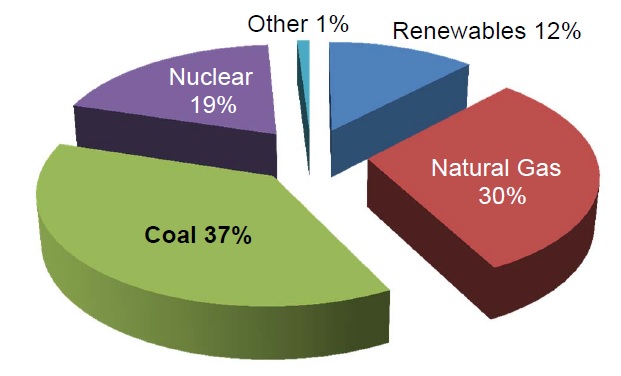
U.S. electricity generation by fuel, 2012 (Source: EIS)
The authors state that “… nuclear power can deliver electric power in a sufficiently safe, economical and secure manner to supplement supply from other carbon-free sources.”
UCS is deeply concerned about climate change and its impact on humanity and the Earth. We believe that nuclear power must remain on the table as a means of combating climate change.
However, new reactors are not currently economical compared to electricity generation from natural gas or from other low-carbon energy sources such as wind and solar. The environmental community, which some blame for crippling nuclear power, has in fact pushed for a price on carbon as a way of building the societal costs of continued carbon emissions into the economics of electricity production. This would in effect create a significant incentive that is currently missing for nuclear power compared to natural gas. Congress has stymied such proposals, and until that changes it is difficult to see what will drive growth in nuclear power, regardless of concerns about carbon or the variability of solar and wind power.
The economics of nuclear power would look even worse if there were another nuclear accident. TEPCO, the owner of the Fukushima plant, estimates that compensation costs for the tens of thousands of people displaced by the accident in Japan will exceed $50 billion and that it will cost about $20 billion to decommission the plant. This does not include the cost of eventually decontaminating the surrounding area, which may also run to $50 billion.
We do not believe nuclear reactors are yet sufficiently safe and secure. UCS has served as an industry watchdog for over four decades, and we have repeatedly seen that the Nuclear Regulatory Commission (NRC) does not enforce its own safety regulations. For example, half of U.S. reactors do not currently comply with fire safety regulations, which were first put in place in 1980. Yet according to the NRC, fire represents half the risk of accidents that result in core damage.
In discussing the issue of nuclear waste, the authors of the letter point to geological storage and the Blue Ribbon Commission’s recommended path toward interim and final storage as the solution, but there is currently no movement forward on this front. An effort by the Senate to legislate the Commission’s recommendations is faltering and is likely dead. In the meantime, nuclear waste continues to accumulate at nuclear reactor sites, with nearly three-quarters of it sitting in increasingly crowded cooling pools, with no end in sight.
While there are clear steps to increase the safety of spent fuel while waiting for long-term storage—such as moving a large fraction of it from cooling pools to dry casks—the industry refuses to implement these steps on its own and the NRC refuses to require them. A recent NRC report purports to show that the risks of continued spent fuel storage in pools is very low, but does not, for example, include the possibility of a terrorist attack on the pool. The NRC analysis is not convincing.
More generally, the authors talk about the possibility that future technologies will provide reactor designs that are safer, more secure, and less of a proliferation risk. However, as we have pointed out in our analyses, whether that is true depends not just on the technology but on the safety and security requirements for these new designs. In particular, if cost considerations result in the industry cutting corners on safety or security systems, then the situation in the future could be worse than today, not better.
Dr Kadak and his colleagues argue for an increased role for nuclear power, but gloss over problems that can and must be addressed to make the industry adequately safe and secure. Proponents of increasing nuclear power should be pushing the industry to meet higher safety and security standards, and for the NRC to require the plants to meet the regulations it is supposed to enforce.
David Wright is a physicist and the co-director of the Global Security Program. He is a nationally known expert on the technical aspects of missile defense systems, missile proliferation, and space weapons. See David’s full bio.
This article was originally published on the Union of Concerned Scientists blog, The Equation. Reproduced with permission
Shutting off rooftop solar is considered a blunt instrument, but a necessary option as household…
Tougher rules to protect Australia's environment have been welcomed by developers, but conservation groups say…
Karl Braganza, head of research at the BoM, explains El Niño and what it means…
Freshly minted NEM data shows solar-charged batteries discharging at record levels, helping lower wholesale prices…
It is now well established that the combination of new renewables and the huge growth…
Remote First Nations renewable energy projects are a complicated sell to investors, but a new…