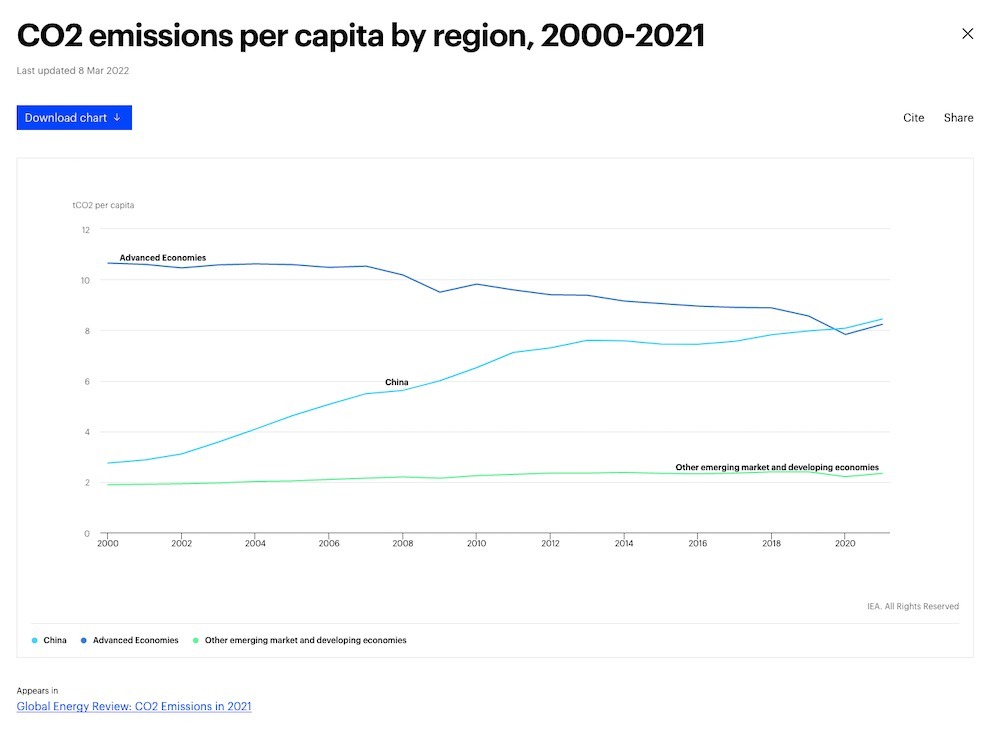
Greenhouse gas emissions from energy rose to their highest ever level in 2021, new analysis has shown, after a record annual increase in renewables-based generation across the world was cancelled out by soaring electricity demand and coal consumption in China.
A report from the International Energy Agency shows emissions from electricity and heat sector emissions increased by almost 2.1 gigatonnes (gT) from 2020 levels, putting 2021 ahead of 2010 as the largest ever year-on-year increase in energy-related CO2 emissions in absolute terms.
The jump comes despite renewables-based generation reaching an all-time high for the year, too, exceeding 8,000 terrawatt-hours (TWh), a record 500TWh above the level in 2020 – which is equivalent to about two-and-a-half times the annual output of Australia’s grid.
Output from wind and solar PV increased by 270 TWh and 170 TWh, respectively, the report says, while hydro generation declined by 15TWh due to the impacts of drought, notably in the United States and Brazil.
But the IEA says the record increase in zero carbon energy generation, and aggregate decline in energy sector carbon emissions from the rest of the world over the past two years, was not enough to offset the increase in China, itself driven by a “particularly energy intensive” economic recovery.
Post-pandemic electricity demand in China jumped by 10% in 2021, adding 700TWh, which the IEA points out is the equivalent of the total demand of all of Africa – and the largest jump in demand ever experienced in China.
“With demand growth outstripping the increase of low emissions supply, coal was called on to fill 56% of the rise in electricity demand,” the report says. “This was despite the country also seeing its largest ever increase in renewable power output in 2021.”
This resulted in a jump in China’s CO2 emissions of 750 million tonnes between 2019 and 2021 –an increase that more than offset the aggregate decline in the rest of the world over the same period.
In 2021 alone, the IEA report says, China’s CO2 emissions rose above 11.9 billion tonnes, accounting for 33% of the global total.
Coal accounted for over 40% of the overall growth in global CO2 energy sector emissions in 2021, with coal emissions hitting an all-time high of 15.3 Gt, surpassing their previous peak in 2014 by almost 200 Mt.
CO2 emissions from natural gas also rebounded well above 2019 levels to 7.5 Gt, as demand increased in all sectors, the report says. Oil, meanwhile, was the only fossil fuel whose emissions fell in 2021, to 10.7 Gt, due to the slower recovery of the transport sector.
That said, the IEA also notes that the global emissions reduction impact of “record electric car sales” in 2021 was cancelled out by the parallel increase in sales of SUVs.
Needless to say, none of these numbers or outcomes reflect where the world should be headed, according to the targets recommended by scientists if we are to avoid dangerous and irreversible global warming.
“The numbers make clear that the global economic recovery from the Covid-19 crisis has not been the sustainable recovery that IEA Executive Director Fatih Birol called for during the early stages of the pandemic in 2020,” a statement from the IEA said on Tuesday.
“The world must now ensure that the global rebound in emissions in 2021 was a one-off – and that sustainable investments combined with the accelerated deployment of clean energy technologies will reduce CO2 emissions in 2022, keeping alive the possibility of reducing global CO2 emissions to net zero by 2050.”
The Macorna wind project will have a simpler ride through state planning, and insists it…
One of the heaviest and longest road trips ever undertaken in Australia's energy transition has…
Australia has a choice between investing in the future we can already see – or subsidising…
The lengthy delays at what would have been the country's biggest wind farm have forced…
The public remains largely in the dark about the full cost of the giant Snowy…
Amandine Denis-Ryan from IEEFA on what can be done about Australia's unique and unhealthy dependence…