(AAP Image/Kelly Barnes)
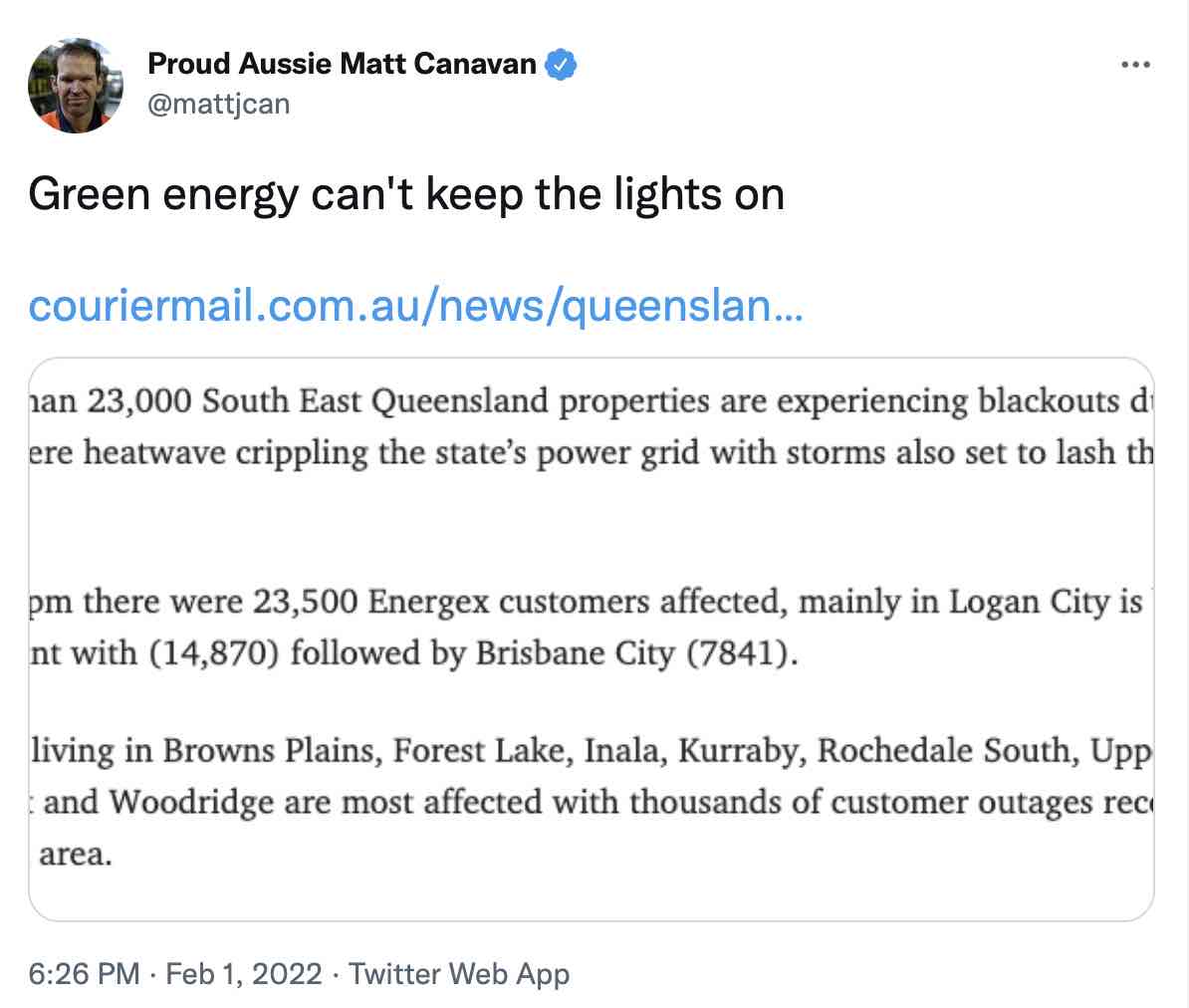
The federal Coalition’s relentless attacks on green energy has hit a remarkable new low, with LNP Senator, former minister and coal spruiker Matt Canavan blaming green energy for power outages that were apparently partly caused by a car accident.
“Green Energy can’t keep the lights on,” Canavan tweeted on Tuesday evening, citing a story in the local Courier Mail that told of at least 23,500 customers without power in south-east Queensland.
What Canavan (pictured above with federal energy minister Angus Taylor) did not care to explain was the cause of the outages, which had nothing to do with the green energy, or supply shortfalls, even on a day of searing heatwaves and major coal outages that forced the market operator to turn to its reserve trading mechanism.
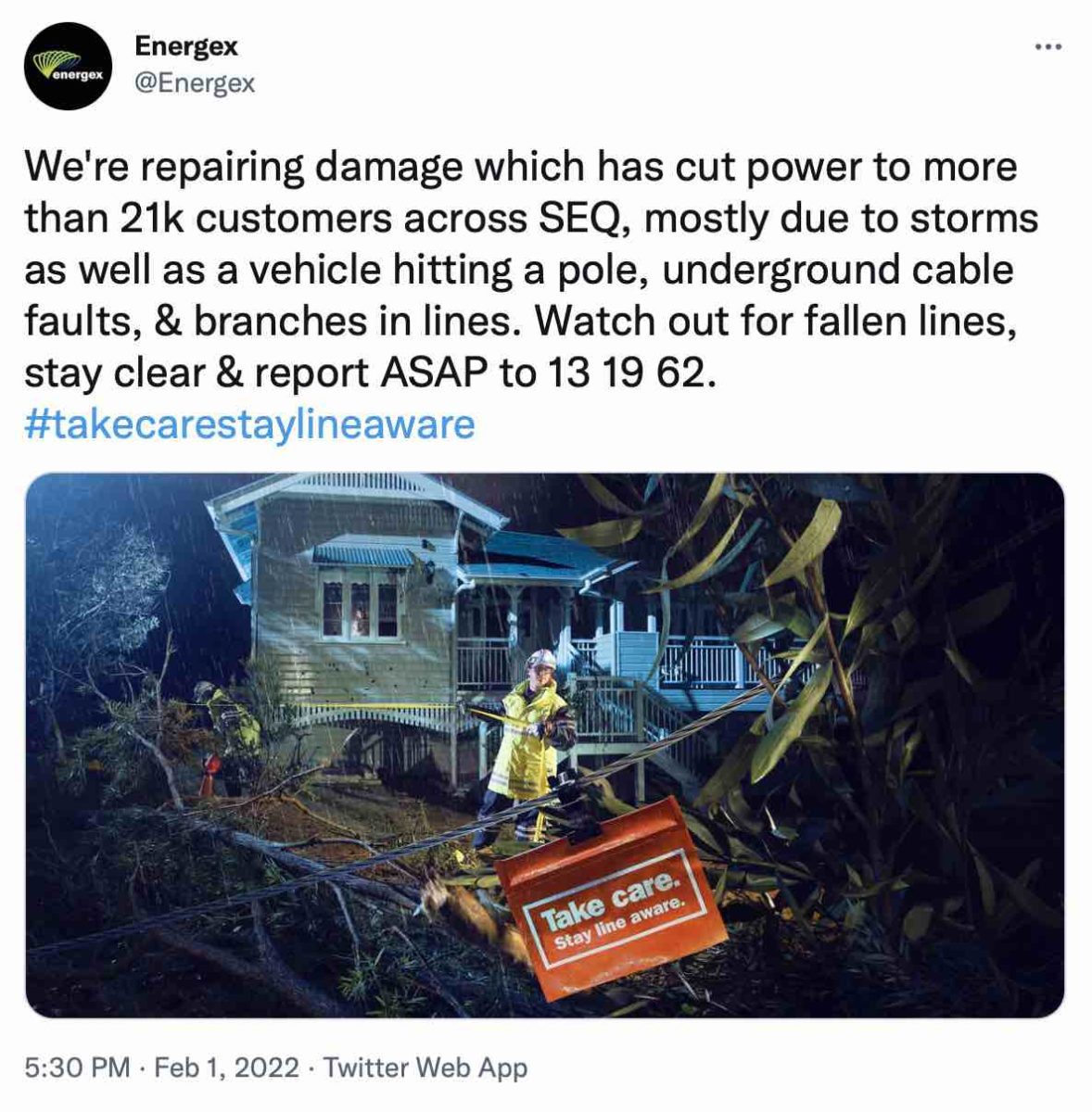
It’s important to note, in an election year when truth may be a valued commodity, that according to Energex, the local network operator, the outages in south-east Queensland were caused by more mundane things.
This included storms, a car driving into a power pole, underground cable faults, and branches falling on to power lines. Energex had made that clear an hour before Canavan whinged about wind and solar.
“We’re repairing damage which has cut power to more than 21k customers across SEQ, mostly due to storms as well as a vehicle hitting a pole, underground cable faults, & branches in lines,” Energex wrote.
There were numerous smaller outages in the network, which Energex also said was the result of “powerlines down” and severe weather.
Canavan’s timing is ironic because Queensland faced a supply crunch on Tuesday, caused by a searing heatwave, record demand levels and the absence of nearly 2GW of what was once called “baseload” coal, mostly due to unplanned outages.
The supply challenge forced the Australian Energy Market Operator to intervene in the market through its reserve trading mechanism, most likely paying large consumers to dial down consumption to ease the pressure on the grid.
PowerLink had asked customers to use less power earlier in the day. According to some analysts, the amount of “native” demand in the state hit record levels on Tuesday afternoon of 11,472.3MW, a rise of 492MW over the previous record set in December, 2019, mostly due to people turning on air conditioners.
Later reports described the storms as “tornado” like, but such events have not stopped the federal Coalition finding a way to blame green energy, all the way back to the state-wide blackout in South Australia when tornadoes tore down multiple transmission lines.
For all the glossy and costly taxpayer funded ad campaigns promoting Australia’s green energy transition, the antipathy towards wind and solar runs deep within the government. Not a single government minister has found the time, or inclination, to attend the opening of a wind, or solar farm, or big battery. There have been no such inhibitions with gas plants though.
As for Tuesday’s events, AEMO said the efforts to reduce consumption were successful. “Electricity reserves, through various sources, including RERT, reduced public use and demand-management support, helped navigate the tight supply conditions during Queensland’s evening peak-demand period today,” it said.
Transmission company Powerlink said the efforts of Queenslanders reduced demand by around 500MW, so avoiding any outages related to high peak demand – which appears to be the opposite of the what the federal Coalition is saying.
“We are expecting a slightly lower peak demand today however, hot and humid conditions means we are not entirely out of the woods,” Powerlink CEO Paul Simshauser said in a statement.
“The state’s power system is still tight, despite some generation coming back online, and we will continue working closely with AEMO, Ergon and Energex to take all necessary steps to avoid impacts on Queenslanders.”
As the heatwave continued on Wednesday, AEMO declared both an LOR1, and an LOR2, lack of reserve notices that point to dwindling options should a major generator experience a sudden failure.
The weather bureau predicted more storms too, which could cause more branches to fall on power lines, and more silly Tweets.
It could be the taste of things to come. Labor’s Chris Bowen on Wednesday admitted he didn’t want to talk to much about energy efficiency, in case the Coalition mounted a fear campaign, much like Snowy Hydro CEO Paul Broad, who once described demand management as enforced blackouts. Snowy has never been a supporter, because it hurts their profits.
Also this week, Bob Katter, the Queensland independent, launched a “stand up for coal” bumper sticker, and promised to pour a can of VB beer down the drain in protest against the decision by some brewers to go 100 per cent renewables. It’s going to be a long election campaign.
Australia's carbon credit scheme is working, according to a review, but some of the nation's…
Australia has the highest rooftop solar penetration on earth because we wrote sensible rules early…
Perth-based home battery maker named as one of three businesses awarded funding to help grow…
The former PM – once one-eyed in his support of pumped hydro storage – is…
State tips $500,000 into local family-owned electric motor specialist to support delivery of a state-of-the-art…
Energy market operator reinforces need for more flexibility, storage and transmission as electricity demand is…