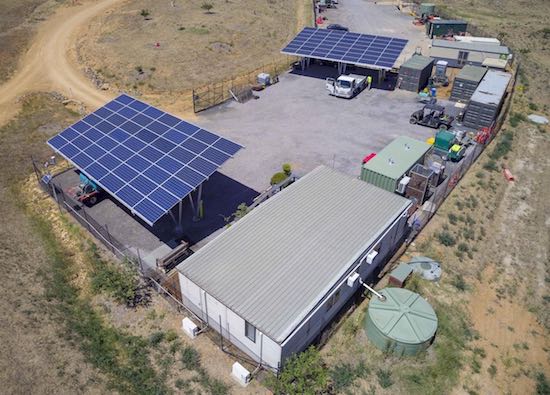
Canberra’s National Arboretum – a 250 hectare tourist centre that hosts 94 forests of rare, endangered and symbolic trees – has gone off grid, or rather, off diesel, after the installation of solar and battery storage.
The 30kW solar system, and a lithium-ion phosphate battery storage system of 82kWh, was unveiled by ACT climate minister Shane Rattenbury on Friday, having been installed by local company ITP Renewables.
The project, which was underwritten with a Territory loan of $283,330, will completely replace the diesel generator that has been powering the Arboretum’s operations, and cut ACT government emissions by 28.5 tonnes per year.
It is also expected to be much cheaper than the diesel gen-set, with the cost of the solar and battery system expected to be repaid completely within eight years, via fuel savings alone.
“The installation of a 30 kilowatt solar panel system, supported by battery storage, replaces the large diesel generator at the Arboretum’s horticulture works depot,” Minister Rattenbury said.
“The system… is self-contained and off-grid. It can run the hot water system, computers, fridges, air conditioners and power tools, even welders.”
Rattenbury said that the arboretum’s team of arborists and gardeners would now also have the benefit of using clean, solar-powered electric chainsaws, hedge trimmers, lawn mowers and so on for their work, instead of fossil fuelled tools.
As we reported here last year, there are fully electric, lithium-ion battery powered and cordless alternatives to most power tools, available to buy in Australia. While a little more expensive up front, they do the same job, but with less pollution, less noise, and much lower ongoing maintenance and refuelling costs.
“(The arborists) are know able to use these electric tools, fully powered by the sun. So it’s clean technology, but it’s also technology that’s making their job easier. They’ve got more than 40,000 trees to look after at the arboretum, so using these (solar rechargeable) power tools obviously makes their job a whole lot easier,” Rattenbury said in comments at the system launch.
“The strength of a project like this is that it is actually off grid, so instead of having to pay to bring the power lines out, it’s cost effective to put this system in here,” he said.
“But the way the price of both batteries and solar panels is changing, these sort of options are becoming more and more affordable for a range of different applications.”
The ACT government’s Carbon Neutral Government Fund, which provided the loan for the Arboretum solar system, had now supported 26 projects, with a total of $14.5 million in loans expected to deliver more than $2 million in annual cost savings, Rattenbury said.
This article was originally published on RenewEconomy’s sister site, One Step Off The Grid, which focuses on customer experience with distributed generation. To sign up to One Step’s free weekly newsletter, please click here.
A renewables developer with four grid-scale battery projects currently under development in Australia has been…
Dan Tehan's attempt to win the climate wars carried a whiff of napalm - dropped…
Plans to build a 1,561 km gas pipeline from the NT Beetaloo Basin to south-east…
A fundamental challenge of the energy transition risks being overlooked: managing complexity. But this is…
The most important imperative for Australia is to get rid of diesel. It is a…
Contracts awarded for the biggest new wind project in Australia for more than two years,…