The Hysata team in Wollongong.
Hysata, an Australian company claiming a significant breakthrough in electrolyser technology that will dramatically lower the cost of green hydrogen, has raised $42.5 million from some big Australian and global investors to build a first pilot manufacturing plant.
Hysata was launched out of the University of Wollongong last year, with $5 million of funding from the Clean Energy Finance Corp and IP Group and last June claimed a breakthrough that would deliver the world’s lowest cost green hydrogen.
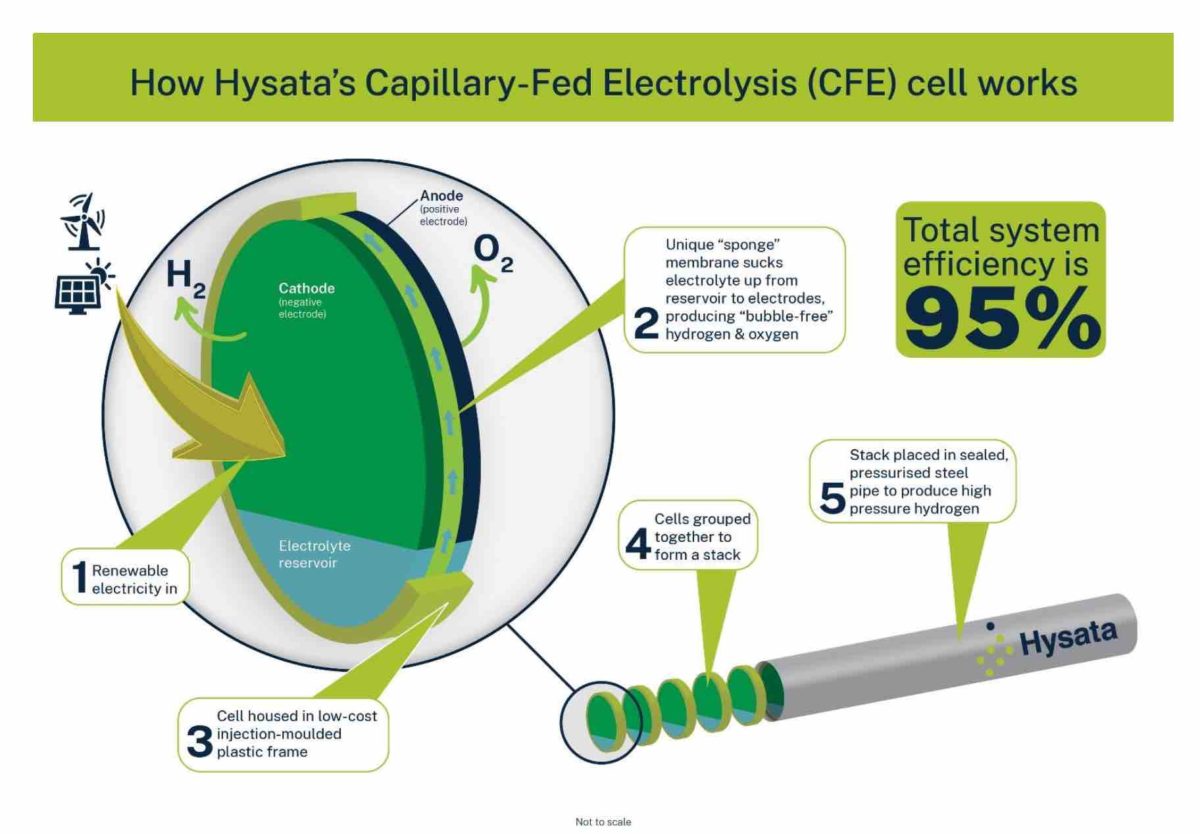
It says that its “capillary-fed electrolysis” (CFE) cell technology is able to deliver green hydrogen at 95 per cent efficiency (its “stack” is 98 per cent, but this translates to 95 per cent with balance of plant), well ahead of the current global average of around 75 per cent or less.
It says that, combined with low supply chain risks and a simple mass manufacturing plan, will deliver a “giant leap” in performance and cost over rival technologie, and puts it on the path to deliver the world’s lowest cost green hydrogen.
The new backers include global wind turbine maker Vestas, which is keen to match green hydrogen technology with its business, along with the venture arm of Australian steel maker Bluescope, which is based in Hysata’s home town.
Others to join the funding include UK-based Kiko Ventures (UK), along with original backers IP Group Australia, and the CEFC, which has tipped in another $10 million to what was its first hydrogen investment.
“Our mission is to redefine the economics of green hydrogen production through our innovative proprietary electrolyser technology,” CEO Paul Barratt says.
“The support of this international syndicate of clean energy practitioners and investors validates our core technology and our approach to scaling and mass manufacture.
“Green hydrogen is a vital energy vector on the world’s path to net zero, critical to decarbonising the hard-to-abate, yet vital, sectors of our economy such as steelmaking, heavy transport, and the chemical industry.”
Barratt says the extensive end use cases for green hydrogen mean it could be a trillion dollar industry, displacing fossil fuels in multiple industries. “The impact our efficiency and system simplicity delivers to customers’ project economics truly moves the needle.”
He told RenewEconomy that the pilot plant will be used to validate the technology, and pave the way for what he hopes will be the first of many gigawatt-scale electrolyser manufacturing plants.
He is “talking to governments” about the location of the pilot and commercial scale plants, and is hopeful that it can be developed in Australia.
“Australia has got a unique opportunity to be a real pioneer and industry leader in green hydrogen, not only an exporter of green hydrogen … but also supporting sovereign capability and electrolyser manufacturing,” Barratt says.
“Just to give you a sense of scale that we need to get to net zero. We don’t need gigawatts, we need terawatts of electrolysers, thousands of gigawatts. So there really is a huge and burgeoning industry that that’s going to explode later in this decade and into 2030.”
The technology is based around the efficient delivery of the electrolyte, in this case fed through a sponge-like material (capillary fed) that eliminates bubbles and delivers the liquid to the point where the electrodes split the water into hydrogen and oxygen.
“It’s a really elegant and simple physics approach to a problem that no one had ever thought of before,” Barratt says.
CEFC CEO Ian Learmonth says green hydrogen will be essential to addressing the hardest to abate sources of emissions.
“We’re excited to see Australian ingenuity providing the technology solutions that will help this industry reach scale,” he said. The CEFC investment was made through its Clean Energy Innovation Fund, which is managed by Virescent Ventures.
Kiko Ventures’ Founding Partner, Robert Trezona, said Hysata has real potential to become a major global clean technology player.
“Having assessed scores of electrolyser technologies in my 20 years in cleantech, Hysata’s technology stands out as a true breakthrough,” Dr Trezona said.
“The company has redefined the core cell architecture for alkaline electrolysis, producing a practical and scalable solution with game changing efficiency. Hysata has the potential to be a globally significant company in the hydrogen economy.” Dr Trezona said.
Australia's most powerful battery now free to trade its full capacity on market after its…
The site of one of Australia's very first wind farms now shows little evidence of…
The "35 by 35" electrification goal has an Australian origin that the government seems to…
If we fail to ensure data centres pay for new renewables and storage to cover…
Home batteries look like resetting the behaviour of households when it comes to responding to…
South Australia energy minister hints that the 100 pct net renewables target may not be…