Image: Dogger Bank
Two declared offshore wind development zones that Peter Dutton has pledged to rescind under a Coalition government have been progressed this week, with federal energy minister Chris Bowen making a final decision on feasibility licences for two proposed multi-billion dollar projects.
Bowen said on Friday he has made final decisions to offer feasibility licences to the 1.2 (GW) Spinifex Offshore project proposed for the Southern Ocean zone off the coast of Victoria and to the 2 GW Novocastrian Wind project proposed for the Hunter offshore zone off the coast of New South Wales.
Both of these offshore wind development zones face being scrapped, however, with the Coalition pledging to rescind their declaration and tear up any associated project contracts if it wins the upcoming federal election.
For now, however, progress on the two zones and the projects proposed for them will move ahead.
For the Spinifex project, Bowen’s decision follows up on a preliminary offer in September last year, gives the all clear developers – Alinta Energy and Jera Nex (Parkwind) – to consult further with Victorian coastal communities and the fishing industry and undertake environmental assessments.
The $4 billion Spinifex wind farm proposes to host between 50 and 75 turbines and would potentially supply 10 per cent of the electricity needs of Victoria – although Alinta has plans to use its output to power the Portland aluminium smelter.
The comparatively small Southern Ocean zone (1,030 km2) was chosen for its access to existing heavy duty transmission infrastructure at the smelter. Spinifex’s planned wind farm will cover just 265 km2 of the declared zone.
The small but important step forward for the Spinifex project’s developers comes just a few weeks after the leader of the opposition stood alongside the the LNP’s federal member for Wannon as he pledged a Dutton Coalition would rescind the Southern Ocean offshore wind zone if elected in May and tear up any contracts connected with it.
In a statement and video message, Tehan accused federal Labor of showing “complete disregard for the people of Warrnambool and Port Fairy in their desperate push to impose a renewables-only electricity grid.”
“Enough is enough,” Tehan says. “A Dutton Coalition government will ensure this bungled project does not proceed.”
In a statement on Friday, Bowen also said that federal Labor was “fixing the broken offshore wind plan left behind by the Coalition,” to deliver the renewable energy Australia’s grid needs along with jobs and an economic boost to the region.
“We back offshore wind because done right it has huge potential for jobs, new industry, and clean, reliable renewable energy in Portland and beyond,” the minister said.
“Peter Dutton prefers to cheer on job losses with his backflip on offshore wind in favour of a $600 billion nuclear scheme that won’t deliver enough power to keep the Portland smelter running and will see the end of regional Victoria’s industry.”
Bowen also stressed that the Spinifex project still must obtain all necessary developmental and environmental approvals before applying for the commercial licence that will allow construction to begin.
He says a newly established Southern Ocean Wind Industry Committee – comprising Spinifex, Victorian and local governments, First Nations groups, local industry and workers’ representatives – will work together to maximise the project’s economic and social benefits.
Bowen has also kicked along proceedings at Victoria’s other offshore wind zone – and the first to be declared in Australian waters – announcing the first management plan has been approved by the independent Offshore Infrastructure Registrar to Blue Mackerel North.
The 1 GW Blue Mackerel North project, which currently holds a feasibility licence in Gippsland offshore wind zone, is another project being led by Japan’s Jera Nex.
Bowen says the management plan paves the way for their next step in assessing the commercial viability of a project, including geotechnical and metocean investigations.
Also in the Gippsland zone, news emerged on Friday that the Star of the South project – Australia’s most advanced offshore wind farm – has partnered with BlueScope to investigate the potential for steel plate made in the Illawarra to be used in boat landings and platforms for the turbine foundations.
The 2.2GW Star of the South project is being developed by Copenhagen Infrastructure Partners, Cbus and its original Australian co-founders Andy Evans, Terry Kallis and Peter Sgardelis off the coast of Gippsland.
The Albanese government awarded Star of the South Major Project Status in December of 2022, at the same time as it officially launched Australia’s domestic offshore wind industry, with the formal declaration of the nation’s first development zone.
“Using Australian made steel in offshore wind is a great step forward for the country and shows the huge opportunity in this industry,” said Wendy Farmer, president of Voices of the Valley and Gippsland organiser with Friends of the Earth.
In the NSW Hunter zone, Bowen’s final offer of a feasibility licence for the up to 2 gigawatt (2GW) Novacastrian project follows up on a preliminary offer made in June of last year.
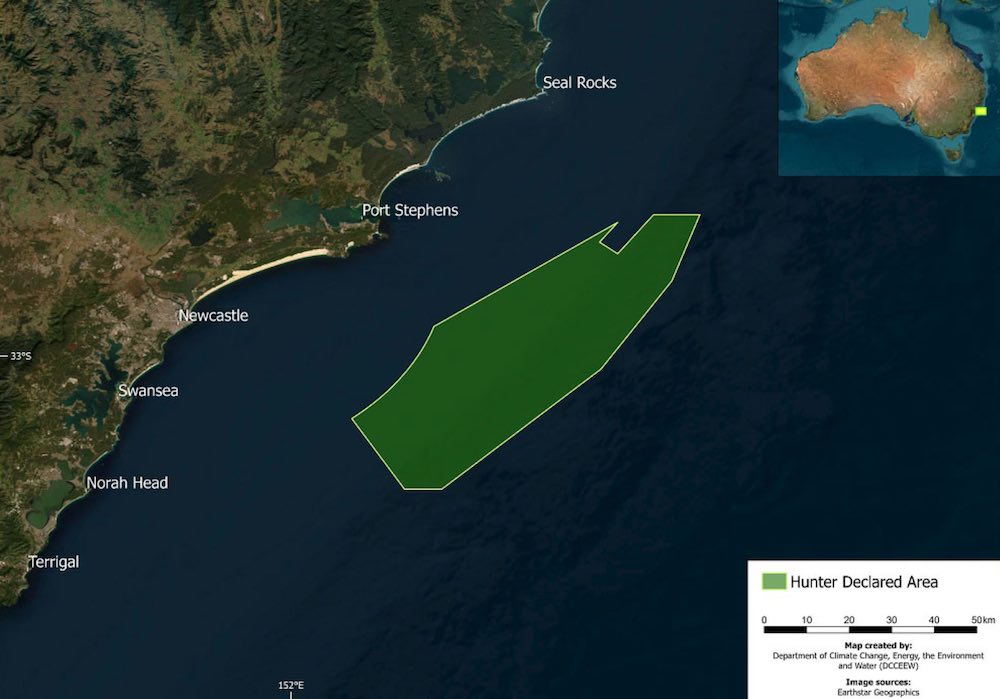
The Hunter offshore wind zone, declared by federal Labor in July last year, is a more than 1,800km2 area that stretches between Swansea and Port Stephens off the coast of the NSW Hunter region.
The Novocastrian project developed by Norwegian energy giant Equinor and Oceanex Energy remains the only project to be awarded a feasibility licence in the Hunter zone so far, and is tipped to be Australia’s first floating offshore wind project.
The Hunter zone, however, is another that Peter Dutton has promised to rescind and “rip up” the $10 billion plans proposed for development there.
“The decision that we’ve taken as a Coalition is to make sure that we rip up these contracts, to make sure that we make it very clear that we will not proceed with the offshore turbines as proposed by the Albanese government,” he said at the time.
The Hunter zone was the first to be declared for NSW and will be the first to host floating offshore wind because of the depth of waters. At just 1,800 km2 – vs roughly 15,000 km2 for the Gippsland zone in Victoria – it is relatively small, having been pared back and pushed to a minimum 20kms out from the coast by Bowen to balance the views of the local community, local industry, and sea users.
The Novocastrian offshore wind farm is proposed for 22 km off the coast of the Hunter and, as Bowen stressed on Friday, will be the only project to be granted a feasibility lincence in the zone.
Bowen says the project has the potential to create hundreds of jobs for workers including engineers, technicians and divers, as well as new opportunities for suppliers and surrounding industry – developers are required to maximise the use of local supply chains, industries and workers.
“We back offshore wind because done right it has huge potential for jobs, new industry, and clean, reliable renewable energy for the Hunter and surrounds,” Bowen said on Friday.
“Peter Dutton prefers to cheer on job losses with his backflip on offshore wind in favour of a $600 billion nuclear scheme that won’t deliver enough power to keep heavy industry running and will see the end of the Hunter as a manufacturing powerhouse.”
Meanwhile, the sole contender for a licence in the Illawarra offshore wind zone, the 1.6 GW South Pacific project being proposed by BlueFloat Energy, has asked for a pause in its application until after the election.
The Illawarra offshore wind zone, also off the cost of NSW, will also require projects to use floating turbine technology due to its deep waters.
Bowen said in a separate statement on Friday that applicant’s request for a pause is due to the “sovereign risk created by Peter Dutton’s reckless and unprincipled opposition to investment and jobs in the renewables sector.
“The Coalition has abandoned its own policy on offshore wind in pursuit of its $600 billion nuclear power agenda that will push power prices up for Australians,” Bowen said.
“Its commitment to scrapping the Illawarra zone will undermine energy security for the region and create operating risks for major energy users.”
ASL outlines plans to structure massive new tenders in ways that supports hybrid projects, with…
Ground-breaking hybrid renewables system installed at an outback opal mining town in South Australia is claiming…
Amid fresh global conflict, the UK government is rolling out new measures to bolster national…
Queensland set two new instantaneous power generation records over the weekend, offering a useful snapshot…
Publicly-owned gentailer completes final concrete turbine foundation at what is the state's first new wind…
The real anathema in the modern Australian economy is not renewable energy, but the idea…