Image Credit: Clean Energy Regulator
A new report released on the first anniversary of the launch of Australia’s Cheaper Home Batteries scheme has confirmed that 2025 was a record smashing year for small-scale storage, with 221,000 residential battery systems installed over the calendar year, adding nearly 5 gigawatt-hours of storage.
This number has since more than doubled – recent updates have put the total number of home battery systems installed through the federal rebate at more than 450,000, and counting, as the scheme ticks over into its second year.
But the Australian Battery Marker Report, published on Wednesday by SunWiz, documents a year where home batteries hit the mainstream and fundamentally changed the course of the consumer energy revolution.
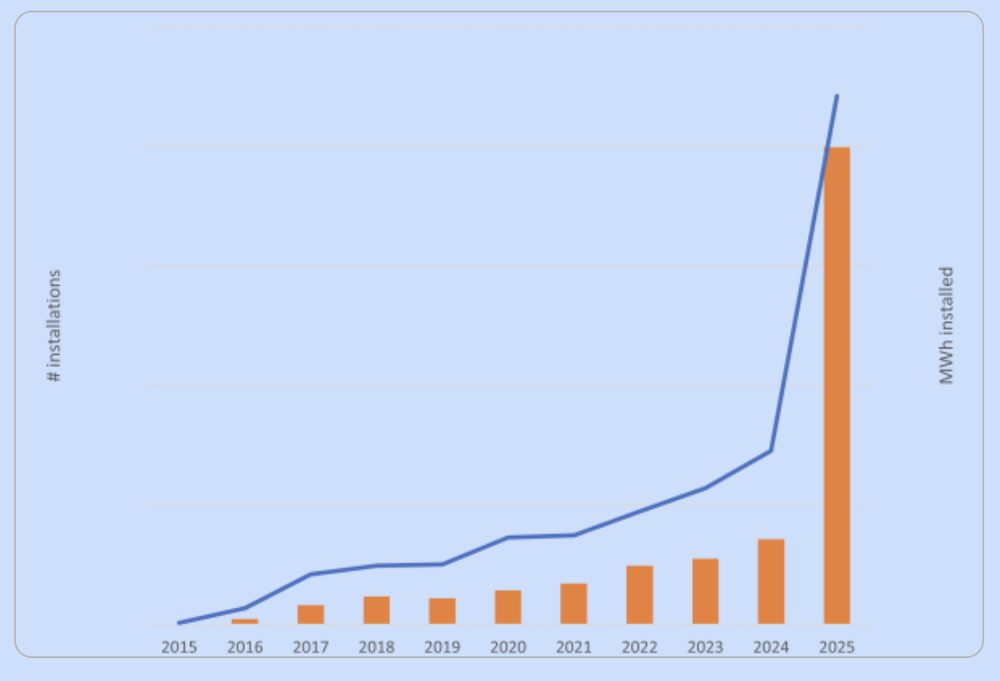
In total, SunWiz says 221,000 systems were installed in 2025, compared with 72,500 the previous year, delivering an additional 4,790 megawatt-hours (MWh) of new storage capacity to the grid.
Source: SunWiz
This, says the report, is equivalent to powering around 1.2 million homes over the four-hour evening peak period, or around 25 times the capacity of the Hornsdale Power Reserve – the world’s first ever big battery, installed in South Australia nearly a decade ago.
Most of the record new home battery capacity, of course, was installed in the second half of year, following the July 2025 launch of federal Labor’s Cheaper Home Battery rebate, the success of which has exceeded all expectations and led to the scheme being adjusted to make it last longer and go further.
“[This] wasn’t just a growth year for Australian batteries – it was a market transformation,” the report says. “We’re talking a threefold increase in system count and a fivefold increase in capacity versus 2024.”
“2025 … was the year [home batteries] went mainstream,” adds SunWiz founder and managing director, Warwick Johnston.
Across the states, New South Wales led on home battery installs with more than 76,000 new systems, representing more than a third of the country. Queensland, meanwhile, overtook Victoria with 19 per cent of installations compared to Victoria’s 18 per cent.
All told, nearly 5 per cent (4.6%) of Australian homes had a battery installed by the end of the year, and 13 per cent of all of the nation’s rooftop solar systems had added a battery.
2025 was also the year that Australian households fundamentally changed how they ‘do’ battery storage; system sizes nearly doubled, the battery-to-solar attachment rate soared, and people also started boosting the amount of rooftop solar they have, to fill their super-sized batteries.
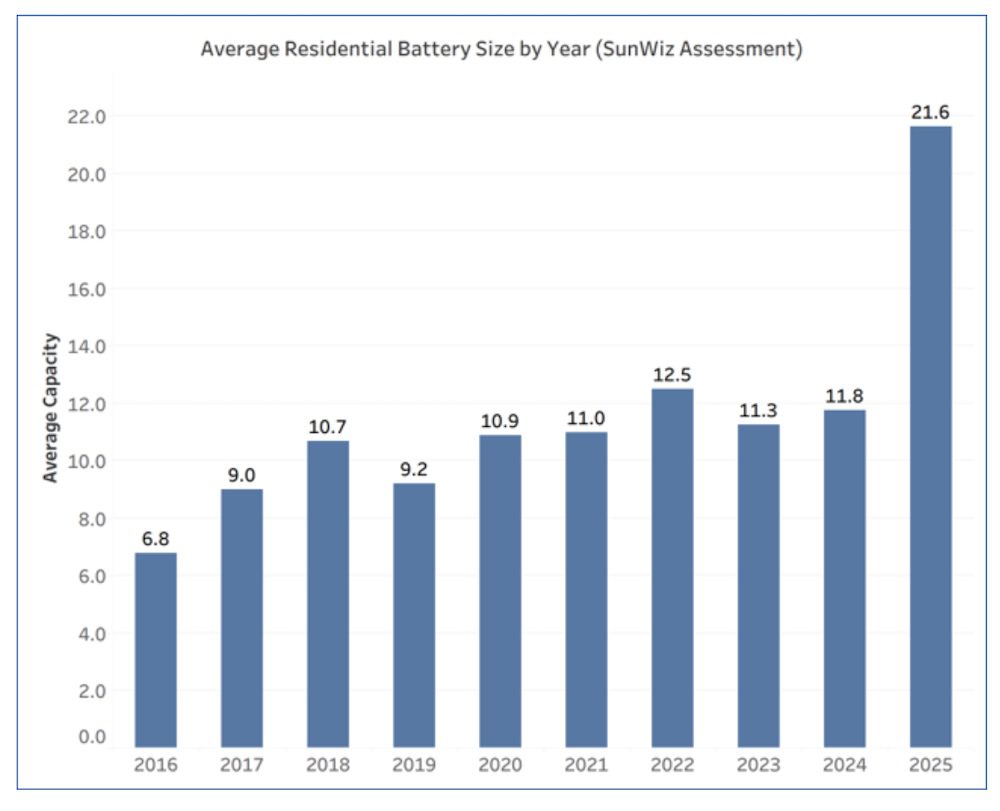
Over the course of 2025, the average battery size jumped to 21.6 kilowatt-hours (kWh) compared with 11.8 kWh the year before, the report says.
Source: SunWiz
“It’s telling that while installations have increased threefold, capacity has increased fivefold,” says Johnston.
“Australian homes are benefiting from more modern and larger battery systems that are supporting the country’s emissions goals and their own back pockets at a time when energy costs have become such a major national concern.”
2025 was also the year that households were given a whole lot more choice on battery brands and offerings. The report names China-based Sigenergy as market leader by the end of the year, having only entered the local market in 2024. Fox ESS also re-entered the Australian market and by year’s end had captured 10 per cent of market share per kWh, while Tesla and BYD continued to slide.
Looking ahead, SunWiz forecasts continued momentum, and is predicting that a new record of 350,000 home batteries will be added in 2026 across the country.
“We’re looking at years of higher energy costs and uncertainty over those costs,” says Johnston. “That motivates Australian families to secure their own electricity supply.
“We anticipate installation volumes to 2030 will be shaped by the interplay of declining rebates, falling battery costs, rising electricity prices, and rising demand for energy self-sufficiently. On balance, these forces point to sustained demand. The boom is far from over.”
If you would like to join more than 29,000 others and get the latest clean energy news delivered straight to your inbox, for free, please click here to subscribe to our free daily newsletter.
Middle of the day wholesale electricity prices are rising, and prices in the evening peak…
UNSW groups set new perovskite efficiency record but the real secret sauce is a new…
Envision Australia’s Peter Cowling talks their plans and the state of the energy transition.
Australia can now boast of record amounts of wind farm construction starts this year, but…
Andrew Forrest-owned Squadron wants to build a massive wind farm in western Victoria and connect…
A sunny Spring has delivered two new output records for rooftop solar in two Australian…