Powin's 72MW, 4.5 hour California 6 battery.
Remember when the first “Tesla big battery” at Hornsdale was connected to the grid in South Australia in 2017? It was the first of its kind in the world, but few would have predicted the astonishing growth of the technology across the world in the years since.
Australia led the world in the uptake of battery storage – at least for a while – and remains in the forefront in the integration of big batteries on the grid, particularly in their ability to soak up rooftop solar, act as giant shock absorbers, and provide key grid services such as inertia and system strength.
But in sheer capacity Australia has been overtaken, in a major way, by California, the state where those first Tesla battery packs at Hornsdale were made.
Australia a week ago (Wednesday, March 5) posted a new record for battery output – a total of 1.22 gigawatts – at 6.45 pm, right in the evening peak. That’s what the batteries not otherwise providing grid services are expected, and paid, to do.
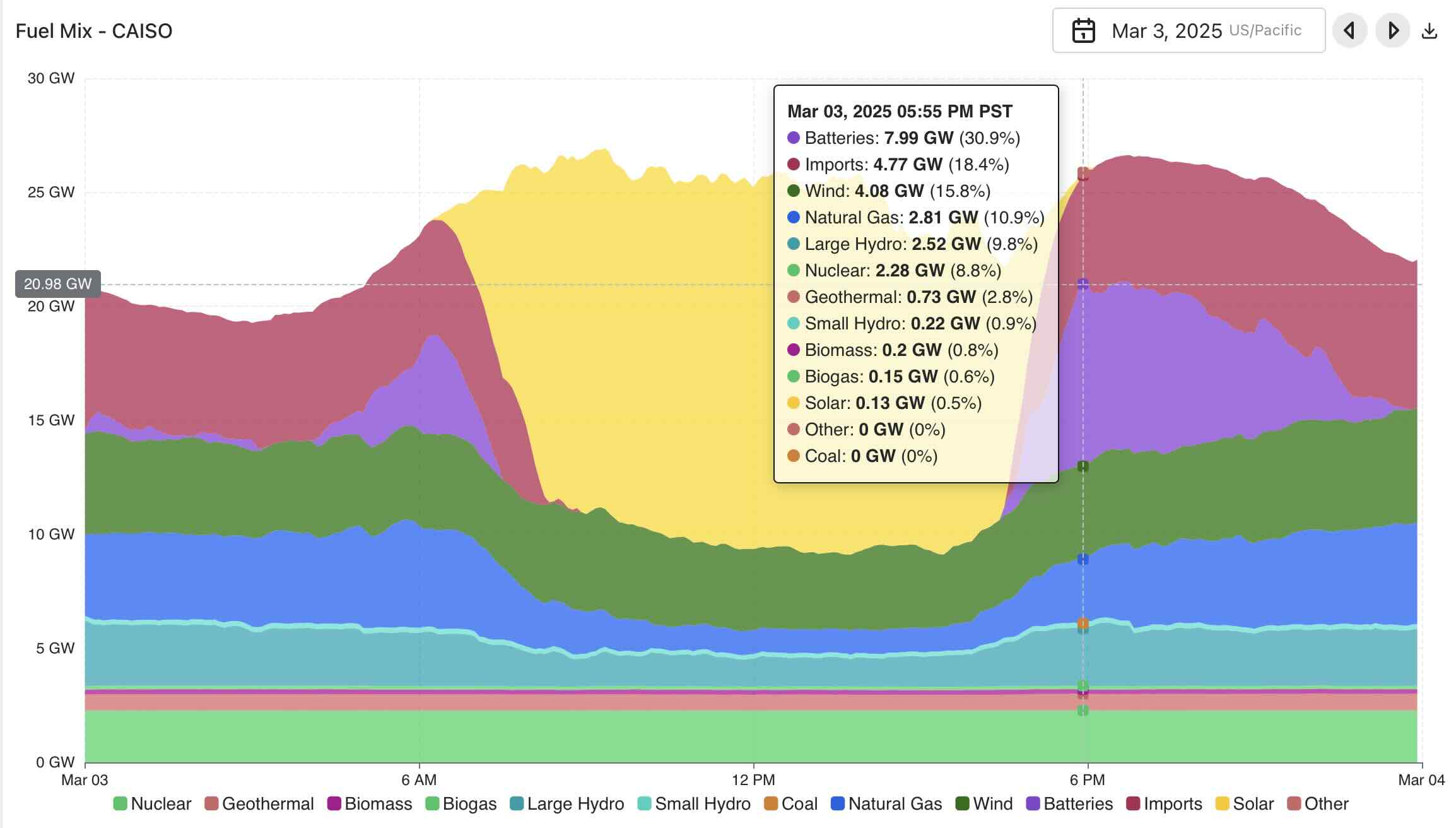
But while that signifies huge growth over the output record a year earlier (784 MW), it is just a fraction of what is being seen in states such as California, where the peak battery discharge has reached 8.35 GW and the record share of battery storage in meeting the evening peak is 31 per cent.
Source: Grid Status
This is what that battery share record looks like (graph above). Battery storage is the biggest single source of power in the critical evening peaks, while solar dominates the output during the middle of the day.
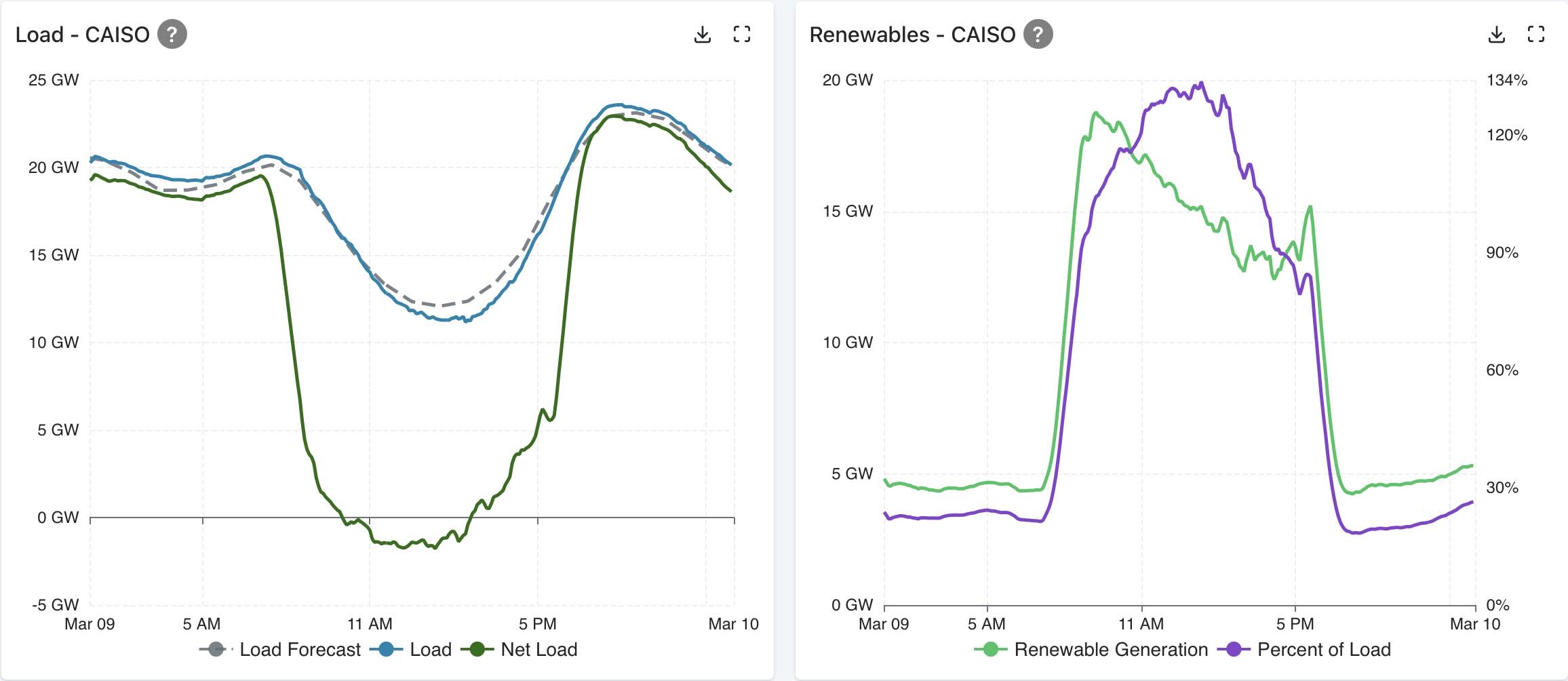
What that graph does not readily illustrate is the impact of solar on the grid and the role that battery storage has in taming it and absorbing it so it can be distributed into that evening peak.
This is what that looks like (graphs below). In Australia, we often celebrate the fact that wind and solar in South Australia regularly meet more than 100 per cent of state demand, with the excess either exported, stored, or curtailed.
In California, a grid 10 times bigger than South Australia, it also happens regularly. In this graph from a few days ago, renewables meets a peak of 134 per cent of demand, while net load falls below zero, with the excess being mopped up by battery storage, which on this day peaked at a maximum battery charge of 7 GW.
California is not the only state in the US that dwarfs Australia on battery storage. Texas, which is rolling out new solar and storage at phenomenal rates, recently hit a battery discharge peak of 4.8 GW, and a demand share of 10 per cent.
That was fortunate, because Texas had about 24 GW of thermal plants offline due to maintenance – about the equivalent of Australia’s entire baseload thermal fleet.
Update: On Tuesday, March 11, the instantaneous battery charge in the state of Victoria set a new record of -592.9 MW, at 2.40pm in the afternoon, according to Geoff Eldridge of GPE NEMLog.
This is nearly 50 per cent more than the year ago record of -397 MW , and reflects the addition of the new Rangebank battery. The biggest contributors to the new record were the Victorian Big Battery (-235 MW), the Rangebank BESS (-200 MW) and the Hazelwood BESS (-147 MW).
A prototype wind turbine using "self-erecting" tower technology is running at full capacity, ahead of…
Battery component of solar and storage facility joins the grid, part of a boom that…
Germany wants to build the world's first fusion power plant, and scientists say that might…
Government seeks expressions of interest to partner in delivering at least three new synchronous condensers…
Until recently, I had little interest in purchasing a household battery. I am now one…
Senate inquiry uncovers countless instances where misinformation – and often disinformation – is affecting public…