Image: AGL Energy LinkedIn
Investment in large-scale storage projects has soared in Australia over the last 12 months, despite a near complete stalling of new wind and solar projects.
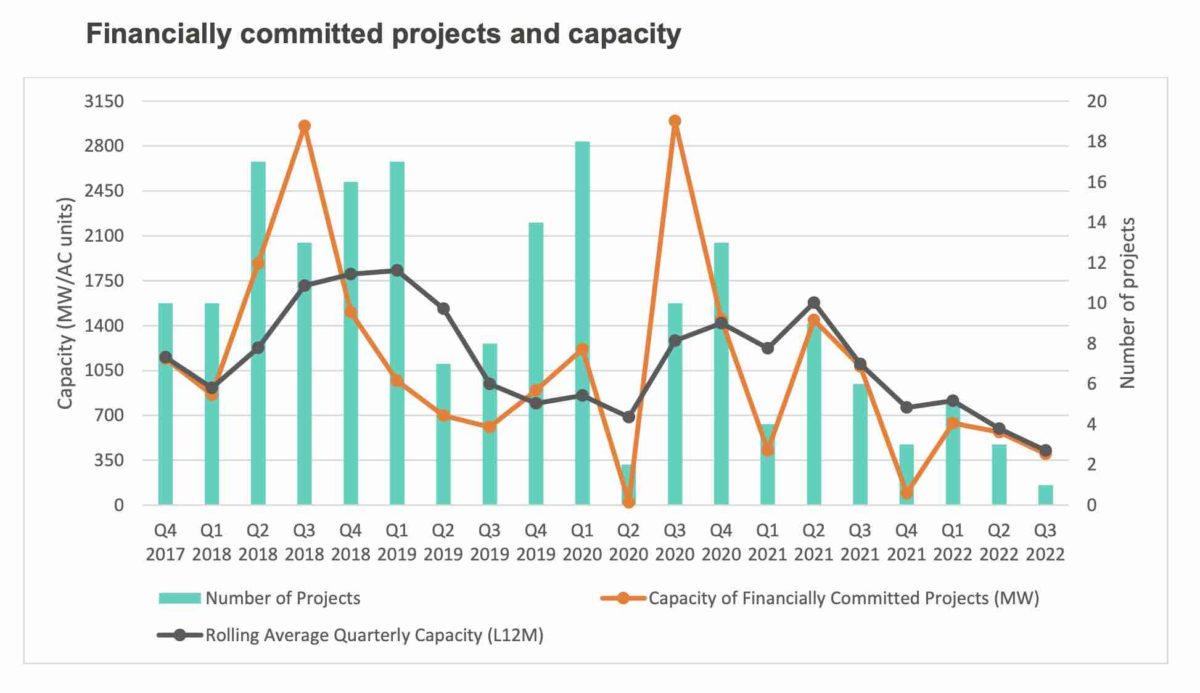
According to the new quarterly report released by the Clean Energy Council, a total of 14 new storage projects worth more than $2 billion were committed in the latest quarter, but it was the only bright spot in a report that showed only one new renewable energy project reach financial close in the third quarter.
That project is the 400MW Stobbo solar farm in NSW, and represents a significant fall over the previous quarter and the year ago period.
The Australian Energy Regulator has also noted the lowest amount of new connections in 2022 for five years, just at a time when the country needs to accelerate its new capacity to at least 4GW a year.
The CEC report reveals the rolling quarterly average of financially closed new renewable energy projects over the last 12 months has fallen by 28.7% to 426MW, the lowest level since data collection began in the fourth quarter of 2017.
A total of three new projects began construction in the third quarter, totalling 902MW of capacity, while two projects were commissioned, with a combined total of 127MW.
And, despite the fact that its 12-month rolling average is so healthy, only one energy storage project reached financial close in the third quarter, the 200MWh storage facility that will be co-located at the Stubbo Solar Farm.
However, two new storage projects began construction in the third quarter, representing 235MWh of new capacity.
“We must provide the firming capacity needed to complement solar and wind generation and supply crucial system services such as system strength and inertia,” said Thornton.
“Storage can also drastically improve the transmission economics by acting as a ‘shock absorber’ that allows much more clean, low-cost renewable energy to flow across the grid to consumers.”
“This report also makes it abundantly clear that Australia’s clean energy transition has been throttled by years of policy uncertainty” says Thornton.
“Industry confidence to invest is growing, aided by clearer and more potent policy directions across the country, but the investment trend over the past year shows that we need a sustained focus on the energy transition from all governments.
“We need to see more projects coming more quickly through state planning systems and policy settings that send consistent signals for ongoing investment.
“Finally, we need to fix the connection and commissioning process to get projects through all the hurdles and actually start producing power. The connection process was designed years ago to account for a few hundred megawatts connecting every few years.”
Australia is in the grip of a global fossil fuel crisis. It knows it has…
CEO of global wind giant says bipartisan agreement needed if local manufacturing is to be…
We face some big challenges. To what extent should we protect businesses designed to operate…
Australia needs to apply a new lens of green energy and industry statecraft, including developing…
We talk to Jeff Monday from Fluence on the fall in battery costs and the…
Independent Planning Commission gives approval to gigawatt-scale standalone battery project just three months after it…