Victoria Big Battery. Image: Neoen
Australia’s growing fleet of big batteries, and its rejuvenated of pumped hydro storage, enjoyed record revenues from energy market volatility in the June quarter, but they were nowhere to be seen when the price cap was imposed and the market suspended.
Big batteries are relatively new to the Australian grid – the Tesla big battery only began operations in late 2017 – and have mostly been short-duration and focused on providing grid services such as frequency control and network support, where they have achieved great success, and made lots of money.
But until recently there hasn’t been much money to be made in the “arbitrage market”, buying electricity at the spot price when it is low, and selling it at higher prices when demand rises and supply dwindles. In the June quarter, that all changed.
The Australian Energy Market Operator’s latest Quarterly Energy Dynamics report shows that market volatility were at record levels in the June quarter, even though the number of negative pricing events in key markets were at their lowest levels for many years.
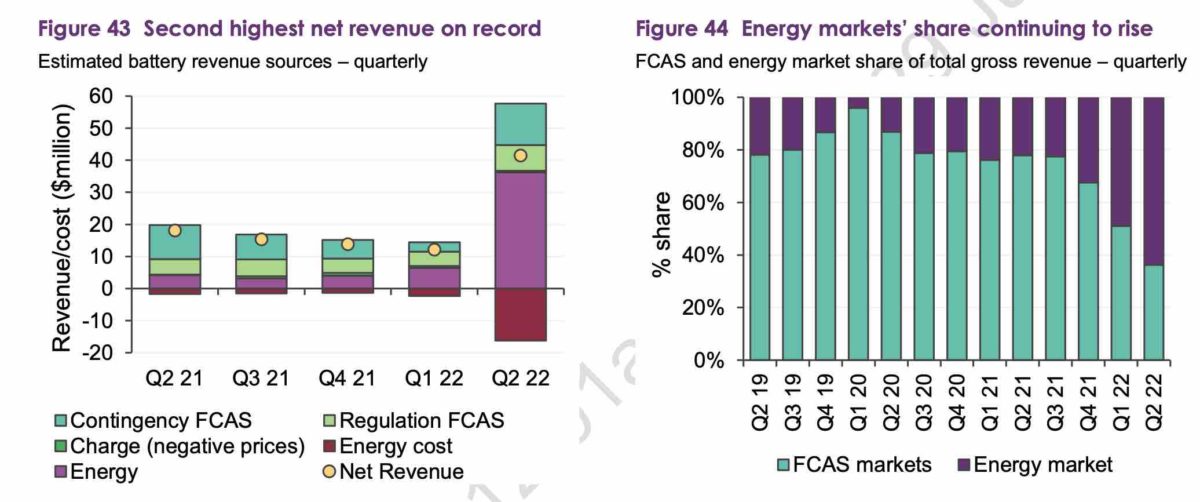
That helped battery storage achieve market revenue of $41 million in the June quarter, the second highest on record. But rather than coming from the FCAS market, most of it was sourced from energy arbitrage.
According to AEMO, the proportion of total gross revenue from the energy markets continued its recent trend upwards from 49 per cent in the March quarter to 64 per cent in the June quarter, supplanting FCAS markets as the primary source of battery revenue for the first time.
The higher energy market revenue reflected increased battery dispatch volume, particularly in Victoria where the Victoria Big Battery, the biggest in the country, started operations last year, as well as a significant increase spot prices.
AEMO noted the impact of the Victoria Big Battery in this quarter, when it was not constrained by its contract to supply network protection in the summer months. That allows it to deploy its full 300MW/450MWh capacity in the energy and FCAS markets.
In Queensland, a $4.5 million increase in battery storage revenues was mostly due to the ramp up of operations at the state’s first big battery, the 100MW/150MWh Wandoan big battery. That battery was only enabled for FCAS markets on June 21.
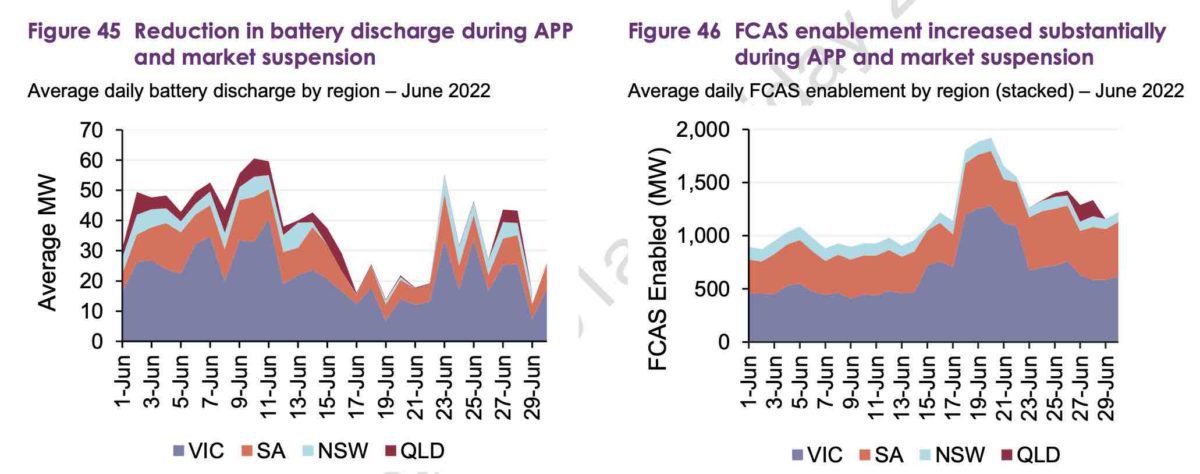
The administered price cap, however, changed the game for big batteries. Activities in the arbitrage market dried up, because there was no longer much volatility, and the focus switched back to the FCAS market.
Pumped hydro also enjoyed record revenue in the June quarter of $61 million, driven by revenue increases at both the Wivenhoe (Queensland) and Shoalhaven (NSW) facilities which contributed $15 million and
$12 million, respectively.
AEMO did not discuss what the pumped hydro power stations did during the price cap and market suspension.
See also RenewEconomy’s Big Battery Storage Map of Australia
And: AEMO urges quicker shift to renewables amid coal failures and soaring fossil fuel costs
And: “Opportunity cost:” The role played by Snowy’s hydro plants in market crisis
Panelists at energy summit in Sydney warn the impact of losing bipartisan support for big…
A four-hour big battery proposed for construction in state's south-east is seeking a federal green…
The Octopus Investments battery has approval for up to 2 GWh, making it one of…
AGL chief nixes the idea that the company would ever be building coal-fired power stations…
One of Australia’s oldest continuously working wind farms, and a vital ingredient of a world-leading…
New funding will help establish manufacturing facilities for two automated technologies – robots that install…