We know Australia is leading the world in per capita uptake of rooftop solar, with total installed capacity on homes and businesses this year soaring past the 6GW mark.
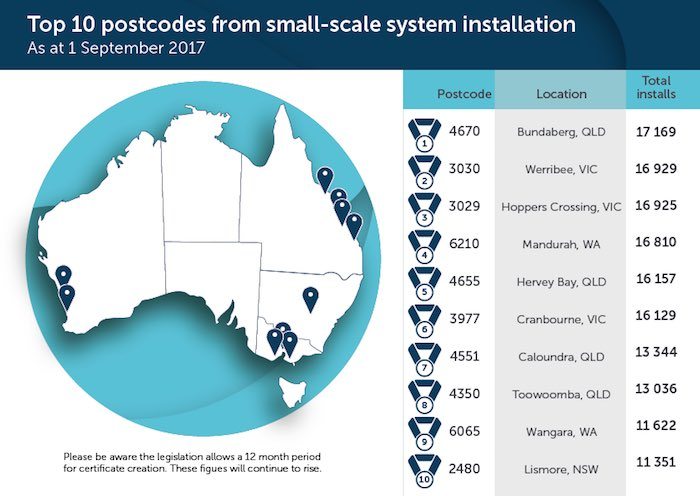
But which parts of Australia are leading the country? New data from the Clean Energy Regulator has revealed the latest ranking of Australia’s top 10 postcodes for small-scale solar installation (up to 100kW), with some interesting new additions.
As you can see below, the list this year features a few new entries, and a more diverse spread across the states, instead of being dominated by Queensland and Western Australia locales.
Both the new entries and the old stagers on the list span the suburban, regional and rural areas of Victoria, New South Wales, Queensland and Western Australia, with no entries this year from South Australia, Tasmania, the ACT or the Northern Territory.
In order from the top, the Queensland town of Bundaberg has again secured the number one spot, followed by new entries on the list, the Victorian suburbs of Werribee and Hoppers Crossing. Last year, no Victorian postcodes made the top 10.
According to the CER data, these three postcodes have accumulated the highest number of small-scale renewable energy installations since the small-scale renewable energy scheme began in 2001, each reaching around 17 000 installations as at 1 September 2017.
In fourth place, down from second place last year, is the WA suburb of Mandurah, where the local council is also pushing hard to install PV on government buildings – and just last week agreed to install a 200kW (not a part of the SRES) system at the local pool and sports centre.
The Queensland suburb of Hervey Bay follows, moving to fifth place from third last year. And another Victorian new entry, the semi-rural south-eastern suburb of Cranbourne, is in sixth place.
Bringing up the rear are regular place holders Caloundra and Toowoomba in Queensland, and new entries Wangara (WA) and Lismore (NSW), the latter of which makes the list probably due to the May switching-on of a 99kW rooftop PV system at the Goonellabah Sports & Aquatic Centre, as part of a major community-based and funded renewables campaign.
Despite some bigger commercial installations coming into play, the CER says the average size of the solar postcode installations is 5kW – which is also the average size, now, of a household rooftop solar system. This indicates the dominance, still, of residential uptake in these numbers, considering the SRES encourages commercial systems, too – up to 100kW in size.
“Over the last 10 years, 23 per cent more Australians have embraced rooftop solar,” the CER said in a release on Monday. “That’s one in five homes and businesses now generating their own renewable energy and reducing carbon emissions through rooftop solar.
As we reported here, Australia hit a milestone of 6000 megawatt (6GW) capacity across 2.8 million small-scale installations of renewable energy systems such as solar PV, solar water heaters and air source heat pumps. Nearly 100MW was installed in August, alone.
Interestingly, while no South Australian suburbs on their own make the list, the entire state is setting all sorts of solar records, including a new record low for minimum demand – barely a week after the previous benchmark was set – with a fall to just 587MW on Sunday afternoon.
As Giles Parkinson notes, the record eclipsed the previous mark by nearly 200MW – with AEMO data showing minimum demand at 1.30pm of exactly 587.8MW, compared with the previous low mark of 786.42MW posted last Sunday – thanks to moderate spring temperatures, combined with the state’s more than 700MW of rooftop solar producing 538.54MW at the time of minimum demand.
“That is a phenomenal share of 47.8 per cent of the state’s electricity demand being met by rooftop solar (compares with 36 per cent in the previous record last week) and is clearly a record for South Australia, and for that matter in any large grid anywhere in the world,” Parkinson says.
Below is the list of last year’s Top 10 solar postcodes:
Capacity in upcoming renewable and storage tenders under the CIS to be reserved for projects…
Renewables described as not only the cheapest new power source around the world, but also…
Network owner says it pursued winding up of Zen Energy due to outstanding debts, as…
One of the biggest solar and battery projects Victoria has been sold to Swedish renewables…
Farming family wants to host solar and battery project to underpin and co-exist with farming…
Regulator bans another company from state's energy upgrades program, because of falsified photos used to…