Photo: Giles Parkinson.
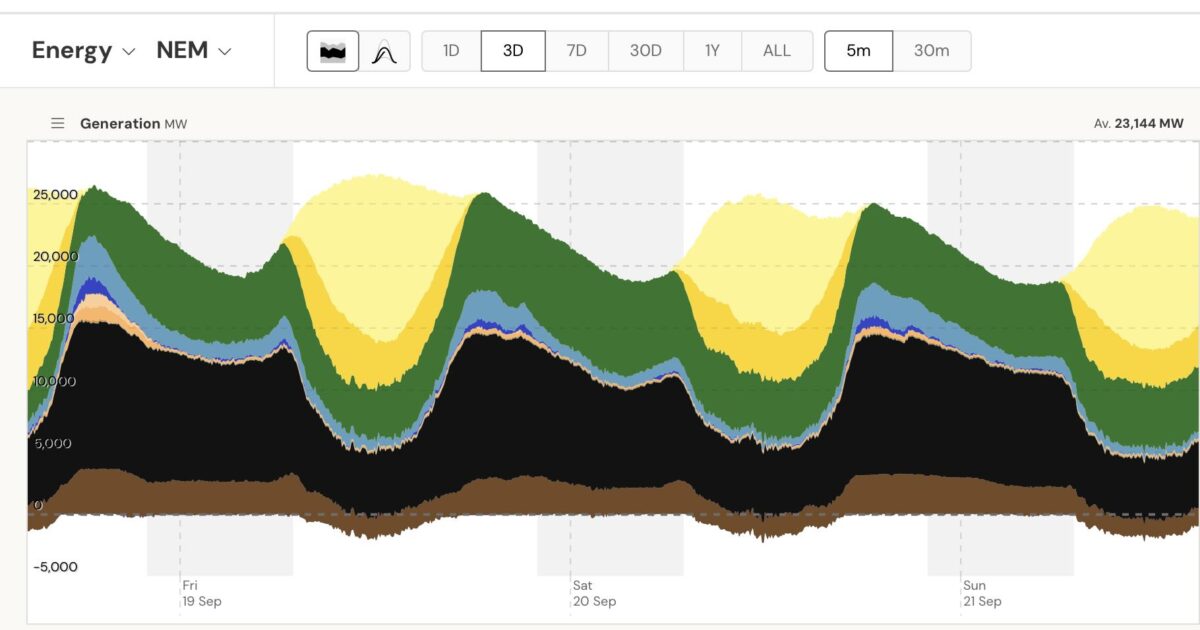
Australia’s main grid reached a new renewable record share of 78.6 per cent on Monday – the third time in 72 hours that the record has been broken. But the milestone was overshadowed by an even more spectacular achievement in South Australia, which reached a new peak of 155.3 per cent renewable share later on Sunday.
The new peak share for the main grid, known as the National Electricity Market, was reached at 11.50am on Monday, according to GPE NEMLog, beating a new peak of 77.8 per cent set around the same time on Sunday, and the 76.8 per cent record that had been set at 12.20pm on Friday.
These new records usually occur in spring – due to the good conditions and mild temperatures – and in the middle of the day because they are also mostly driven by large amounts of rooftop solar generation, which on this occasion accounted for more than 43 per cent of grid demand.
The share might have been higher but large amounts – nearly 3.6 gigawatts on Monday and more than 5 GW on Monday – of potential large scale wind and solar output were curtailed at the time of the records, mostly due to negative wholesale prices.
If that supply had not been curtailed it would have taken the renewable share beyond 90 per cent on both occasions, although that would have also required more coal and gas to switch off – or a lot more storage capacity. The wholesale price is usually forced into negative territory by coal fired power stations because they do not want to switch off.
Source: Open Electricity.
The Australian Energy Market Operator has said it aims to accommodate 100 per cent instant penetration of renewables – and had hoped to reach that milestone in 2025 – but it still needs to complete its engineering groundwork to allow that to happen.
“Our goal is to co-design and co-engineer the NEM and the WEM to manage 100% instantaneous penetration of renewables at any moment on any day by 2025,” it says on its website.
According to AEMO, the highest penetration of renewables remains 75.9 per cent, reached in November last year, but that relates to a 30 minute interval, rather than the five minute intervals identified by data services such as GPE NEMlog, Open Electricity and others.
It’s been a strong week for renewables across Australia, one way or another.
In South Australia, the world’s most advanced renewable grid with the highest penetration of wind and solar, the new record of 155.3 per cent was reached at 2.20pm on Sunday, and beat a record of 150.7 per cent that had stood since September last year.
South Australia, which aims to reach an average of 100 per cent “net” renewables by 2027, is able to reach such high figures because it can export to neighbouring states, and has a growing fleet of big batteries. It also has added its biggest wind farm, the 412.5 MW Goyder South facility, to its fleet since last year.
That share of generation is expected to hit new peaks as more wind and solar farms are built, the new transmission link to NSW is complete, and as more big batteries are completed. There are currently eight under construction in the state at the moment.
Over in Western Australia, the largest standalone grid in the world, the penetration of renewables reached 83 per cent this week, not quite a record (that remains 85.1 per cent in November last year), but still remarkable given the W.A. grid has no connections to any other state or country, and only three big batteries.
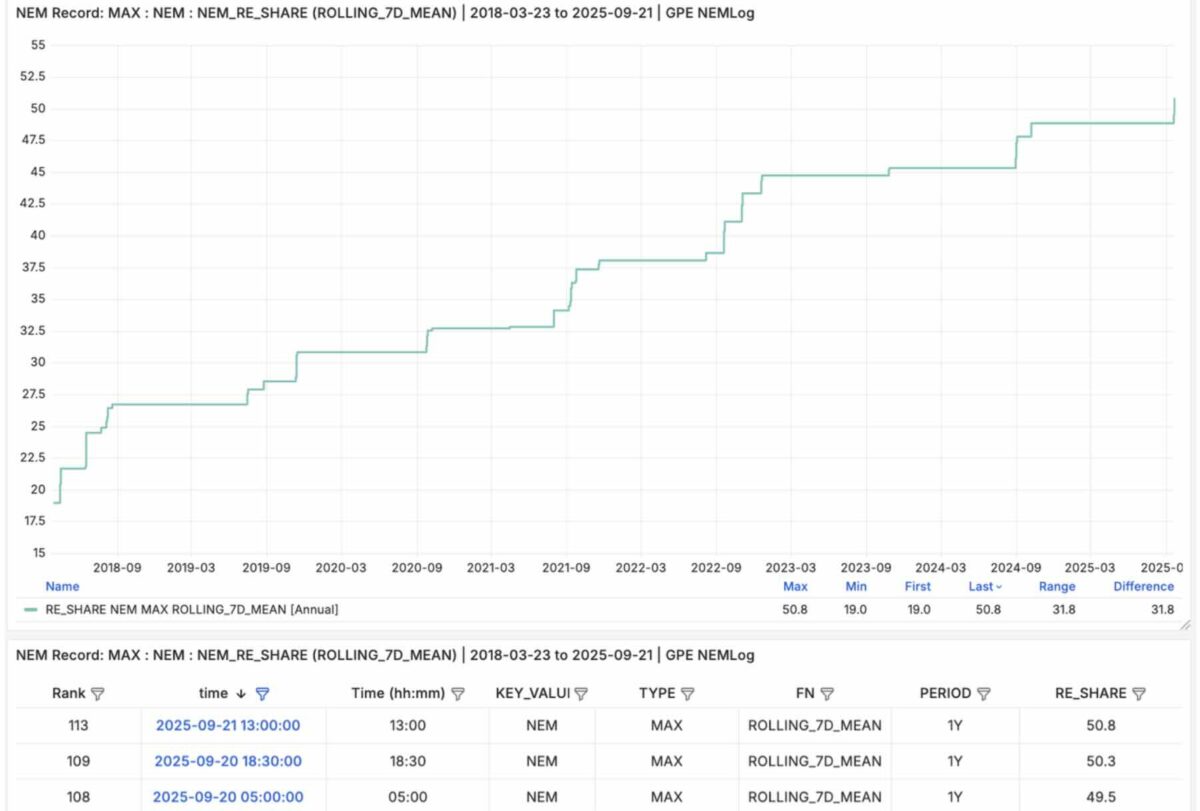
In Australia’s main grid, known as the National Electricity Market, the record for rolling seven day mean penetration of renewables was broken for the third time in three days on Sunday, to a new peak of 50.8 per cent, beating the 50.3 per cent share set on Saturday and the 49.5 per cent share set on Friday.
GPE NEMLog’s Geoff Eldridge confirmed to Renew Economy that this was a first of more than 50 per cent for renewables in the grid over a rolling 7-day period. He expects the record to be broken again later on Sunday or Monday.
Source: GPE NEMLog
In 2018, as the graph above illustrates, the record stood at less than 20 per cent.
The average share of renewables in the past 12 months on the NEM is just under 42 per cent, still just halfway to the federal government target of 82 per cent by 2030.
(Note: Story updated to give more information about the 7-day rolling record, and the new record in South Australia).
Want the latest clean energy news delivered straight to your inbox? Join more than 26,000 others and subscribe to our free daily newsletter.
Electricity retailers with their own version of Solar Sharer offer bigger power bill savings than…
Sea surface temperatures are now way ahead of previous levels at this time of the…
When Greens elder Bob Brown addressed a throng of forest campaigners on Saturday, he did…
One of Australia's landmark renewable energy "gen-tailers" is reportedly up for sale, with its major…
Large-scale solar curtailment was "reduced significantly" in August as batteries help prevent electrons from going…
Seven home battery models from one of the up and coming new budget brands on…