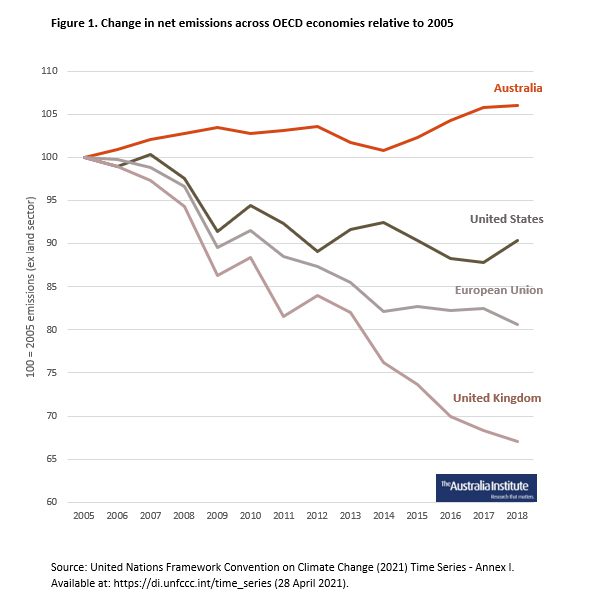
Australia is not achieving reductions in emissions at a level comparable to international peers, and has largely relied on ‘accounting tricks’ to meet its international targets, new analysis of Australia’s emissions data suggests.
The analysis published by The Australia Institute on Monday shows that while Australia’s overall greenhouse gas emissions have fallen by 19 per cent since 2005, very little of this reduction is the result of Morrison government policy, or from reductions in emissions from economic activity.
Indeed, when land use are excluded, emissions across the rest of the Australian economy have increased by 7 per cent since 2005, the analysis found.
The TAI’s head of climate and energy, Richie Merzian, says Australia’s greenhouse gas emissions are going up rather than down, and prime minister Scott Morrison’s claims that Australia was on track to deliver reductions comparable to other countries did not stack up.
“In the face of increased scrutiny and pressure, and absence of any real climate policy, the Australian Government is increasingly relying on accounting tricks that superficially demonstrate a solid performance on climate action,” Merzian said.
TAI’s analysis shows that Australia had been heavily reliant on reductions in land use emissions in the early 1990s – that related to significant reductions in land clearing that were achieved under the Hawke government – that had suppressed Australia’s overall greenhouse gas emissions in international reporting.
“Negotiators knew deforestation had declined sharply since 1990 and that including deforestation in the base year would enable Australia to claim credit for emissions reductions that had already occurred and were largely unrelated to policy changes,” the report says. “The international community relented to get Australia’s support for the [Kyoto] Protocol.”
When these emissions are excluded from Australia’s greenhouse gas accounts, data shows that Australia’s overall greenhouse gas emissions have been increasing since 2005 – while emissions from Australia’s major trading partners have been steadily decreasing.
“The Australian government is taking credit for changes in the land sector, that have not been impacted by any federal climate policy. By contrast, key allies like the United Kingdom and United States have decreased their net emissions and are exercising real credible climate leadership,” Merzian said.
Federal minister for energy and emissions reduction, Angus Taylor, has repeatedly said that Australia was on track to ‘meet and beat’ its 2030 target, to cut emissions by between 26 and 28 per cent from 2005 levels.
The most recent emissions projections published by the federal government showed that Australia was on track to fall short of this target, predicted to to fall to just 22 per cent below 2005 levels. However, under a hypothetical scenario aligned with the Technology Investment Roadmap, the government suggests that emissions could fall by as much as 29 per cent.
Ironically, the Morrison government will seek to fund the development of its preferred technologies, identified in its Technology Investment Roadmap and including carbon capture and storage, hydrogen and soil carbon, by tapping into funds that had already been set aside for renewable energy research and administered by the Australian Renewable Energy Agency.
While there have been steady decreases in emissions in the electricity sector, as a result of the growing share of power supplied by wind and solar projects, these reductions have largely been offset by increasing emissions from the extraction and processing of fossil gas, and increasing transport emissions.
In recent years, reductions in Australia’s overall emissions have largely been driven by the temporary impacts of drought – which had reduce agricultural emissions – and the impact of the Covid-19 pandemic on transport emissions.
In each case, the Australia Institute says, the reductions in emissions have not been the result of the policies of the Morrison government.
“The harsh truth is that the Australian economy has not decarbonised over the last 15 years. This might explain why the Australian Government has been so reluctant to commit to a net zero target when the economy is headed in the wrong direction,” Merzian said.
“The Australian Government is shirking its responsibly to decarbonise, and this unfair stance will only put more pressure, and cause more tension, with other countries that will be forced to further reduce their emissions to keep the climate at a safe level.”
The powers of the resources minister to change how much a gas exporter must quarantine…
Snowy Hydro says latest cost reveal of Snowy 2.0 pumped hydro project is imminent, says…
AEMO boss says big and small batteries are lowering prices and changing nature of grid,…
Panelists at energy summit in Sydney warn the impact of losing bipartisan support for big…
A four-hour big battery proposed for construction in state's south-east is seeking a federal green…
The Octopus Investments battery has approval for up to 2 GWh, making it one of…