Image: Still from Engie livestream video
A survey has found that the majority of Australians support replacing fossil fuels with a mix of firmed renewable energy, but few are aware how soon the nation’s remaining coal power generators are scheduled to shut down.
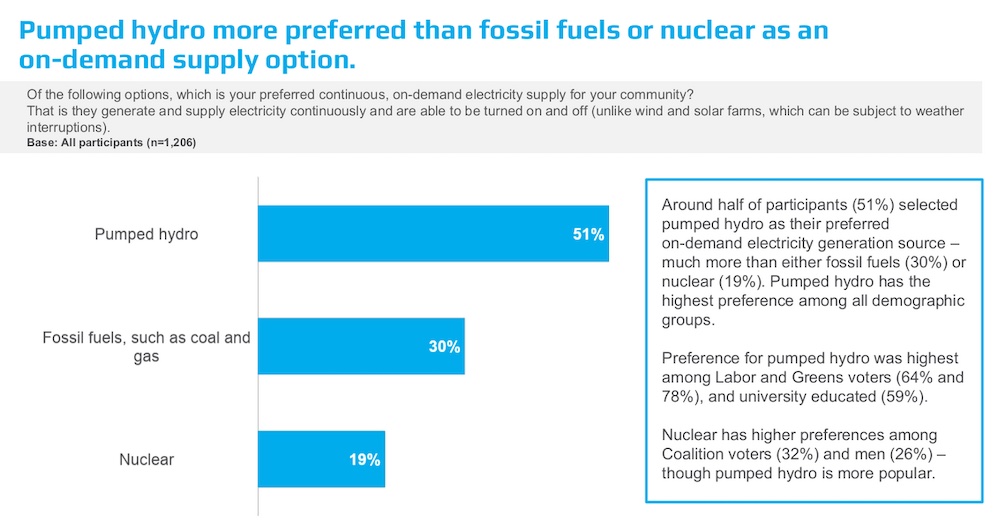
The Essential poll of of 1,200 voting age Australians also found that a significant majority of respondents reject nuclear energy (81%) or fossil fuel-based options (70%) to provide on-demand or back-up energy – opting instead for pumped hydro, despite having limited knowledge of how it works.
The research, conducted as part three of Zen Energy’s This is Transition project, found a high level of awareness that federal and state governments are supporting and subsidising the transition to renewables, but also that most people remain very sketchy on the details.
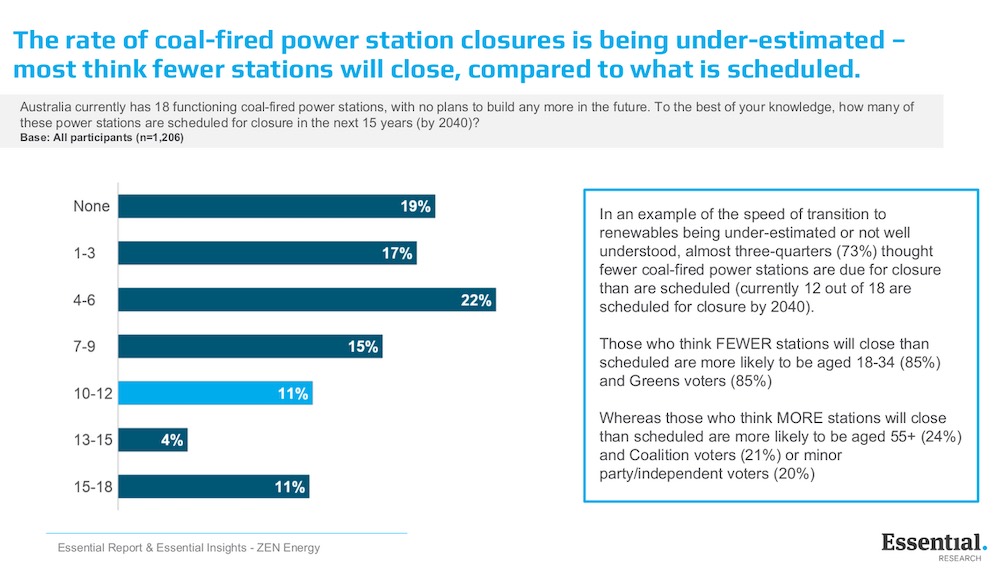
Asked how many of Australia’s 18 operational coal plants are due to shut down over the coming 15 years, almost three-quarters or 73 per cent of respondents underestimated the current number, which is 12.
As the chart below shows, a total of 19 per cent of those surveyed said they thought that none of Australia’s remaining coal plants were slated close by 2040, while nearly 40 per cent of respondents said between one and six plants would close in that period – up to half the actual number.
This apparent hole in the knowledge of Australian voters reflects a broader lack of understanding in how urgent the transition to firmed renewable is – and why putting off the closure of coal plants, as is likely under the federal Coalition’s nuclear plan, would be a massive and likely very costly gamble.
As Zen Energy notes in its report on the survey, the lack of awareness and readiness for change is further exacerbated by the fact that the current schedule of coal-fired power station closures is well behind what’s required to meet Australia’s emission reduction and renewable targets.
Indeed, according to the Australian Energy Market Operator, up to 90 per cent of the National Electricity Market’s remaining coal-fired power stations are projected to retire before 2035.
“People, overall, reflect that they don’t hear much about the renewable transition and they are generally not engaged with the topic,” the report says.
“Public confusion driven by a lack of consistent, accurate information about the energy transition has been a constant theme of the three quarters of This is Transition research.
“In Q1 of this research project, a majority of Australians expressed their support for renewable energy to replace fossil fuels, but also revealed they believed the main reason the transition was not being more advanced was that renewable energy technology isn’t ready to replace coal and gas-fired power plants,” says Zen.
“Poorly informed, people are worse placed to advocate for a renewable energy transition that delivers accompanying climate, health, economic and reliability benefits.
“Low awareness means that people are less able to reflect back to politicians their inherent desire for a safer low emissions future.
“This in turn contributes to roadblocks in bipartisan support for the energy transition, and a clear coal closure schedule – creating the investment certainty required to build the renewable infrastructure needed to adequately replace the current fleet of coal-fired power stations.”
Sea surface temperatures are now way ahead of previous levels at this time of the…
When Greens elder Bob Brown addressed a throng of forest campaigners on Saturday, he did…
One of Australia's landmark renewable energy "gen-tailers" is reportedly up for sale, with its major…
Large-scale solar curtailment was "reduced significantly" in August as batteries help prevent electrons from going…
Seven home battery models from one of the up and coming new budget brands on…
French energy giant seeks federal approval to start work on offshore wind projects in newly…