Image: Glencore
Australia’s thermal coal pipeline, which seeks an additional 1.8 billion tonnes of production capacity, seems misaligned with market and climate realities amidst a landscape of shrinking demand, growing competition, escalating costs, climate risks and labour shortages.
Renewable energy has overtaken coal in global electricity generation for the first time in history, according to new data from Ember. In the first half of this year, solar and wind power not only met but exceeded global electricity demand growth.
The trend aligns with the International Energy Agency (IEA)’s projection that global clean energy capacity will double by 2030 to 4,600 gigawatts, roughly equivalent to the combined output of China, the EU and Japan.
The IEA’s Net Zero Emissions by 2050 (NZE) scenario projects a 90% fall in thermal coal use by 2050, and unabated coal-fired power generation phased out by 2040.
Its latest World Energy Outlook 2025 estimates global coal use will start declining by 2030 under its Current Policies scenario, or even earlier if the Paris Agreement goal to limit global heating to 1.5°C is taken seriously.
A recent report by the Centre for Research on Energy and Clean Air suggests that coal power use in China, India and Indonesia could peak this decade.
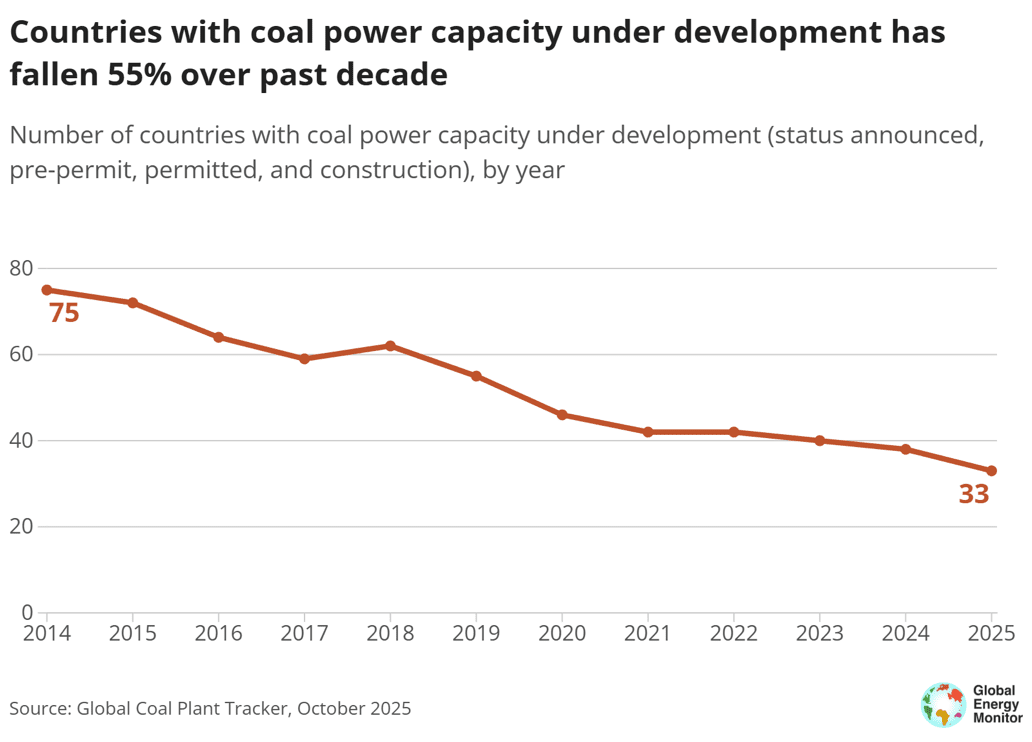
Recent IEEFA research found that China’s energy transition has reached a major turning point, achieving a net decrease in emissions this year and a likely peak in coal use for power generation. Additionally, the number of countries proposing or building new coal-fired electricity plants hit a record low this year (Figure 1).
Figure 1: Number of countries with coal power capacity under development, 2014-2025
Source: Global Coal Plant Tracker, October 2025. Note: includes status announced, pre-permit, permitted and construction.
For Australia, this means thermal coal exports face declining demand as renewable energy and battery costs continue to fall and investments in gas and nuclear power increase in our major destination markets.
At last month’s COP 30, South Korea pledged to close all unabated coal-fired power stations by 2040. It has already announced it will close two-thirds of its existing coal fleet by 2040, and several MPs have since proposed a new bill to require all coal units to close even earlier, between 2030 and 2035.
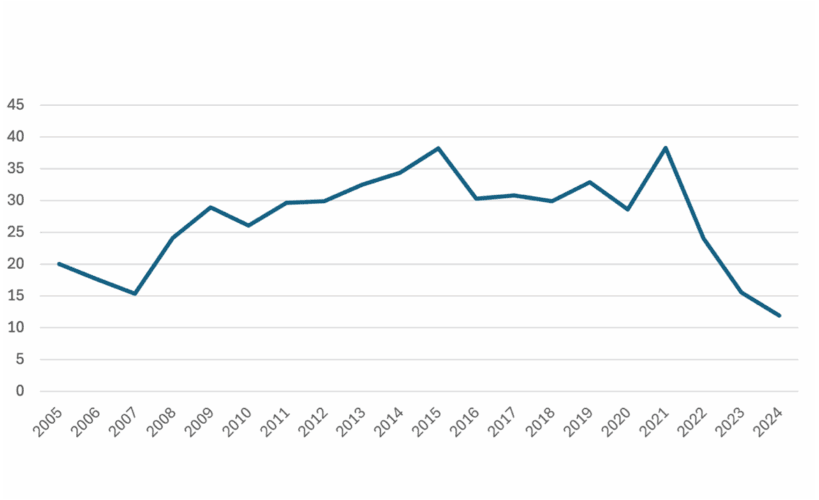
South Korea has been Australia’s third-largest destination market for thermal coal exports for the past decade, but volumes were declining even before its pledge to phase out thermal coal (Figure 2).
Last year, Australia exported more than 10 million tonnes of thermal coal to South Korea worth more than US$1.1 billion (~AU$1.7 billion). These latest developments mean demand for Australia’s high-quality thermal coal is likely to decline further and faster than previously anticipated.
There are no replacement markets for Australia’s high calorific value (CV) coal as Japan, South Korea and Taiwan phase out coal-fired power. And import demand growth in South-east Asia will likely be met by cheaper thermal coal from suppliers such as Indonesia, South Africa, Russia or Colombia.
In fact, S&P Global recently noted the share of Russian and Indonesian thermal coal in the South Korean market was already increasing before its COP30 pledge, due to their lower prices and more reliable shipping.
Figure 2: Australian thermal coal export volumes to South Korea, 2005-2024, Million tonnes
Sources: UNComtrade Data (HS code 27011299), IEEFA.
In addition to these downside demand outlooks, thermal coal producers also face increasing operating costs and risks from extreme weather events and regulatory changes, including increased scrutiny and costs associated with methane emissions from coalmining.
Many of these risks also affect metallurgical coalminers and could already be influencing some miners’ decisions to apply for extensions and expansions.
Whitehaven Coal has withdrawn its application to expand and extend production at its recently acquired Blackwater North coalmine. It had been seeking to mine an additional 220 million tonnes of metallurgical and thermal coal through to 2085.
Despite this, many mining companies are still seeking thermal coalmine expansions or extensions in Australia, meaning they are applying to mine larger volumes of thermal coal or to mine for longer.
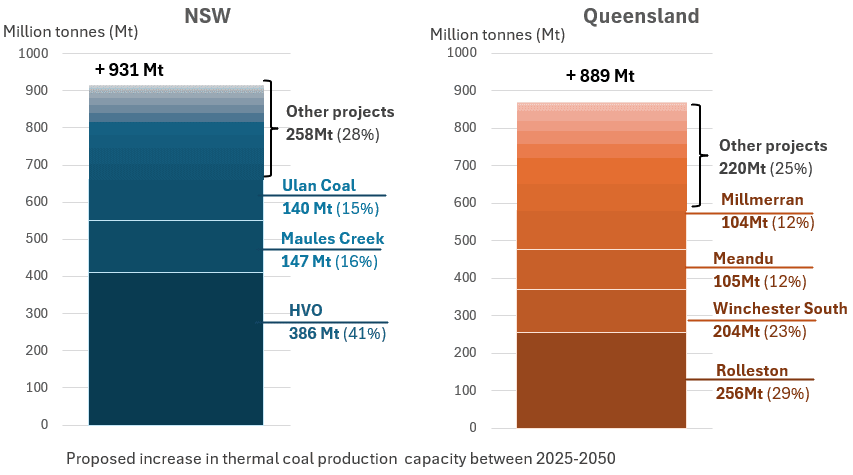
This pipeline of projects would increase Australia’s thermal coal production capacity by 1.8 billion tonnes between 2025 and 2050. Seven of these projects are seeking approval for more than 100 million tonnes of additional thermal coal by 2050 (Figure 3).
With the exception of the Meandu and Millmerran coalmines, these large coalmine projects are seeking to produce additional thermal coal predominantly for export.
Figure 3: Proposed increase in thermal coal production capacity, 2025-2050
Sources: IEEFA; Mine licences and approvals, based on EPBC application documents and company reports.
In NSW, the largest thermal coalmining state in Australia, multiple large thermal coalmine projects are seeking approval. The largest are the Hunter Valley Operations (HVO) Continuation Projects (North and South), Ulan Coal Modification project and the Maules Creek Continuation Project.
The IEA has stated that no new coal investments are needed, beyond those committed by 2021, to achieve NZE by 2050. This means no new coalmines or mine extensions should be approved under this scenario.
Anne-Louise Knight is a Lead Research Analyst, Coal Industry, at IEEFA Australia
Farms need to be electric - because, once this kit is scaled appropriately, on-farm costs…
Hungary has rapidly become an EV battery manufacturing “superpower”, but lax environmental controls have become a…
Well-designed reforms are needed to accelerate the shift away from the exposure to oil and…
Calls for governments to get their plans – and subsidies – in order, as the AEMC…
A huge solar and battery project been given the green light by the independent planning…
The first transmission tower in the first renewable energy zone is now up.