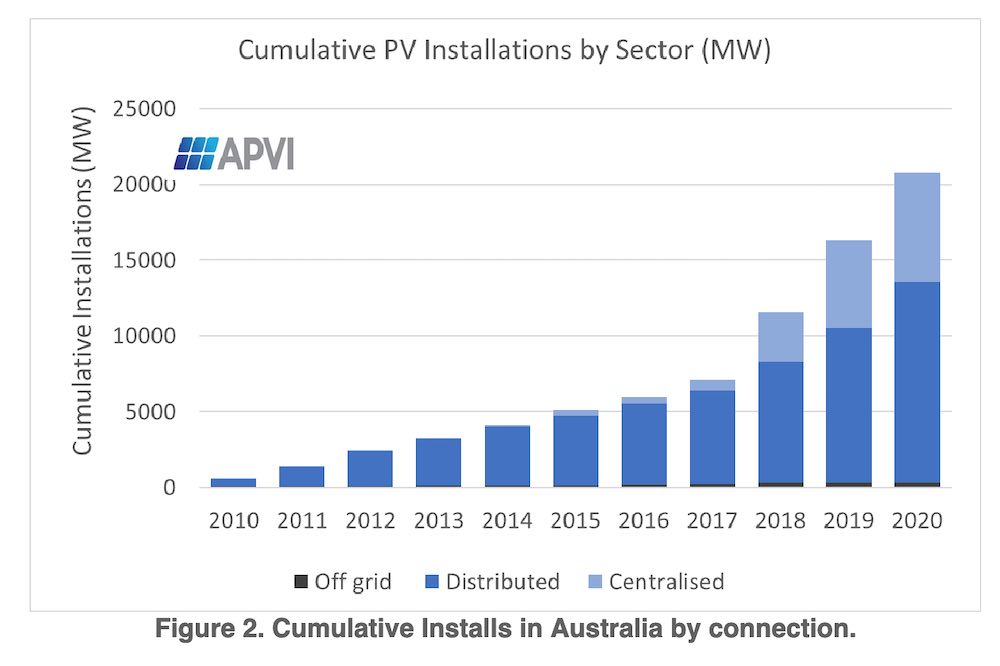
Australia’s insatiable appetite for home solar has made it the country with the most solar per capita in the world – nearly 1kW of panels for every one person – after a smashing year of uptake in 2020 pushed the total installed capacity of all solar in Australia to 20.8GW, of which 13GW is on the nation’s rooftops.
The PV in Australia Report for 2020, published on Monday as part of the International Energy Agency PV Power Systems analysis, details what was a record-breaking year for rooftop solar, with total of 370,000 new systems installed on homes and businesses, and no sign of this trend slowing down.
With the addition of 3GW on rooftops and another 1.5GW of ground-mounted solar, Australia’s solar uptake grew to 810W of solar per person at the end of 2020, the report says, putting it ahead of Germany with 650W/person, and on top of the world on that metric.
By the end of 2020, an average of more than 31% of free-standing households in Australia had panels on their roof.
Both Queensland and South Australia average close to 40% of free-standing homes powered by solar and the report notes that a significant number of localities in those states have densities of rooftop solar over 50%.
The report notes that with a total of 13GW of PV on rooftops, Australia has seen a greater than 10-fold increase over the total installed capacity of 1.3GW in 2011.
“The Australian market is very different to most world markets as it has been dominated by rooftop PV,” the report says.
“The demand for rooftop solar has kept Australia in the top 10 markets for photovoltaics by annual installs and total installed capacity for over 10 years, a remarkable outcome for a country of only 25.7 million people.”
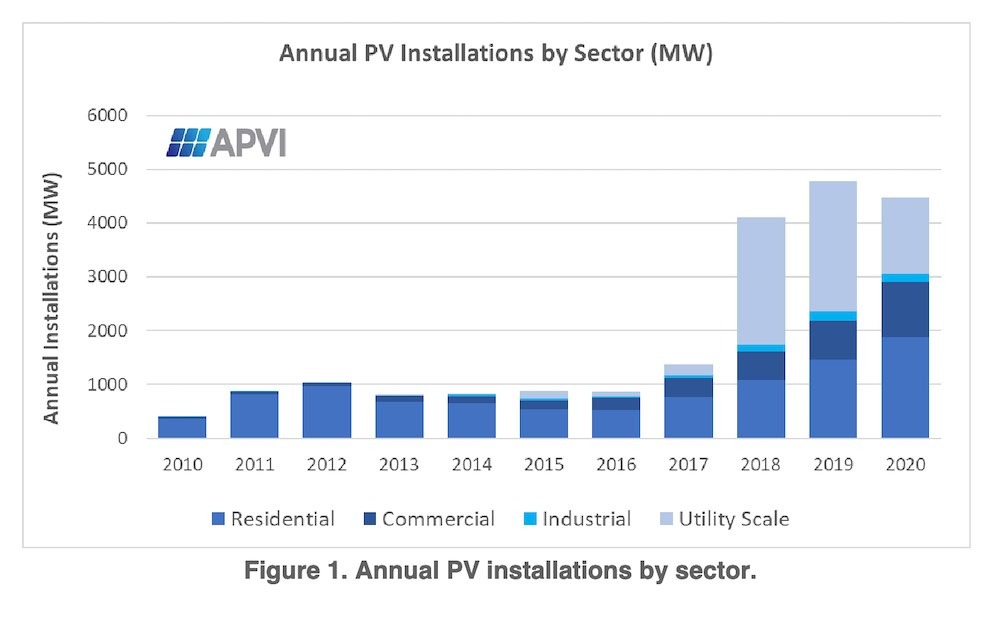
In annual installs, records were broken in all rooftop sectors (see Figure 1, above) in 2020, with residential solar (0-10kW) growing to over 1.8GW in new systems and commercial solar (10-100kW) adding a further 1.2GW of new rooftop solar.
Large-scale solar, meanwhile, contracted compared to a record year in 2019, still adding a total of 1.44GW solar installations over 5MW, all registered as installed and connected to the grid in 2020.
That said, the amount of utility-scale solar connected to the grid has also increased 10-fold in just three years, climbing from 740MW in 2017 to 7.4GW in 2020. The total installed capacity across all sectors has nearly tripled to 20.8GW in three years.
The report puts the average rooftop install at 8kW, up from 7.1kW in 2019 – part of a steady upwards trend that is put down to an increase size of residential systems and the growing number of businesses investing in PV.
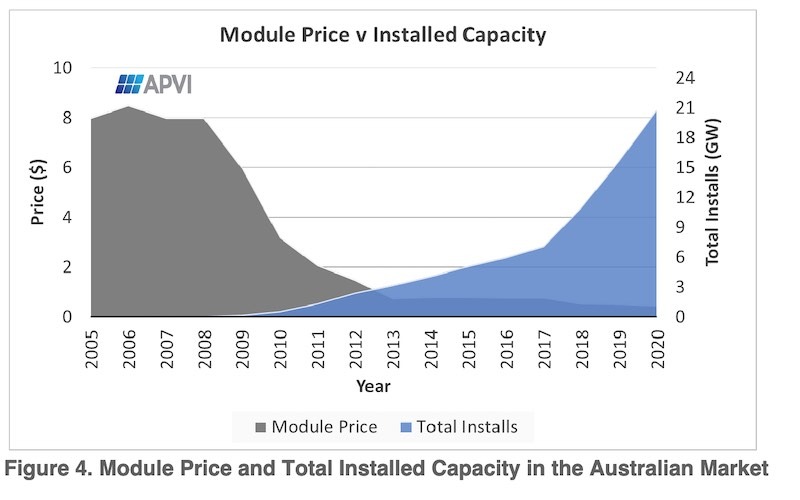
On prices, the report says technology and manufacturing improvements led to a steep drop in prices between 2007 and 2013, since which time they have continued to fall less dramatically.
This pattern of falling solar prices could see a turnaround in 2021, however, due to the surging cost of manufacturing materials and shipping in 2021, driven by to supply chain bottlenecks and commodity price inflation.
Senior CSIRO scientists discussed how to have an "open conversation" about the rising threats from…
New 150 MW solar farm joins the NZ grid on the South Island, matching Aotearoa's…
Pacific leader turned activist says his island nation urgently needs to start "radical adaptation measures"…
A study tested two wind forecast models and found that more accurate one does not…
Australia's biggest wind projects have mostly locked in approvals and contracts, but are still shaking…
New analysis says Australia's dependence on imported diesel means some households are getting hit twice…