The Bango wind farm near Yass in New South Wales (CWP Renewables).
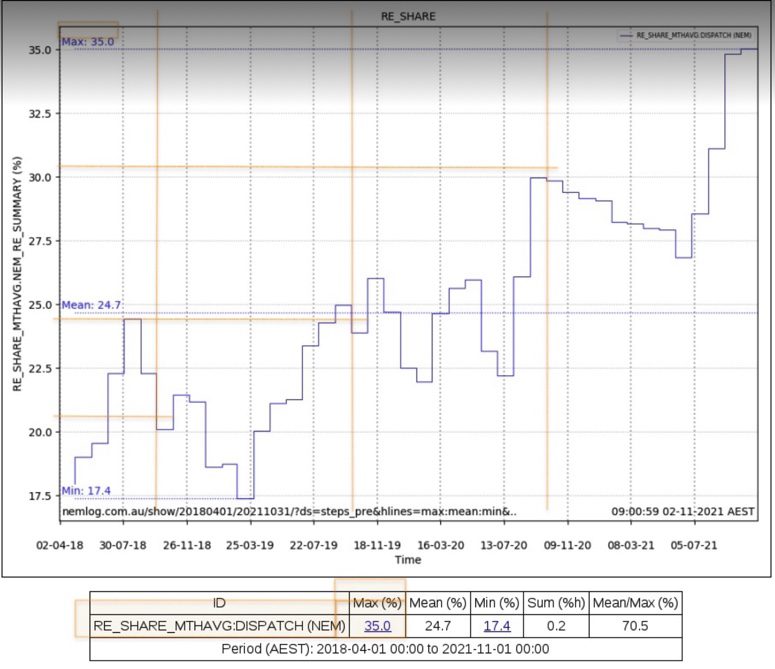
Australia’s main grid hit a record share of 35 per cent renewables in the month of October, just pipping the previous record set a month earlier, and well on the track to deliver on the federal government’s forecast of 69 per cent renewables by 2030.
Yes, you read that right. As part of the emissions projections buried beneath the net zero rhetoric of the past week, the federal Coalition government – the same mob that said Labor’s 50 per cent renewables target would wreck the economy – now assume that renewables will make up 69 per cent of the grid by 2030.
And the good news is that we are half way there. According to data analyst Geoff Eldridge, off NEMLog, renewables made up 35 per cent of the total output of the National Electricity Market in October, pipping the 34.9 per cent achieved in September.
About 27 per cent of the total electricity supply in the main grid in October came from “variable” wind and solar, although wind and solar delivers more than 73 per cent of local demand in South Australia.
By way of comparison, as this graph from NEMLog below illustrates, the share of renewables in Octobers of previous years has jumped from 20 per cent in 2018 (soon after Angus Taylor’s appointment as energy minister), to 23 per cent in 2019, and to 30 per cent in 2020. Well done, Angus!
One of the more remarkable admissions in the federal government’s new emissions assumptions was the prediction that NSW – the country’s biggest grid and the one most dependent on coal – will flip to be 84 per cent renewables by 2030.
That concurs with the plans by NSW energy minister and treasurer Matt Kean to build multiple renewable energy zones, and sufficient storage, to cope with the anticipated retirement of at least three coal generators over the coming decade, if not all five of them.
And if 69 per cent renewables on the main grid sounds ambitious, at least for a federal Coalition that worries about solar power – and perhaps even wind power – not producing at night, the industry itself thinks it can go much faster.
Transmission company Transgrid last month revealed an “energy vision” that suggested that 91 per cent renewables is possible by 2030, with a bit of planning.
The Australian Energy Market Operator is preparing the next edition of its Integrated System Plan, which factors in a 1.5°C scenario that delivers a carbon-free grid by 2035, in line with the global expectations of advanced economies.
That’s a lot quicker than the federal government’s scenario planning, which despite apparently accepting 69 per cent renewables within a decade, assumes it will take a further two decades to reach 97 per cent renewables by 2050. Presumably, they didn’t want to scare the Nationals.
Farmer tells review forced by long distance objectors that hosting wind turbines enables him to…
Solar recycling industry calls on federal government to make an "immediate legal and procedural intervention"…
Australia's renewable energy sector is facing an increasingly complex operating environment at a time when…
Federal government backs trial for 1,000 households in national capital that will use a specially…
A $30 billion-plus data centre could significantly add to greenhouse gas emissions and drain as…
A coalition of over 30 organisations wants to accelerate electrification across Australia’s homes, businesses, farms,…