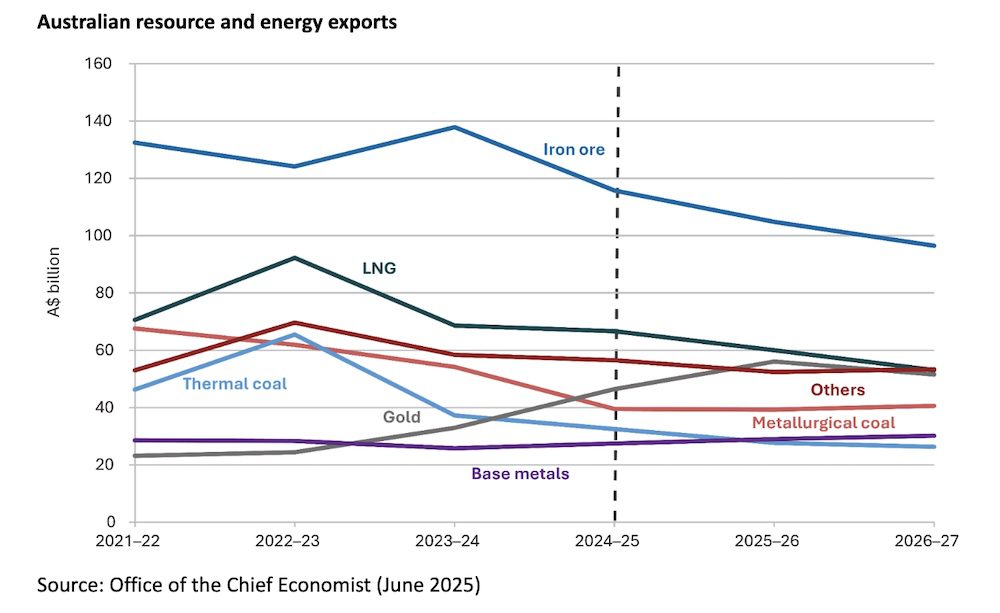
The latest data from the Office of the Chief Economist (OCE), out this week, forecasts that Australia’s resource and energy export revenues will decline by $33 billion in 2026-27, compared to 2024-25.
The projected deflation of Australia’s export earnings is a lens to threats to our future economic resilience and security, while our key trading partners accelerate their economic decarbonisation and deliver on their Paris Agreement commitments.
It is a stark reminder of the need to increase our economic complexity, to diversify from fossil fuels, which face inevitable structural decline, and to prioritise value adding our resources. The projections underscore the strategic importance, for example, to pivot to green iron production rather than shipping rocks of ore.
The projected decline is driven primarily by a 17% drop in iron ore revenues from $116 billion to $97 billion and a 20% drop in LNG from $67 billion to $53 billion over this period.
From 2022-23, where Australia’s energy exports spiked due to Russian sanctions, LNG revenues are forecast to fall 42% to 2026-27, whereas iron ore revenues are expected to drop 22%.
Thermal coal, meanwhile, is forecast to drop by more than 60% from highs of $66 billion in 2022-23 to $26 billion in 2026-27. Metallurgical coal revenues are forecast to fall around 34% from highs in 2022-23 to $42 billion in 2026-27.
In our recent Green Metal Statecraft report, we stressed the opportunities that emerge from an accelerated global transition. Australia should be leveraging our comparative advantages in renewable energy to process our commodities onshore, embodying decarbonisation to value-add our exports and scale-up a green commodities industry here.
A key issue is that currently commercialised technologies to produce steel without coal and gas are not suitable to the vast majority of Australia’s lower iron content, higher impurities iron ores.
One of the recommendations of our report was $500 millio over 10 years to the CSIRO for RD&D into commercialisation of green iron tech. Leading up to the 2025 election, the Albanese government allocated $750 millio of the $1.7 billion Future Made in Australia Innovation Fund to green metals projects. This needs to be deployed in semi-commercial scale projects to ‘learn-by-doing’ in the domestic context and pull-forward and crowd-in private capital.
This is a critically important step. Failure to actively facilitate research, develop and demonstrate enabling technologies, in partnership with key allies across East Asia, risks the erosion of Australia’s iron ore industry alongside our traditional fossil fuel exports.
Steel supply chains are restructuring to regions with high-quality, low-impurity iron ores, particularly given the absence of a price on carbon in international trade across Asia (a path to an Asian CBAM should be a COP31 agenda priority).
Developing a value-adding green iron industry in Australia is a clear path forward to replace the inevitable loss of GDP as our fossil fuel exports progressively, but inevitably decline.
Given the scale at which we compete in the global steel value chain, as world #1 exporter of iron ore and coking coal, there is much to gain by a Team Australia approach, and much to lose by inaction.
Our report shows that repositioning Australia as a global leader in green iron exports has the potential to more than double the value of our iron exports to greater than $250 billion per annum, key to securing our economic prosperity.
Failure to pivot to green iron risks halving Australia’s export revenues, as China, which takes an 86% share of Australian iron ore exports and other nations decarbonise and restructure iron and steel supply chains.
This transformation would also support a huge win for climate. Steelmaking is 6.7% of global emissions, more than 3.6 billion tonnes annually. Australian green iron production could slash this by 1bn tpa, double Australia’s annual domestic emissions.
We are calling for a national green iron and steel strategy with clear, measurable targets. We need demand-side policies and incentives, including innovations such as a Trilateral Clean Commodities Trading Initiative encompassing Australia, South Korea and Japan.
We need an Australasian Green Iron Corporation JV between Australia and key trade partners; public procurement for green metals to create a national demand signal; and ‘Contracts for difference’ to bridge the gap between pricing and production costs of green commodities.
Supply-side policies and incentives are also key. We proposed a $20 billiion Future Fund equity and infrastructure mandate for renewables-powered green metals processing and enhanced production tax incentives for green metal refining.
Foreign policy and international collaboration are critical. We have called for the Australian government to build collaboration on an Asian CBAM in the lead up to COP31, pricing carbon in international trade and creating an investment signal for a pivot green iron, and to focus on Australian/Asian steel supply chain decarbonisation collaboration pre-COP31.
Equally important is to scale and accelerate renewable energy deployments, via measures such as an Overriding Public Interest Test to speed up project approvals, accelerated development of Renewable Energy Industrial Precincts, domestic content incentives and industrial demand response mechanisms to optimise renewables supply/demand for large grid-connected refineries.
The OCE forecasts are a critical reminder of the importance of the Future Made in Australia re-industrialisation package, the role of the National Reconstruction Fund, the Safeguard Mechanism and the Capacity Investment Scheme to accelerate renewables deployment as a key enabler of commodities value-adding.
Progress made in Labor’s first term is substantial, but to safeguard our future economic resilience and security, we must now see a step-change in ambition to structurally pivot away from our end-of-life facilities and industries and towards the immense opportunities for Australia in an emerging net zero world economy.
The hotly contested New England renewable energy zone has finally put in its application for…
Balcony solar has taken off overseas, but Australian rules mean apartment dwellers and renters are…
Regulator pings two businesses for allegedly breaching the rules of state-based energy upgrades scheme, including…
Offshore wind project canvasses turbines of up to 23 MW, as locals raise concerns about…
A rule change request quietly put through in December wants to radically change how the…
Video shows dramatic collapse of a 20-year-old wind turbine that falls on to a neighbouring…