The Newman battery.
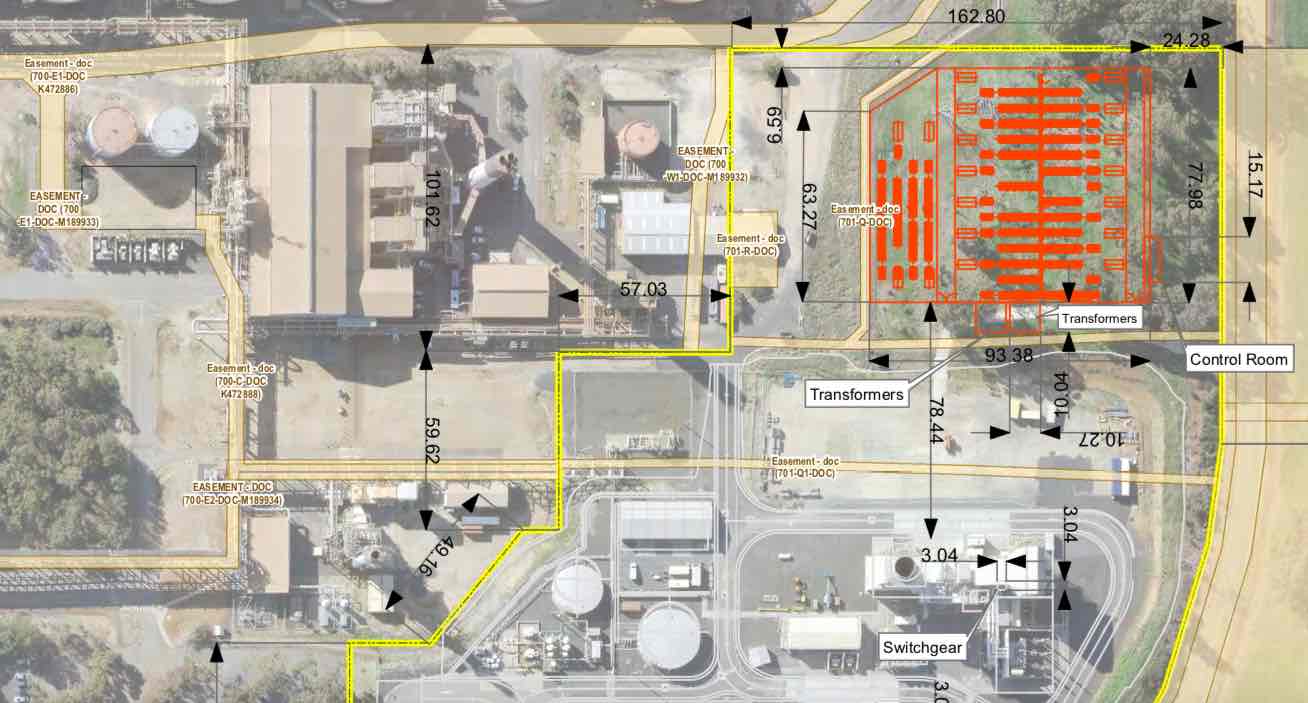
Energy company Alinta is planning to build a 100MW big battery next to its Wagerup peaking gas and diesel plant, signalling the second big battery to be built in Western Australia’s main grid, and the second big battery to be built by Alinta.
Alinta already owns and operates the highly successful 35MW/11MWh Newman battery, which plays a key and profitable role on the private network that provides power to the giant iron ore mines owned by billionaires Gina Rinehart and Andrew Forrest.
In December, Alinta filed an application with the Waroona shire council for a 100MW lithium ion battery – the storage duration will be decided after choosing a supplier and after more market studies – to be built next to its 380MW gas and diesel peaking power plant at Wagerup, located right next to the Alcoa alumina refinery.
The $100 million project has already gained approval from the WA Environment Protection Authority, as reported by the Perth-based energy, industry and climate website Boiling Cold.
“The ability of large batteries to respond instantly to fluctuations on the grid is critical to the development and operation of increased renewable energy in the state of Western Australia,” Alinta says in its council application.
Alinta secured approval more than a decade ago to build a 350MW “co-generation” plant to provide “baseload” power at the site. But time and technology has moved on. Wind and solar, backed by battery and other forms of storage, is now clearly the cheapest and cleanest alternative, and the need is now for batteries and their fast response and flexibility to fill in the gaps in wind and solar, rather than continuous and inflexible “baseload”.
“With the continued introduction of intermittent energy sources into the SWIS, such as domestic and utility scale solar, the need for fast-start, balancing capacity becomes more important,” the Alinta application says.
“The installation of a battery at this scale creates the opportunity for much more renewable and intermittent electricity generation to be connected to the SWIS while maintaining power quality and continuity of supply.
“The ability of large batteries to respond instantly to fluctuations on the grid is critical to the development and operation of increased renewable energy in the state.”
The first big battery to be built in WA’s main grid – known as the South West Interconnected System (SWIS) – was announced last October, when the state-owned Synergy unveiled plans for a 100MW/200MW big battery that will help reduce the strain of gas generators responding to the variations of wind and solar.
Alinta is likely to go for a similar configuration with their Wagerup battery, so it is likely to be 200MWh. The demand for battery storage is growing rapidly in Western Australia and the rest of the country.
In WA it is being used at local level, in some instances to provide stand alone power systems to take people off the grid or boost the reliability of off grid power systems, and also as “community” batteries that relieve the pressure of rooftop solar on parts of the network.
The Newman battery is designed to respond quickly to problems at the Mt Newman gas generator, and remove the need for having gas units running all the time as back-up, and will be joined by another battery as the network is expanded to provide power to new mines planned by Forrest’s Fortescue Metals.
The Synergy battery, and presumably the Wagerup battery, will be designed to provide instant frequency response to incidents on the grid, as a general “shock absorber” if a big plant trips, and acting as peaking generators to provide power at peak times, or to smooth out the variations of wind and solar.
Australia’s main grid already has five operating big batteries, including the newly expanded Hornsdale Power Reserve, but another three have been completed and are awaiting commissioning and there are more than a dozen more in construction or about to begin. Many more are in the pipeline.
Data centres should carry the cost of higher electricity rates if allowed to build now,…
Coalition leader Angus Taylor wants to scrap renewable energy agency, funding for home batteries and…
Across Australia, $32.5 billion of generation and storage is now under construction or at financial close,…
The response to the shocking attack on Helen Haines suggests we need to bring more…
A new 4 GW wind and solar project is intended to power green iron prospects…
My biggest analysis error this year has been missing the point of the Nelson Review.…