Prime minister Scott Morrison at the 2019 G20 talks held in Osaka, Japan. (AAP Image/Lukas Coch)
Australia has again been ranked among the worst for climate action in a new assessment that finds G20 countries are not doing enough to stop the rise in global emissions and fossil fuel use.
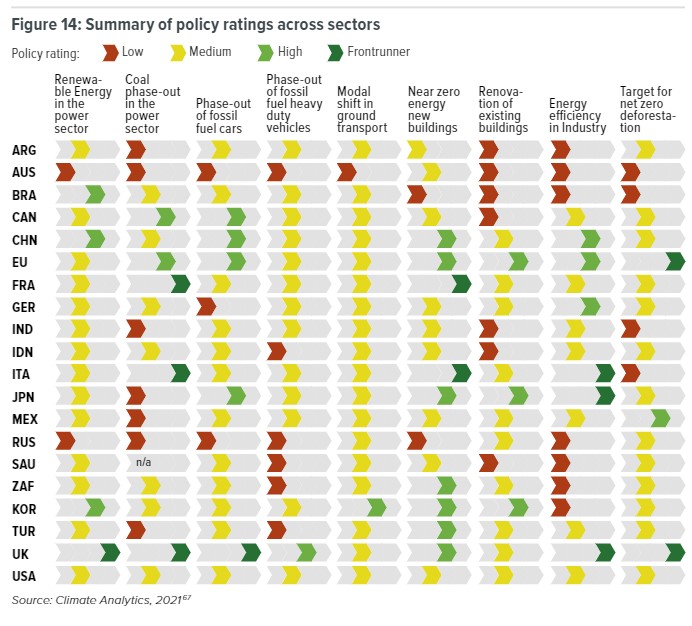
The assessment has been published in the latest edition of the Climate Transparency Report, which saw Australia consistently awarded some of the lowest scores amongst G20 countries, including for renewables uptake, the phase out of fossil fuels, and support for electric vehicles.
The report has been released ahead of a meeting of the G20 to be held in Rome at the end of the month and the COP26 climate talks in Glasgow in early November, and as federal Cabinet wrestles with what policies to present at the crucial meeting.
The G20 is made up of some of the world’s largest economies and greenhouse gas emitters – and combined is responsible for around 75 per cent of global greenhouse gas emissions.
According to the report, energy-related emissions of G20 countries fell by 6 per cent in 2020 – primarily due to the impacts of the Covid-19 pandemic – but are expected to rebound by around 4 per cent in 2021 as G20 economies start to return to normal conditions.
“Rebounding emissions across the G20, the group responsible for 75 per cent of global GHG emissions, shows that deep and fast cuts in emissions are now urgently needed to achieve net zero announcements,” one of the report’s lead authors, Gahee Han, said.
The report found that coal and gas consumption has continued to rise amongst G20 countries, despite global agreements to tackle rising greenhouse gas emissions to avoid worsening global warming.
The report scored G20 members on the strength of their climate commitments, including targets to grow the amount of energy sourced from renewables, plans to phase-out fossil fuel use and investments in low emissions infrastructure.
Australia received the lowest rating on all but one of the nine metrics assessed by the Climate Transparency report, securing a “medium” rating only for Australia’s policies to support the construction of low emissions buildings.
No other country scored so poorly, and it sees Australia yet again ranked amongst the worst countries on climate action.
“This result should not be surprising for anyone following climate action in Australia: we haven’t seen a single policy put in place by the Federal Government that will reduce emissions in any sector,” CEO of Climate Analytics, Bill Hare said.
“Instead, we see continued support for fossil fuels – it recently approved four new coal mines and is subsidising new gas developments.”
Australia is the only developed country within the G20 that lacks a formal price on carbon emissions and has a per capita emissions footprint nearly three times the broader G20 average.
Australia’s share of energy sourced from renewables and uptake of electric vehicles were both found to be well below the G20 average.
The assessment found that Australia’s emissions targets – deemed to be “highly insufficient” – were consistent with 4 degrees of global warming should they be adopted by other countries.
“The “Highly insufficient” rating indicates that Australia’s targets, policies and climate finance are not Paris Agreement Compatible,” the report says.
“The federal government accelerated a “gas-fired” recovery not a green economic recovery, refused to increase its 2030 domestic emissions target or set a net-zero emissions target, and is not on track to meet its current target.”
“Australia’s 2030 domestic emissions reduction target is consistent with warming of 4°C if all other countries followed a similar level of ambition. Under current policies, emissions will continue to rise and are consistent with more than 3°C warming. To achieve a better rating, Australia needs to set a more ambitious target for emissions reductions with associated policies, and provide finance to support other countries.”
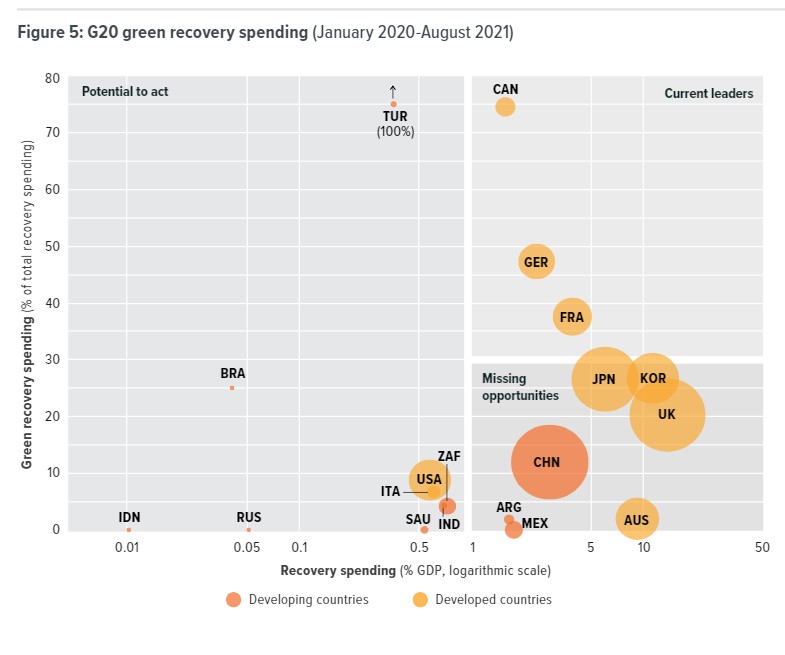
Australia was also found to be one of the countries missing the most in terms of green recovery opportunities, committing a significant amount of public funds to its Covid-19 economic recovery but committing virtually none of it to green infrastructure.
The report also cited increases in Australian fossil fuel subsidies, which grew to US$7.66 billion (A$10.37 billion) in 2020-21, and mostly directed to liquid fuels.
Following the report’s release, former executive secretary of the UNFCCC, Christiana Figueres, said that G20 countries needed to “get up to speed” on the green transition.
“Incrementalism was yesterday’s choice, it cannot be today’s. The damages coming at us from the climate crisis are accelerating exponentially. People are suffering the dire consequences and they want things to change. It’s time for G20 governments to get up to speed and deliver the green transition we need,” Figueres said.
The Climate Transparency report was prepared through a collaboration between 16 research institutions and non-governmental organisations.
Earlier in the year, a report produced by the UN-backed Sustainable Development Solutions Network ranked Australia last of all UN member countries for climate action.
See also: Australia needs up to 74 pct emissions cut by 2030 to stay on track for 1.5°C
And: Australia slips another place in renewables ranking, despite efforts of states
The lengthy delays at what would have been the country's biggest wind farm have forced…
The public remains largely in the dark about the full cost of the giant Snowy…
Amandine Denis-Ryan from IEEFA on what can be done about Australia's unique and unhealthy dependence…
For maximum readings, September came in as Australia's third warmest. For minimums, last month narrowly…
Diesel fuel tax credits earned over 10 years nearly equate the price of a huge…
Updated: The biggest wind farm to reach financial close in Australia in the last two…