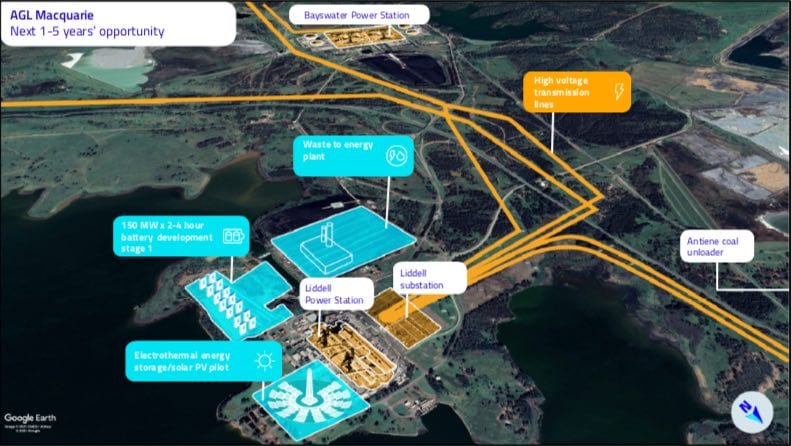
AGL Energy has gained NSW state planning approval for its proposed Liddell big battery, which it says will be sized at up to 500MW and up to four hours of storage, or a total of two gigawatt hours.
The $763 million battery will be located adjacent to the former coal yards area, right next to the 50 year old coal generator that is due to close in early 2023, and also next to a new solar array planned for the site, which also hosts the Bayswater coal fired generator.
Approval was granted on March 8 by the state’s planning authorities, and the documents show that it will have a 20 year life, will be built in three stages starting in each of 2022, 2023 and 2024, and will involve a work force of up to 250 people.
The Liddell battery is one of a number of batteries planned by AGL at the energy hubs created around its major fossil fuel power stations – Liddell, Loy Yang A in Victoria, and Torrens Island in South Australia.
The Torrens Island battery has already begun construction and will be sized at 250MW with one hour storage, but could grow to four hours storage as market needs and opportunities emerge. The Loy Yang A battery will be around 200MW with a similar strategy for storage.
AGL also plans a number of other batteries, including 200MW/400MWh of battery storage to be provided by Australian developer Maoneng, and it also is looking at a 50MW, two hour battery at Broken Hill.
It already operates, but does not own, the Dalrymple North battery in South Australia, and has a similar arrangement with the new 100MW/150MWh Wandoan battery in Queensland, that state’s first big battery.
AGL has previously said the first stage of the Liddell big battery is likely to be sized at around 150MW and between two and four hours storage. It also wants to repurpose the Liddell hub into a mix of generation and industry options.
Big batteries will play a crucial role in the transition of the grid from fossil fuels to renewables, and Australian Energy Market Operator has identified the need for at least 19GW of new dispatchable resources to replace the coal and gas generators over the coming decades.
In NSW, the need for storage is more urgent as it expects at least four of its five remaining coal generators to close by 2032, and possibly all of them.
Origin recently announced that Eraring, the biggest in the country at 2.88GW, will now be closed in 2025 rather than 2032, and it also plans a big battery of up to 700MW and four hours storage (2,800MWh), that will also be built in stages.
AGL has already brought forward the planned closure of Bayswater to 2033 from 2035, and most expect this to happen earlier.
AGL recently fended off an $8 billion bid by tech billionaire Mike Cannon-Brookes and Canadian asset management giant Brookfield, who want to close Bayswater and Loy Yang A earlier. However, they have “downed pens” on their offer after a raised bid was rejected, but some analysts expect them to return.
That leaves Vales Point, owned by Delta Energy, which is currently slated for closure in 2029 but whose owners want it to keep generating for longer than that (if it can secure capacity payments), and Mt Piper, owned by EnergyAustralia, which is also fast tracking the closure of its Yallourn coal plant in Victoria.
Treasurer and Energy Minister Matt Kean said batteries will play an important role in delivering reliable and affordable electricity to the homes and businesses in NSW and will become an intergral part of the State’s energy future.
“The NSW Government’s Electricity Infrastructure Roadmap is the nation’s most ambitious renewable energy plan, which is expected to attract up to $32 billion of investment in new electricity infrastructure,” Kean said.
“Big batteries combined with solar, wind and pumped hydro will help to deliver some of the cheapest and most reliable energy to the families and businesses of NSW.”
The lengthy delays at what would have been the country's biggest wind farm have forced…
The public remains largely in the dark about the full cost of the giant Snowy…
Amandine Denis-Ryan from IEEFA on what can be done about Australia's unique and unhealthy dependence…
For maximum readings, September came in as Australia's third warmest. For minimums, last month narrowly…
Diesel fuel tax credits earned over 10 years nearly equate the price of a huge…
Updated: The biggest wind farm to reach financial close in Australia in the last two…