The demolition of the Wallerawang coal fired power station near Lithgow, NSW. (Credit: Greenspot/Liberty Industrial).
The Australian Energy Market Operator has defended its modelling of a rapid exit of Australia’s ageing coal fleet included in its draft Integrated System Plan, saying previous forecasts had failed to capture the pace of transformation in the grid.
The draft ISP, released in December, suggests that all brown coal generators in Australia will likely close within a decade in its “step change” scenario, which is now considered by the overwhelming majority of the industry to be the most likely.
In its “hydrogen superpower” scenario, which many – including Andrew Forrest – will emerge as the most likely scenario within a few years, all coal generation is modelled to close by around that time.
That modelling produced howls of protests from parts of the fossil fuel industry and within the federal Coalition government. Prime Minister Scott Morrison on Monday repeated his calls for coal generators to run for the “life of the plant”, and says he would be “fine” with new coal generators “if they stack up.”
The concerns prompted the Australian Energy Regulator, which has been advocating for a “capacity payments” to help protect against coal generator closures, to ask AEMO in January to explain its assessment.
AEMO has now responded, saying that the modelling is based on revenue assumptions, and whether the coal generators can remain economic in the face of increased competition from large scale and distributed renewable resources, and on the impact of carbon budgets as climate targets are addressed.
“In recent years, the growth in large-scale variable renewable generation (VRE) and distributed energy resources (DER) has put pressure on the market share of incumbent generators,” it says.
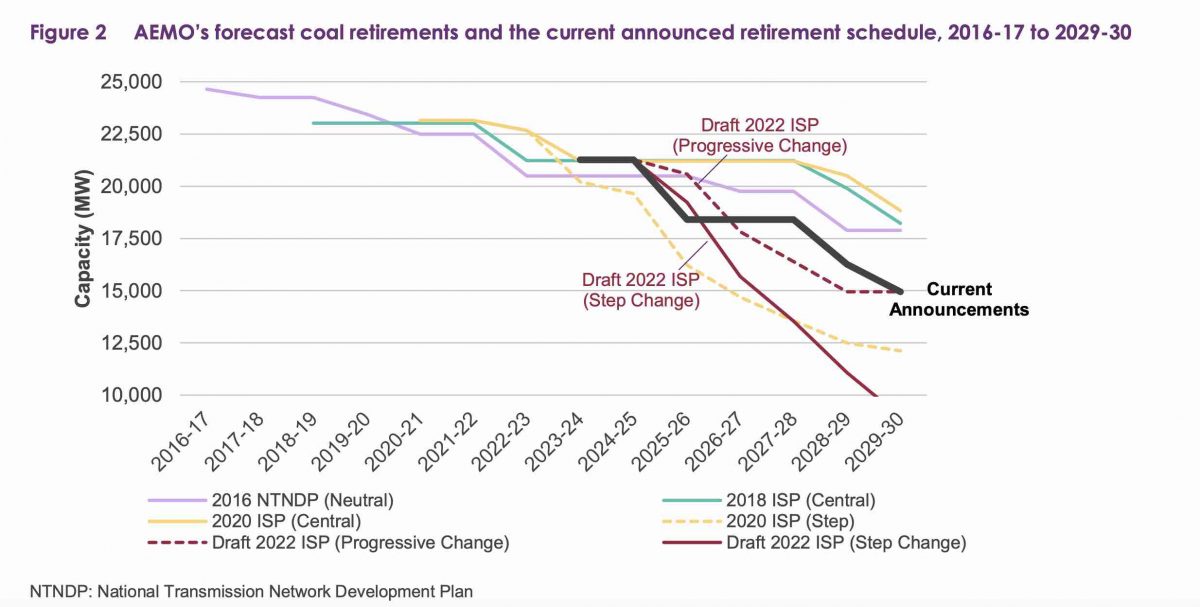
“As demonstrated in Figure 2 below, only the 2020 ISP (with the schedule lying between the Step Change and Central scenarios) and the Draft 2022 ISP have forecast a scale of coal retirements that is keeping pace with current announcements.
“Prior to these publications, the ‘central’ planning scenarios did not, in hindsight, sufficiently capture the risks now being observed in terms of the pace of the transformation of the National Electricity Market (NEM).
“AEMO therefore considers that the current collection of approaches to model potential coal retirements represent an improved collection of methods to inform the needs of the future power system, and inform the ISP’s optimal development path (ODP).”
AEMO says that the recent announced early retirements of the Eraring (2025, from 2032)) and Bayswater power stations (2033, from 2035), “demonstrated that the modelled trajectory is broadly in line with the latest coal retirement announcements, providing an appropriate foundation for the ISP.”
The modelling for the step change and hydrogen superpower scenarios look at a least-cost retirement trajectory that take into account the impact of cumulative emissions, and the influence of the scenario-specific carbon budgets.
“These retirement outcomes were then validated in the time-sequential modelling, applying a similar bidding approach as applied in Approach 1 to identify if revenues after the carbon-budget triggered retirements were sufficient across the generation portfolio,” it notes.
“This assessment observed no large negative profitability outcomes to trigger further or earlier retirements, reflecting that the carbon budget was the dominant driver for retirements in the Step Change and Hydrogen Superpower scenarios.”
Meanwhile, carbon budgets seemed to be the last thing on Morrison’s mind when he fronted a “town hall” discussion on Rupert Murdoch’s Sky News on Monday night.
He vowed support for the coal industry, said coal generators should “run as long as they possibly can”, and would be happy with new coal generators if the economics stacked up.
UK developer and local council sign community benefit deals for two projects stuck in limbo…
A record amount of large-scale renewable generation has reached financial close, the federal government says,…
China's Envision lines up its first wind and battery deal at a new energy park…
Final all-clear for huge wind and battery project comes just in the nick of time,…
The Albanese government is making great strides on clean energy, while at the same time…
Slow grind of getting commercial, industrial businesses off gas is accelerating, a new report says.