TRY community battery being craned into position in June 2021. Photo: Indigo Power
Community batteries could generate $250,000 a year in revenue for their owners, a new paper claims, as long as they are paired with the right energy management smarts and target the most lucrative grid services value streams.
The white paper, called Community Battery 101, sees energy management specialist GridBeyond come into bat for the storage segment that sits somewhere between home batteries and big batteries on modern electricity networks.
Not everyone is a fan – or at least, not everyone is a fan of the extent to which monopoly network companies are moving into the space, with little guarantee that the government-subsidised batteries they install will deliver the “community” benefits that are promised on the tin.
Experts from this school of thought, such as Green Energy Markets analyst Tristan Edis, argue that if energy equity and rooftop solar optimisation are the true goals, then government money would be better spent on subsidising home batteries.
Network companies, meanwhile, argue that community battery costs soon will become economically viable without the need for ongoing subsidies – and that distribution companies like Ausgrid, for example, are best placed to put them where they will deliver most bang for buck.
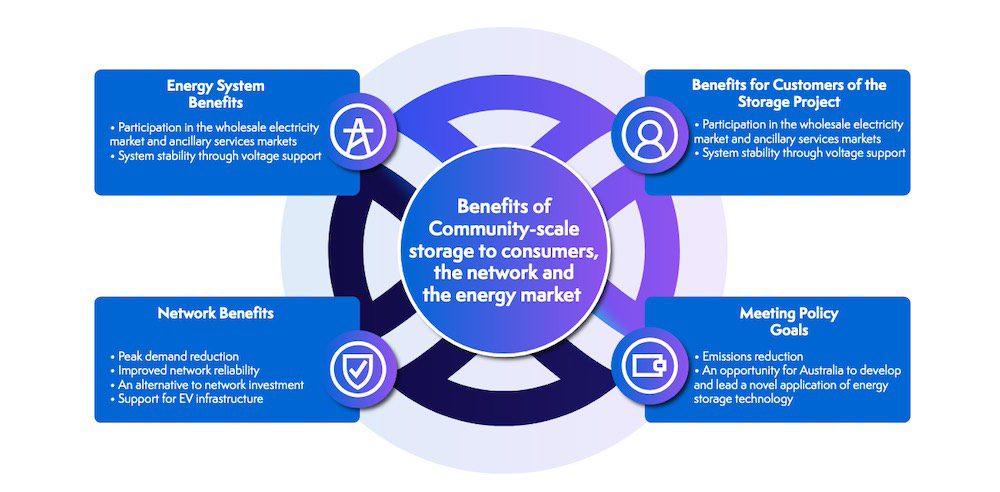
In its white paper, published this week, GridBeyond says battery storage of the “community” scale – typically somewhere between 100kW-5MW – offers benefits over household batteries, including lower costs and increased ability to integrate more solar PV energy generation.
The paper also argues that community batteries can provide an opportunity to increase energy equity, providing an opportunity for a wider range of individuals to access the benefits of renewable resources.
Further, they can help create “mini independent networks,” GridBeyond says – a service that will become increasingly important for remote and small communities as climate change increases the intensity and frequenct of storms, floods and extreme heat events.
But there are a couple of “buts,” the first being that community batteries should be designed to value stack multiple services, and installed in high-value locations, to achieve the best economic return on investment.
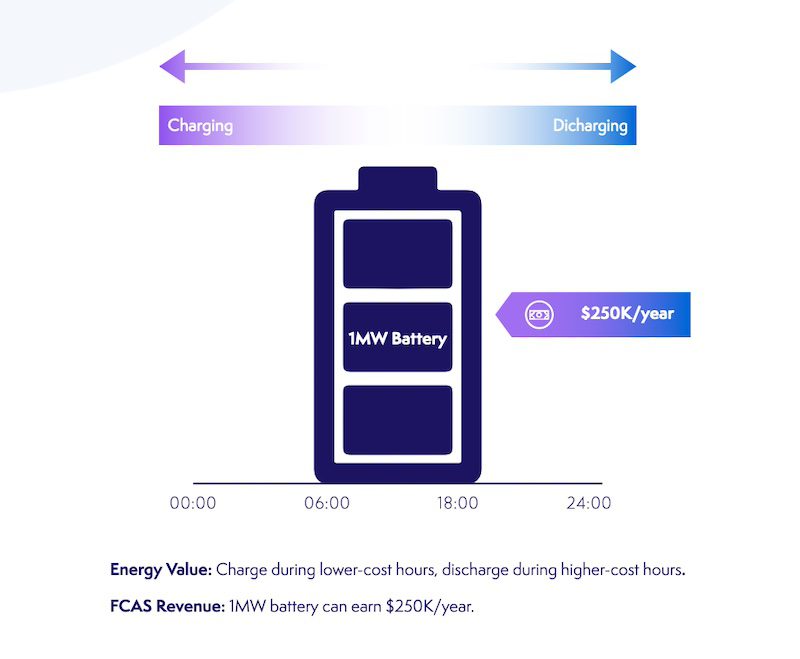
GridByeond says energy arbitrage – storing excess rooftop solar, say, and discharging it into the evening peak – promises the single largest source of value for community batteries, however, “significant values” can also be realised from Frequency Control Ancillary Services (FCAS).
According to GridBeyond’s calculations, a 1MW battery enrolled in an FCAS program could generate $250K/year revenues for its owners.
A community battery may participate in the FCAS and arbitrage markets, earning the operators a valuable income stream and realising attractive payback and return on investment opportunities.
The second “but” relates to GridBeyond’s stock-in-trade. For community batteries to be commercially viable, the paper says, an intelligent energy storage management system (ESMS) platform must be interoperable between a grid operator’s system, grid edge control layer, and energy market interfaces.
“By pairing sophisticated battery hardware with predictive energy storage and flexibility management software, asset operators can optimise value in real time as they respond to changing community and market energy needs,” the paper says.
“Community batteries are a great opportunity for everyone as everyone can benefit from those,” says GridBeyond asset development director, Scott Berrie.
“[They] can help the government to reach its decarbonisation goal, they generate savings and can help communities to benefit financially through an intelligent energy storage management system.”
As solar module makers use fewer valuable materials to get prices down, questions arise about…
Amandine Denis-Ryan from IEEFA on what can be done about Australia's unique and unhealthy dependence…
A Melbourne project to assess apartment buildings' electrification potential suggests that technically it's doable but…
The former Nationals leader has come out swinging on social media against a global wind…
The only wind farm under construction in NSW has entered the grid management system, the…
Large-scale solar generation hit record highs in three states across Australia's main grid in September,…