Australia solar technology innovator 5B has claimed a global “speed record” for the deployment of utility scale solar, but also warned that the rate of solar deployment needs to multiply many times over to reach net zero targets.
5B specialises in making pre-fabricated solar arrays, allowing for fast deployment of ready to operate solar projects, as the panels are mounted and wiring arranged prior to delivery at the site.
In the past week, working on the Los Andes solar project in the Atacama desert in Chile, it says it has set a new record for the deployment of solar, as calculated in megawatts installed per person.
A team of 10 is working on a 10MW facility – part of a bigger 180MW project being developed by AES – and 5Bs Chris McGrath says 1.1MW – 22 of its Maverick system packs – was deployed in a single day. That translates to 110kW per person per day.
“That is five to 10 times faster than conventional solutions,” McGrath says. The obvious benefit, he says, is that more capacity can be installed more quickly with fewer people.
In challenging regions like the Atacama Desert (elevation 3,000m), and in remote parts of Australia and other regions where solar will be deployed, that amounts to a significant saving.
“It sets a new benchmark for how quickly engineering, procurement and construction (EPC) contractors can stand up utility-scale solar projects in remote locations with the most efficient use of resources,” he said.
5B has been growing rapidly since it was founded just a few years ago, and is the preferred supplier for what will be the world’s biggest solar project, the massive 20GW Sun Cable project in the Northern Territory backed by billionaires Mike Cannon-Brookes and Andrew Forrest.
McGrath says that the new solar speed record is satisfying, because such rapid and efficient deployment will needed because the pace and scale of solar installations around the world is still way too slow.
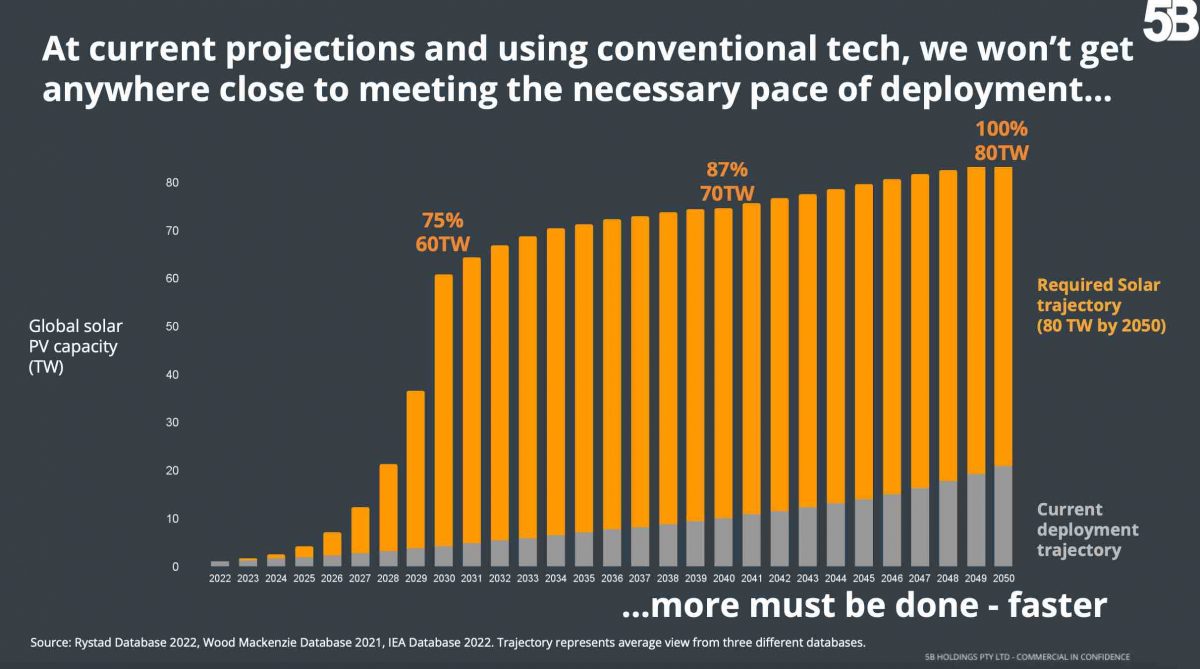
He says the global deployment of solar is simply not fast enough to meet the net zero targets, even by 2050, and most of that capacity needs to be deployed over the next 10-15 years to meet those targets.
“We need to electrify almost everything, and we need it to it with clean electricity,” McGrath says. “We need around 80 terawatts of solar capacity. Solar PV is the lowest cost, simplest and fastest of those technologies and we will be relying on that to meet those targets.”
The problem is that the current deployment trajectory is for just 15-20TW of new capacity. And while some aspirational project pipelines look good, actual deployment is being stymied by the lack of short term planning, the lack of market signals, and transmission.
“The pipeline sounds huge, but it is not enough,” McGrath says.
“That 80TW target for 2050 really has to be met by 2040. So we need 60TW by 2030, and that is an incredibly steep ramp rate, massively eclipsing the current planning by industry.
“There is a big lack of policy settings.”
Tougher rules to protect Australia's environment have been welcomed by developers, but conservation groups say…
Karl Braganza, head of research at the BoM, explains El Niño and what it means…
Freshly minted NEM data shows solar-charged batteries discharging at record levels, helping lower wholesale prices…
It is now well established that the combination of new renewables and the huge growth…
Remote First Nations renewable energy projects are a complicated sell to investors, but a new…
Sod turned at first major solar and battery project to connect to new REZ, at…