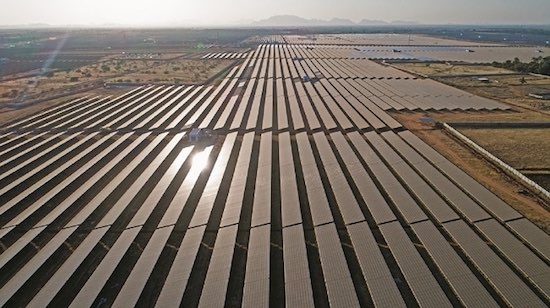
Last week, the chief minister of the Indian state of Karnataka inaugurated the first 600MW of what is being dubbed the largest single solar farm in the world – the 2GW Pavagada Solar Park.
But it is not the size of the project – all 2GW of which is expected to be completed by the end of this year – that makes it so interesting.
The innovative project, which has been co-financed by the Indian government’s Union Ministry of New Renewable Energy (MNRE) and the state government, aims to use the solar farm both as an economic lifeline to struggling local farmers, and as a massive clean energy injection to the state’s struggling grid.
The $A3.2 billion solar park, also known as Shakti Sthala, has been built over 13,000 acres across five villages in the Tumakuru district of Karnataka; a farming region that has been ravaged by drought and unemployment.
The farmland is being been leased from the farmers, by the government, for the life of the solar project. So far, a total of 2,300 farmers of Pavagada have leased out 13,000 acres of land at Rs.21,000 ($A416) per acre per annum.
Not only does this help empower those farmers, and keep them and their families on the land, but the unique leasing model removes what can be a major obstacle to solar farm development: the sourcing and acquisition of suitable land.
“Pavagada, in Tumkur district, is one of the most arid regions of our state. Over the last five decades, due to extreme weather conditions and low possibilities of economic growth, more than 10,000 people had migrated annually from Pavagada,” said state energy minister DK Shivakumar.
“To solve this problem… this ambitious project, spanning five villages, looks at farmers as the key partners, and also as beneficiaries. Shakti Sthala is creating new job opportunities and economic growth leading to the prosperity of the people of Pavagada,”
The project is part of the Karnataka Solar Policy 2014-2021, which was launched in May 2014 and, the Karnataka government claims, has helped to deliver a massive 23,379MW of new capacity in just four years.
Meanwhile, the Karnataka Power Transmission Corporation Limited has reportedly upgraded 311 substations and started works on a total of 141 new substations of various capacities also with those four years.
“As a result, people are gaining more power, with transmission losses reduced from 3.81 per cent in 2012- 2013 to 3.288 per cent in 2016-17,” the state government said.
“The number of substations has increased from 1,353 in 2012-13 to 1494 in January 2018. 40 new substations have been set up in 2017-18 alone, increasing the overall transmission line capacity of various voltages.”
This article was originally published on RenewEconomy’s sister site, One Step Off The Grid, which focuses on customer experience with distributed generation. To sign up to One Step’s free weekly newsletter, please click here.
Amandine Denis-Ryan from IEEFA on what can be done about Australia's unique and unhealthy dependence…
For maximum readings, September came in as Australia's third warmest. For minimums, last month narrowly…
Diesel fuel tax credits earned over 10 years nearly equate the price of a huge…
Updated: The biggest wind farm to reach financial close in Australia in the last two…
Australian battery maker whose customers include the federal energy minister has gone into voluntary administration,…
A major new transmission line that the state opposition has vowed to scrap is seeking…