A small community near the end of the transmission line in Western Australia is planning on doubling its homegrown wind farm – and adding batteries.
The Denmark Community Wind Farm is a two-turbine, 1.6 megawatt (MW) project that started generating power in early 2013. But plans are now afoot to add another 4MW from two more turbines, and installing a supporting battery within the next three years.
The project is estimated to cost $10-14 million, says Paul Lewellyn, who is on the board of the community-run organisation that looks after the project.
But the full vision is even more ambitious, he says, describing a future for the small town that includes a bigger wind farm that can supply all and more of the wider Denmark community’s energy needs, supported by a big battery that can handle the big intermittent loads created by coastal weather fronts.
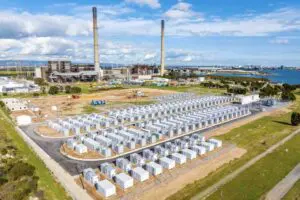
Community batteries will support transformers handling as much as 5MW of rooftop solar added over the last decade, and an upgraded transmission line to remove local grid constraints for the extra wind power.
All of which are possible, with the right regulation, belief, and finances. Even the big battery is now realistic: a study commissioned about four years ago by the Denmark Community Wind Farm found a big battery wasn’t economic – but with prices tumbling, it’s now achievable.
“We call for support for renewable energy generation and medium scale storage at local and subregional scale, because that is where networks are weakest and where you get maximum return on investment, in the form of avoided network costs and reinforcement,” Lewellyn told Renew Economy.
“We have shown this to be the case.”
High barriers to success
But Denmark is running up against the same barriers they faced during the decade it took to get the initial wind farm running, Lewellyn says.
“There’s a lack of belief in renewable technologies being able to do what the network requires to meet loads,” he says.
“The network is not fit for purpose and there is a lack of belief in renewables to [fix] it.
“From a regulatory point of view there are simply too many barriers to connection and access. Some of them are legitimate and some of them are nuisance barriers that hinder efficient integration and development.”
Last year, Denmark community applied for one of the ARENA community battery grants but was unsuccessful, despite offering up modelling around load management and wind integration, and a supportive community.
“These are all the same barriers that we faced 10, 20 years ago. Nothing has changed. If you want to build a wind farm you need a big bank account and you need forward purchase offtake agreements,” Lewellyn says.
Finishing the vision
The Denmark community decided in 2003 it wanted to build some community wind turbines.
Sitting near the end of one of Western Australia’s long, stringy networks, it was prone to regular outages that could last hours or days.
Lewellyn says the two Enercon E48 turbines have done a lot to solve that problem as well as delivering a return on investment to the community of around 10 per cent from two years after commissioning.

One of the original Denmark Community Wind Farm turbines being lifted into position.
The concept they began working on in the last eight years is creating an islanded network around Denmark, leaning on rooftop solar, wind and battery backup.
But as he said, network constraints, a lack of will within the network operator Western Power, and the need to either secure offtake agreements upfront or secure major funding to make the project bankable are barriers for a small community project.
Nevertheless, he is confident their past experience will allow the community to get the job done in the next few years.
“I think because we have some approvals [for an extra two turbines] and we have runs on the board it is actually quite doable,” he says.
“We would like the state to consider a line upgrade in addition to our batteries.”