Plans have launched for an off-grid giga-scale data centre complex in Western Australia’s remote Sandy Desert, powered by up to 6.7 gigawatts (GW) of wind and solar capacity, backed up by batteries and gas.
A privately-owned company Gingerah Energy has referred Project Meridien, in the state’s Kimberley region, to the federal EPBC to find out whether it is a controlled action.
In doing so it has revealed how it plans to put together a 1 gigawatt (GW) data centre, 5.2 GW of solar, 1.5 GW of wind, 1.5 GW of gas power, and a 5 gigawatt-hour (GWh) battery, by 2038.
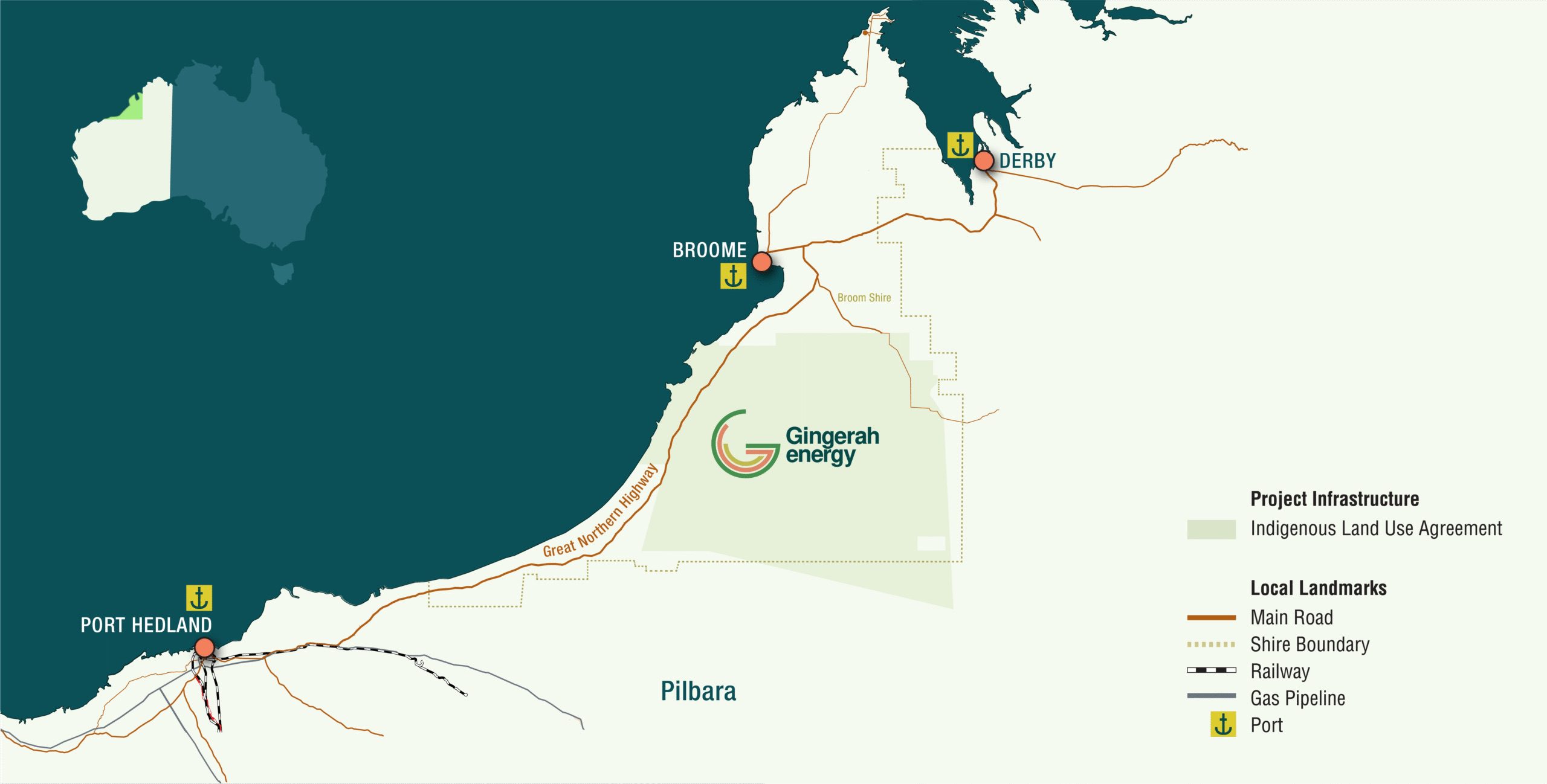
The project is slated for a 27,520 hectare site that is about 100 km south of Broome on lands owned by the Karajarri people.
The staged development would start with 48 megawatt (MW) of data centre IT load, scaling up to 240 MW, 620 MW and 1,000 MW, with the first two stages expected to start being built from 2029.
The wind and solar components should supply 85 per cent of the data centre energy needs, including extra power needed for cooling, with gas backup to settle the remaining 15 per cent, says Gingerah Energy CEO Jop van Hattum.
While it could – in theory – run just on the 1.5 GW gas power station, that would “soak up most of the gas in Western Australia,” van Hattum says, not something the state or federal government would appreciate.
The total cost of the project comes, including the data centres, could come to more than $40 billion.
Installing a 400km length fibre optic cables to connect to the submarine cable at Port Hedland to Singapore is costed at just $80 million in comparison, van Hattum says.
Ginegerah Energy has an Indigenous Land Use Agreement, relative proximity to the international fibre-optic cable from Broome to Singapore, and is a joint venture between the Karajarri Traditional Lands Association, Perth-based Longreach Capital Investment, Dutch geo-data company Fugro.
Fugro posted a €21 million ($35.6 million) annual loss for 2025 in February, and has been facing ongoing struggles to get its renewables business to make money.
The parties has already submitted a Western Australia planning application and is closing in on a submission to the state’s environmental authority as well.
Van Hattum says the joint venture could “potentially” bring in outside help and capital from other companies.
“Fugro and Longreach are supporting the project in this early phase. Clearly we are looking to engage in project partners to develop the energy system to develop the data centre. and bring in an anchor tenant,” van Hattum told Renew Economy.
“We are well funded to work through the development process.”
Gingerah Energy is not the first company to propose an enormous renewable energy project for Western Australia’s remotest places in order to serve the latest cause of the day, be it a data centre, green steel, green hydrogen, or something else.
Fortescue is setting aside 200 MW of its new green grid that will power its mines in the Pilbara for data centres or other third party users, while Intercontinental Energy is still banking on green hydrogen – and now also data centres – to move its huge 16 GW Australian Renewable Energy Hub (AREH) forward.
The Yindjibarndi Energy Corporation plans to sell green power to miners from its two biggest projects.
But the collapse and descent into lawsuits at former green hydrogen aspirant Infinite Green Energy, thought bubbles from the likes of Engie and South Korea steel maker Posco, and an absence of progress on government-funded projects such as the Pilbara Hydrogen Hub, show that nothing is certain until someone commits to a final investment decision.
However, unlike with untested industries such as green steel or hydrogen, van Hattum says the data centre trend is at least in their favour.
This is despite the current correction caused by overvalued companies and speculation.
“Western Australia is in the same timezone as half the world’s population and our side is the closest to Singapore you could get from anywhere in Australia,” he says.
“We don’t see that the build out of AI training and AI inferences is going to slow down.
“We understand this is a very evolving landscape and the technology is moving extremely rapidly [but] the constraining factor is power and we can deliver that in spades with the amount of land and community support that we have.”
To join more than 29,000 others and get the latest clean energy news delivered straight to your inbox, for free, click here to subscribe to our free daily newsletter.